
Who do you follow? We're not talking about Twitter...
In previous Inside Line articles, we showed how oil pattern breakdown happens with today's high flaring bowling balls and how different styles of play can affect an oil pattern in different ways. In this article, we will show how different groups of players with similar styles can greatly affect an oil pattern by strategically "managing the oil pattern" during practice time and the first game, and the resulting scoring pace for all those that follow these skillful "pattern managers."
The scene was the Men's Team event second block on the WTBA Seoul oil pattern during the 2013 WTBA World Championships in Las Vegas. The WTBA rule for practice time for 5 person team event is 15 minutes, then all teams bowl 3 games moving lanes every game. This gives us about 4-5 games per lane by the time each team finishes the 3rd frame of game one.
Our testing and after tapes at many modern day events show that when players play a similar line each and every shot during this time on a fresh oil pattern, over 50 percent of the lane conditioner can be removed from that area throughout the ENTIRE length of the applied oil pattern. This is significant and something all competitive players and coaches must be aware of in today's game.
Here was a test showing how much conditioner was removed in the area of play after each 3 games:
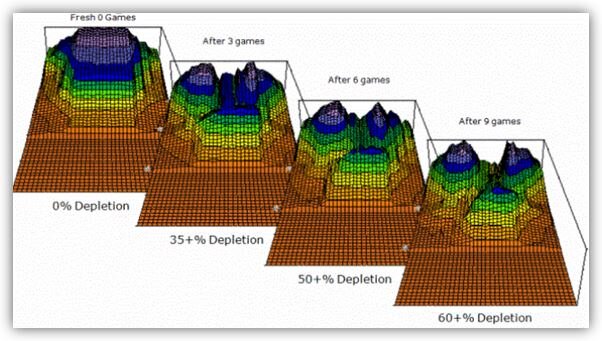
The significance and rapid pattern change is so prevalent in today's game that some Federations even employ multiple coaches during championships- one coach on the lanes helping the players during competition, and another coach "scouting out" the pair of lanes they will be moving to. Just knowing how and where the teams are playing on the lanes in front them can give them valuable information and help them get lined up quicker. In championship events, this can be the difference between winning, losing, or not even getting a chance to win. This played out exactly this way during the 2013 World Championships this year in the men's division.
Here is a graphic of the Seoul oil pattern just before the men's second squad of team event took the lanes - the graphic is with the perspective of looking at the oil pattern from the pins, so the 10 pin side is the left side of the graphic. Also shown below are the Sport Bowling ratios at multiple tape distances before the players took to the lanes:
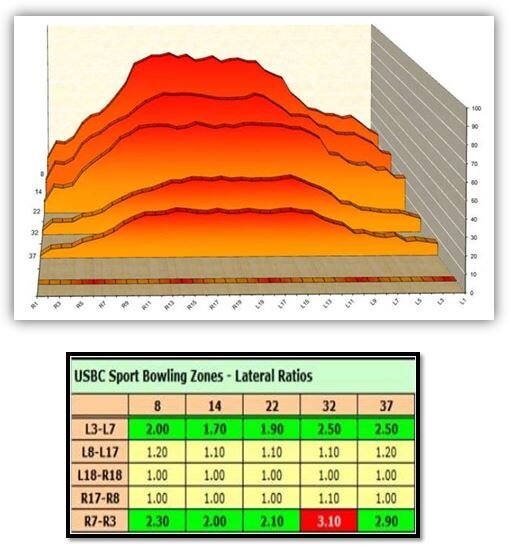
As a side note, the WTBA Seoul oil pattern is asymmetrical with more oil outside on the left side than the right side, hence the lower ratios on the left side. You may also notice that at 32' this pattern does not fall within the 3 to 1 ratio parameters, but Sport Bowling ratios only use 22' and 2' before the end of the pattern to calculate whether it meets USBC Sport Bowling requirements, and the WTBA does not have any ratio requirements.
During this second block of team play, with these pairs of lanes being right in front of the tournament office, I was able to watch and see how each of the teams on these pairs were breaking down the lanes during the 15 minutes of practice. While watching Puerto Rico and Brazil on 57-58 play more outside, and the teams on 55-56 play more inside, I was wondering how much an effect that might have on the teams coming to these pair of lanes in games 2 and 3, so I planned on taking after tapes as soon as the block was over. Little did I know at the time, the way the teams on 57-58 broke down that pair would help Team Finland make history.
After 15 minutes of practice and three 5-man team games (15 plus games per lane), here is what the Seoul pattern morphed into on lanes 55-56:
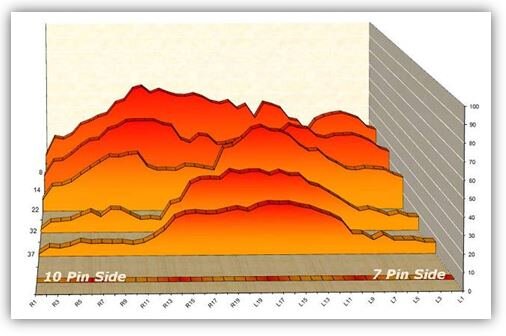
From looking at these after tapes, it is clear how deep inside the bowlers on this pair ended up playing the lanes, which all came from how the initial teams decided to play the lanes in practice and game 1.
Here are the after ratios of lanes 55-56, calculated the same way as before:
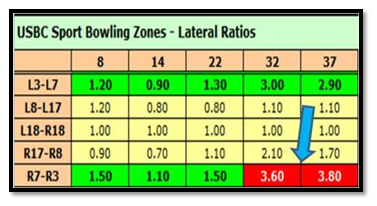
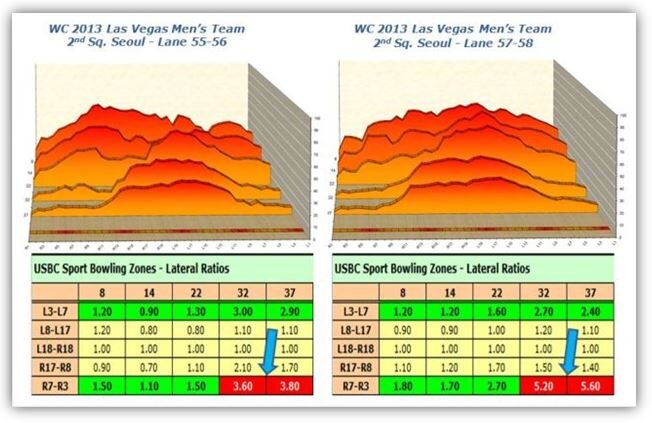
The ratios normally get lower up front as the oil pattern gets depleted from the middle of the lane. What makes scoring pace rise as players break down the oil pattern is when all balls come together towards the end part of the oil pattern, which raises the ratios from outside to the middle. In this example the ratios from the fresh oil pattern went from about 3:1 to 3.6:1 at 32 feet and from 2.9:1 to 3.8:1 at 37 feet. This is enough for world class players to increase the scoring pace, and this block was no exception.
Here is the resulting scoring pace of each team for each game of this particular block of games on lanes 55-56::
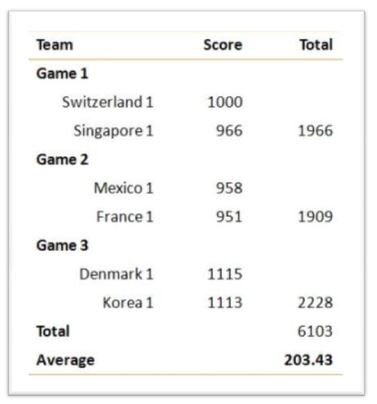
As you can see by game 3 that pair became more playable because of oil pattern development with both Team Denmark and Team Korea breaking the 1100 barrier. It took longer because of how deep the previous teams played that pair. The reason it took longer is because when teams start in the deeper amount of oil, it takes longer for the ball to reach the "spark point", or in other words, break down the oil pattern enough for the ball to poke through the oil film and get to the lane surface. Once the ball sees the lane surface, it also sees friction. The earlier the ball sees friction within the oil pattern, the easier that pattern becomes because left of that is the created oil line.
And now the pair of lanes where the Seoul pattern was changed into something else, which helped Team Finland make history. The mutated Seoul oil pattern on lanes 57-58:
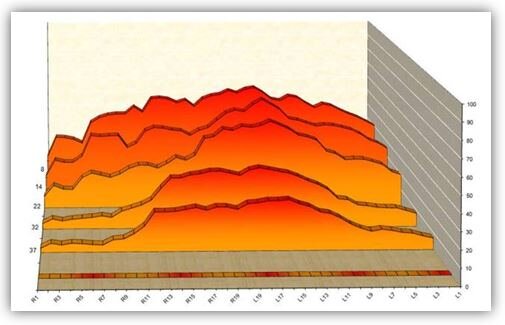
From looking at these after tapes, it is clear how much more outside the bowlers on this pair ended up playing the lanes, which also was decided because of how the initial teams decided to play the lanes in practice and game 1.
Here are the after ratios of this pair, calculated the same way as before:
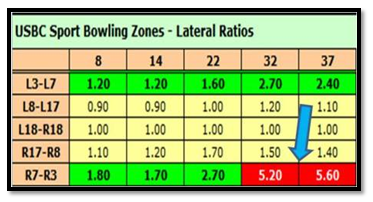
While lanes 55-56 went to 3.6 and 3.8 to 1 towards the end of the oil pattern, the players on lanes 57-58 took the ratios to 5.2 and 5.6 to 1! This is borderline what many house shots are in today's game, but like I said before, most of the change happens within practice and the beginning of game one.
Here is the resulting scoring pace on lanes 57-58 of each team for each game during this block of games:
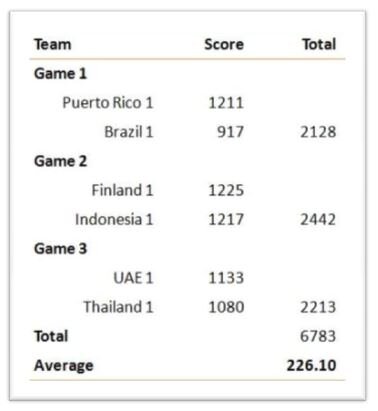
As you can see by the team game total scores, the teams that were fortunate enough to follow Puerto Rico and Brazil benefited greatly, but none more than Team Finland. This second team game with a score of 1225, along with the momentum that gave them and another 1200 plus score in game 3, catapulted them into the Team finals. After winning their semi-final match they defeated Team USA in the finals for the first team Gold medal for Finland in 30 years.
Fortunately, during this championship we also had available Kegel's LaneMap Guide of Sunset Station which shows the gravity influence on the ball based upon topography so we were able to see if one pair was significantly different causing that to be the reason for higher scores this block on 57-58, but that proved to be not the case, as the below graphic will clearly show. Both pairs have very similar characteristics.
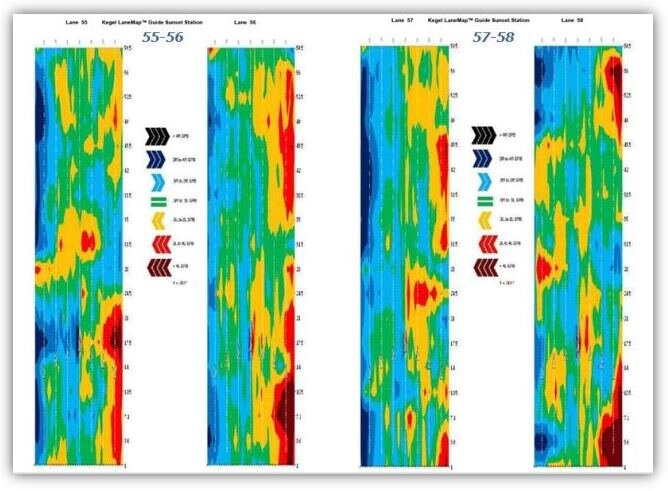
Finally, one more look an after bowling graphic of both patterns and the resulting ratios side by side:
A well renowned Kegel laneman and now National Team Coach for Indonesia, John Forst, had a saying; "the applied oil pattern is only the pattern until the bowlers start bowling on it. After that, they are the ones that decide what happens, not the laneman."
In today's vernacular, the Seoul oil pattern, or any other named oil pattern for that matter, is only the intended pattern until players start rolling balls over it, and then that named pattern becomes something else. Some players can turn it into Easy Street, and some can turn it into the Highway to Hell. Keep your fingers crossed you follow players that can turn things into Easy Street.

Oh No! My pattern is not playing the same as last year!

By Doug Dukes - Kegel Technical Sales Specialist and Kegel Pinsetter Parts
"My pattern is the same as last year but it is not playing the same" is one of the #1 lines we hear this time of year. As one of the techs at Kegel that has the privilege to not only help all of you on the phone, but to also work on lane machines in the field, let’s take a look at some overlooked parts and adjustments to your lane machine.
CLEANING - “You can’t paint the Mona Lisa on a piece of toilet paper.”
The number one overlooked problem on a lane machine is its ability to clean. Anytime a pattern adjustment is requested because they don’t play the same, our first question is “have you done a clean only”.
On Spray Jet machines, the screen check valves (153-0220) should be taken out regularly and cleaned. Lint build up on these can wreak havoc on the jet's ability to spray properly and as the check valves get weak, your spray tips can drip. If you notice that your machine is using less cleaner, it may be a good time to take these screens out and clean them. There are also two filters that cleaner passes through before it gets to the screen check valves, one in the tank (154-0212B) and one inline filter before the pump (154-8867A or 154-8887). It is always good to replace these filters every summer.
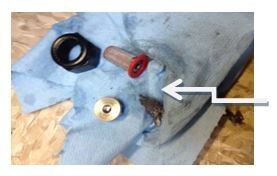
On Sprayless Cleaning Systems, you need to replace the two filters talked about above, but also your Norprene tubing in your cleaner pump (154-0861B). This style cleaner pump operates by using a set of rollers that press cleaner through this tubing every time the motor turns on. Over time, this tubing can lose its ability to allow cleaner to be pushed through it, and your volumes can be significantly reduced. Many times I have run a cleaner volume check on a lane machine and looked at the touchscreen only to realize that I was the last one to run the test during the yearly service last year!!! You guessed it……the volume was significantly lower than what it should have been.
Once you change the tubing, run a volume check and set it to your desired output and monitor this for a few weeks as the tubing breaks in. It will vary a bit during this time and a readjustment may be required, but it will settle in quickly. This should be checked on a regular basis throughout your season as well.
The cushion roller (153-8838 standard roller and 153-8839 roller with wrap), is another frequently overlooked piece to the cleaning puzzle. The size of the cushion is the key to your cleaning. If we think about how the cushion roller works, when the cloth unwinds, the cushion roller drops onto its stop bolts. When the machine is pushed onto the lane, the cushion actually lifts up off the stop bolts, and the weight of the cushion is what helps clean the lane. Simple right? If your cushion has gotten smaller over time, now it is not making full contact with the lane surface. This means it will not clean well. Mona Lisa and toilet paper soon to follow.
If you look at your cushion roller and see the “alligator skin” look, the ends are flaring out or torn and the cloth is visually pulling into the roller, or if you can wrap your hand completely around it, it is probably time to send it to greener pastures. One trick I show during service stops is releasing the tension on the cushion roller when you finish your lanes.
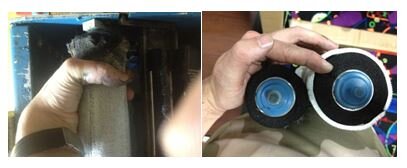
On machines that have the take up roll on the top, you can stand the machine in the transport position when finished and open the duster compartment. Slide the take up roll to the side and turn it 180 degrees and lock it back in place. This will relieve the pressure on the roller and when you turn the machine on to run lanes the next day, the machine will find “home” and wind the cloth back up for you. This can extend the life of your cushion and save you from headaches mid-season.
Squeegee blades (153-8204E Blue or 153-8834 Brown) normally are not overlooked, but why leave them out. Your squeegees should be flipped every six months, and changed once a year. You don’t want to leave any cleaner behind. Always check for your 1/8 to 3/16 adjustment as well, once you change or flip your blades and adjust accordingly.
Recovery tank filters are another overlooked item in the cleaning process. Waste tank a little lighter than normal? Check your filter and change it regularly. This is the perfect time to flush out your vacuum hoses and check for small pin holes that may affect suction, along with cleaning your vacuum motor and checking the motor brushes.
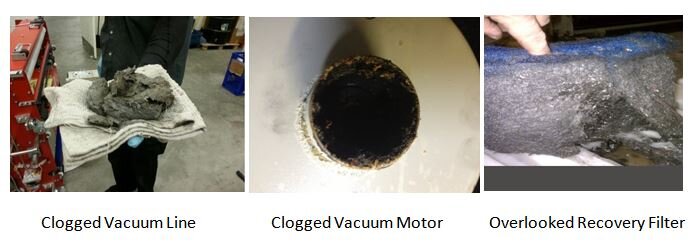
Conditioning - “The best canvas deserves a worthy brush.”
A few minor adjustments in your transfer system that have been overlooked can also make you pull your hair out when you’re dialing in your pattern.
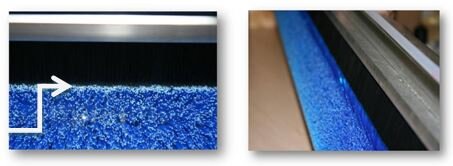
Have you checked your crush adjustments on your brush? Most people check the crush from the buffer brush to the lane and set their buffers at 1/8 to 3/16. What most people don’t check is the crush to the transfer brush or roller depending on the machine type. If it can’t pick it up off the transfer brush or roller it can’t get it to the lane!
As the brush wears, it may lose some contact with the transfer brush or roller. When getting ready for the fall season with an existing brush, or when putting in a new brush, always check this adjustment. We like to see 1/8 inch of crush to the roller or transfer brush.
On a transfer brush system, if you turn the buffer on while the brush is in the down position, you should see a thin light colored line where the transfer brush and buffer brush meet. This is from the bristles on the buffer brush being pushed together as they push against the transfer brush. Adjust accordingly.
Your pressure gauge can tell you a lot about your lane machine as well. If your pressure gauge fluctuates as you are applying loads or your pressure seems much higher than normal, you may need to clean your oil control valve. Dirt can accumulate in your valve over time and cause pressure fluctuations while applying loads. If the valve is dirty, take a good look at your filter inside your oil tank as well (154-0212). Replacing it once a year will keep you in top running order.
Your lane machine is one of the most important machines in your center. My final example I tend to give to proprietors and mechanics alike goes something like this…….
If one of your pinsetters happens to go down during a league, you may upset at most the 10 people that are bowling on that pair. But you probably have the parts to be able to fix this later that evening. If your lane machine goes down, and you have a 32 lane center that is full, you’ve now made 160 people upset, and you may NOT have the parts to fix it. You next day air the parts, but your still down the next night, and 160 turns into 320. It is extremely important that you keep your machine clean, do your daily and monthly preventative maintenance, and not take your lane machine for granted. Always keep a few parts on hand. One of every relay, two of every fuse, a fuse holder, a head drive belt, check valves, etc.
This minimal list of low-cost items can be the difference between a full house of happy bowlers, or a lynch mob and a quick backdoor exit of the center. Spend ten minutes a day, 20 minutes once a week, an hour a month and a half day every six months on your machine, and you will be able to keep it clean, and inspect the machine for wear on a regular basis. Always remember we are only a phone call away 24 hours a day 7 days a week from anywhere in the world. We are ALWAYS here to help.
Good luck and good scoring on your new season.
Oil Pattern Graphs: KOSI Composite Graphs
How many times have you gone to a bowling tournament, or even a bowling league, and seen a lane pattern graph and not known what in the world you were looking at? I was at a collegiate bowling tournament where lane graphs were given to the teams at check-in and I heard many a team trying to decipher what the lane graphs meant. Over and over, I heard teams trying to decide where to play based on the lane graph. It actually surprised me how many people didn’t know what to look for.
If you are like me, and I know there are many of you out there, when you look at a lane pattern graph, you don’t really know how to extract information from it. Basically, you’re just looking at a picture of a lane or worse, some lane tapes that might as well be written in an ancient language. To help you, I have consulted some of the top minds in pattern theory for a little lesson in how to read and understand the various types of lane graphs.
To begin, we must first understand that there are different types of lane graphs. Some are related to the lane machine program sheet and some are related to the actual oil pattern on the lane.
Calculated from the lane machine settings (the program that is entered into the lane machine), we have the overhead graph and the composite graph. From lane tape readings (taken directly off the lane from the oil itself), we might see the 3D graph or the 2D graph. Each of these graphs look different and provide different ‘views’ of the oil pattern, but ultimately they all give you the same basic information – the shape of the oil pattern.
Some of the information you should look for, regardless of the graph type, is pattern distance, pattern volume, inside/outside ratios (don’t get confused, we’ll discuss) and pattern shape. All of these things will provide clues about what to expect from the oil pattern.
Pattern distance tells you how long (or short) the lane pattern is; in other words, how far down the lane from the foul line the oil is applied. A short pattern will play much different than a long pattern simply because there is longer part of the dry lane to deal with.
Pattern volume tells you how much total oil is applied to the lane. It does not tell you where that volume is; only how much oil is there. The total volume of oil is measured in milliliters and per board values are measured in microliters.
When you see a graph with units as the value, it is a calculated measurement based upon the ultra violet additive (UV) that is mandated to be in each batch of lane oil. The UV additive allows the optical lane reader to “see” the oil. Units of oil should not be confused with volume of oil.
Ratios tell you the difference in the amount of oil from left to center and right to center. Pattern shape is the shape of the oil on the lane. Some examples of shape are top hat, block, Christmas tree, or flat.
The first type of graph we’ll study, the composite graph, is one that most people will see most often. The composite graph is also called a volume per board chart. The composite graph, shown below, gives us the total amount of forward and reverse oil that is applied to the lane. The total amount of applied oil is calculated based on the program that is entered into the lane machine.
In actuality, the composite graph shows us the amount of oil on each board. The best way to understand the composite graph is to imagine taking all of the oil that was applied to the lane, then drag it back to the foul line and stack it up. This would look like the composite graph.
Take a look at the composite graph example below.
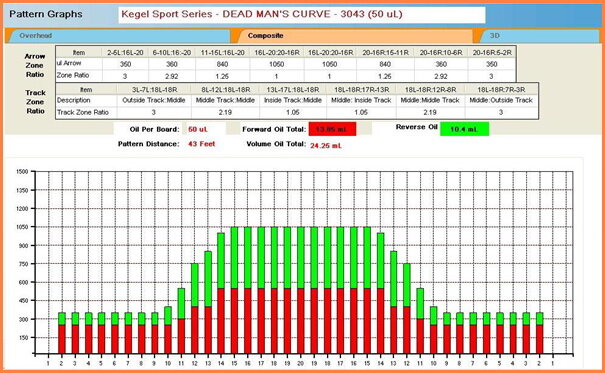
Along the bottom, or the ‘x’ axis for you math people, you can see the lane boards labeled; board one on the left to 20 in the center to the one board on the right.
Along the side, or the ‘y’ axis, the amount of oil is measured in micro liters.
This particular example is the composite graph for Dead Man’s Curve, a Sport pattern in the Kegel Navigation Series. Sport Bowling uses ratios to describe (or define) the level of difficulty of a pattern; a lower ratio is more difficult than a higher ratio. The Sport Bowling ratio is defined as the average amount of oil (in units) between boards Left 18 to Right 18 divided by the average amount of oil (in units) between boards R3-R7 & L3-L7, respectively.
While this graph does NOT give us units, nor does it tell us exactly where the ratios are within the oil pattern, it is still a good reference. In this graph, we can see that there is about three times as much conditioner in the middle of program as there is on the left and right side of the program; a 3 to 1 ratio.
The chart area above the graph, which you may or may not see on a composite graph as it depends on how the graph was generated (which computer software program generated the graph), also gives information on ratios in different parts of the pattern program. It may be somewhat difficult to read in this example due to the size of the picture; however, some information about ratios around the track area is given.
The track area is generally defined around the 10-board on either side of the lane (typically a bowler will play the track on a house shot). In this example, ratios are given for outside the track (boards 3-7 on either side of the lane), middle track (boards 8-12 on either side) and inside track (boards 13-17 on either side). In general, the lower the ratio of the oil, the more difficult the pattern will be to play.
In this example, the inside track (boards 13-17) would be very difficult as it is basically flat with a 1:1 ratio whereas the outside track (boards 3-7) would be somewhat easier at a 3:1 ratio. To put the ratios into perspective, a house pattern might be 6:1 or even higher. A high ratio program, like many house patterns are, will give the bowler a defined “ridge” to play against within the oil pattern.
This difference can help you determine how best to play the lane. Don’t misconstrue that; the composite graph can give you an idea of how to play the lane, but a common misconception is that it can tell you where to play the lane. This isn’t always true since the topography of the lane surface can often be more dominant than the oil pattern.
The composite graph is more of an idea of how difficult, or how easy, the oil pattern may play. Again, generally the lower the ratio of conditioner from the inside to the outside, or the flatter the oil pattern, the more challenging the oil pattern will be.
The last things to note in this graph, and they may be difficult to read because of the graph size, are the pattern distance and pattern volume. In this particular example, the pattern distance is 43 feet and the total volume is 24.25 mL.
Since a lane is 60 feet from foul line to head pin, there is 17 feet of ‘dry lane’ after our 43 foot Dead Man’s Curve pattern. That basically means there is 17 feet of friction that the ball must move through before it hits the pins.
We hope this information has helped you understand how to read a Composite Graph. It is important to remember that the information is only as useful as your interpretation. The graph isn’t telling you where to play; it is only providing you with some information to help you make an informed decision regarding lane play.
Next time, we’ll see another type of graph, learn about how to read it, and extract useful information from it. Until then, Happy Bowling!
Breakdown and Carrydown - By The Numbers
In our last Inside Line feature article, Breakdown and Carrydown – Then and Now, we discussed the reasons why breakdown and carrydown are different today. For this edition’s feature article, we will add some data and visuals to support the previous article. The data was taken from the recently concluded European Bowling Tour Masters in Munich, Germany and it shows the same thing we often see in bowling tournaments today.
The event consisted of the top 16 men and women from the 2011 European Bowling Tour point list. On the men’s side there was a mix of styles; high rev players, medium rev players, and low rev players, with fourteen right-handed players and two left-handed players. On the women’s side there was also a good mix of styles, even though most fall into the medium to low rev rate category, with 15 right-handed players and one left-handed player.
The players on the men’s side were: Martin Larsen (RH), Mika Koivuniemi (RH), Karl Wahlgren (RH), Sean Rash (RH), Gery Verbruggen (LH), Dominic Barrett (RH), Perttu Jussila (RH), Syafiq Ridhwan (RH), Osku Palermaa (RH), Mik Stampe (RH), Paul Moor (LH), Dennis Eklund (RH), Jesper Agerbo (RH), Robert Andersson (RH), Thomas Larsen (RH), and Stuart Williams (RH).
The players on the women’s side were: Rebecka Larsen (RH), Clara Guerrero (RH), Mai Ginge Jensen (RH), Krista Pöllänen (RH), Nina Flack (RH), Patricia Luoto (RH), Wendy Kok (RH), Bianca Wiekeraad (LH), Britt Brøndsted (RH), Joline Persson-Planefors (RH), Jacqueline Sijore (RH), Zandra Aziela (RH), Lisanne Breeschoten (RH), Nicole Sanders (LH), Heidi Thorstensen (RH), Sascha Wedel (RH).
The Data and Graphics - Breakdown
The oil pattern used for the event was Kegel’s Navigation Sport Series pattern The Turnpike. This pattern is almost flat from the midlane to the end of the pattern because the forward application consists of only 2L-2R loads. The shape from the mid portion of the oil pattern to the foul line is built on the return pass.
Here is a graphic of the fresh oil pattern with tapes taken at 8’, 22’, 32’ and 39’ (left side of the graphic is the right side of lane, right side of graphic is left side of lane – you are looking at these graphs from the pins perspective):
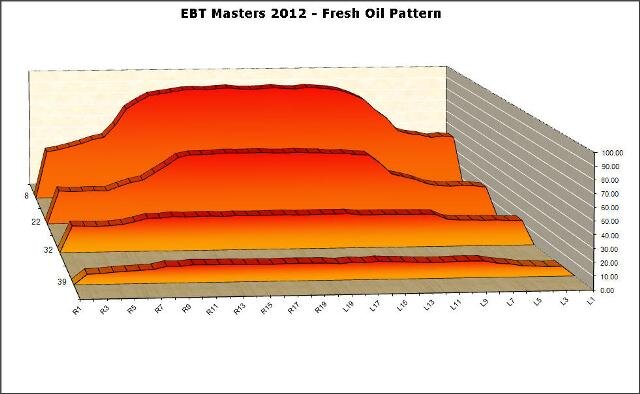
As we have known for many years, apart from the type of equipment being used, how the oil pattern breaks down is dependent on where the players play on the lane. When styles or rev rates are more similar, players tend to play in a more similar area of the lane, causing a much different type of pattern breakdown than when styles and rev rates are more diverse.
During the EBT Masters, all blocks consisted of 6 games with four players per pair, which equals 12 games per lane, plus ten minutes of practice. In comparison, a five person league would be 15 games per lane, plus 10 minutes of practice.
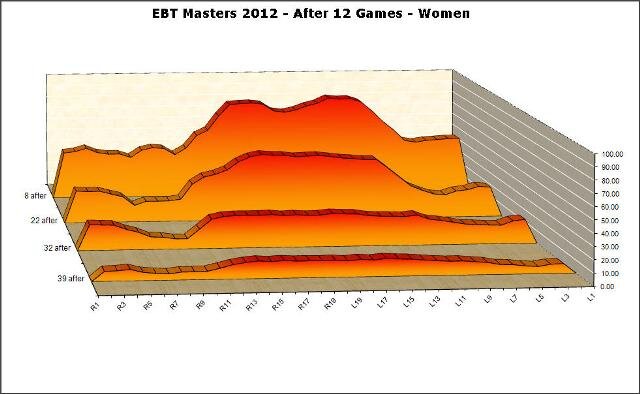
Here is the graphic of the EBT Masters pattern after one block of play by the women:
Here is the same graphic of the men’s pattern breakdown after one block of play:
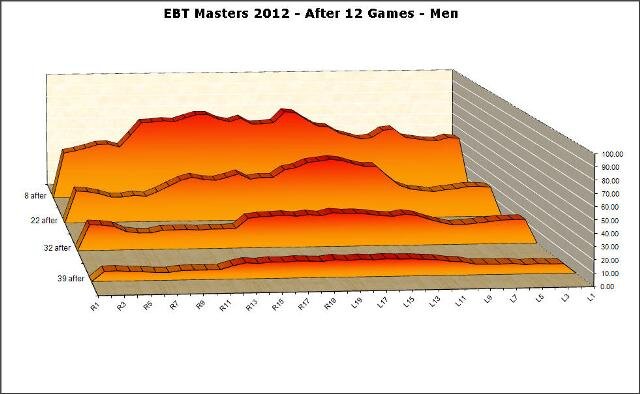
You can plainly see (I hope!) that the pattern breaks down significantly different when styles/rev rates are more similar versus when styles/rev rates are more diverse.
Here is a graphic of the before to after bowling between the men players and the women players at each tape distance, 8’, 22’, 32’ and 39’ (fresh oil is behind the after bowling tape):
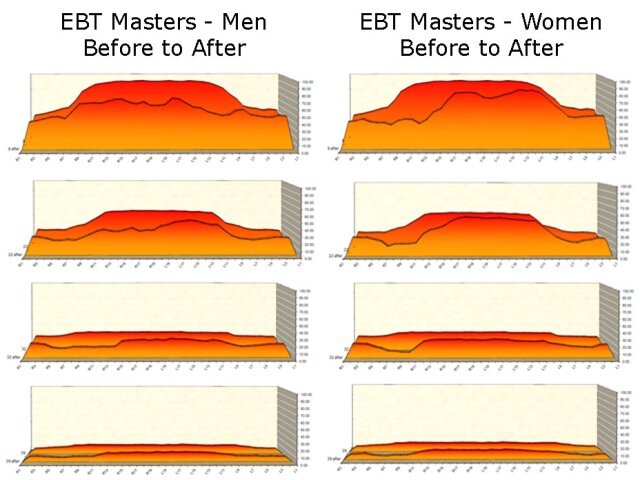
This graphic clearly shows how the lower rev rate women players “cliff” the oil pattern much more than the men players simply because the women play in a more similar area.
But now comes the interesting part of this breakdown pictorial and data article – the numbers.
What we often track is the oil depletion in percentages from that of the fresh oil pattern. As you will see, the percentages match up to the above graphics. What might surprise you is how much each group depleted. Common thought is high rev players deplete much more conditioner than lower rev players, but is it really so?
Here is the depletion by percentage on the men’s side of the event, with the square boxed area being a guide to show where the greatest depletion took place:
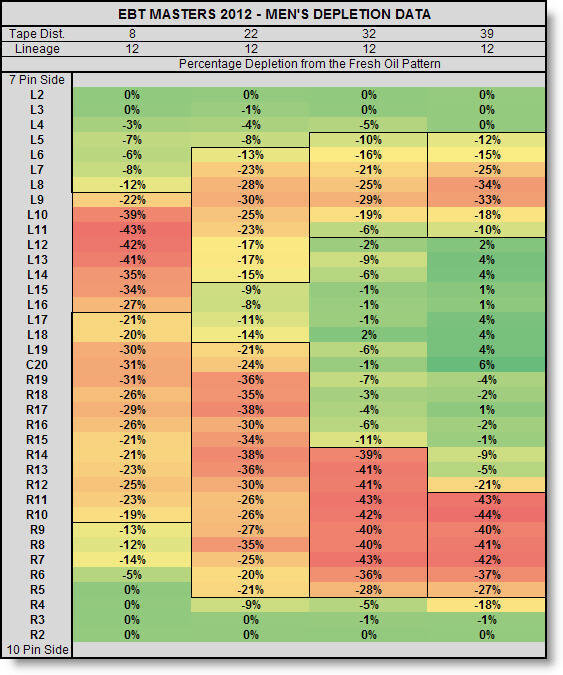
As you can see, the men took off about 40 plus percent at each distance throughout the oil pattern. After about 4 games of play, the right-handed players and the left-handed players came together in the fronts (8 feet) from boards L10 to L15, causing the greater depletion numbers in that area.
Before that move left, the right-handed men players continually moved towards the inside portion of the lane in their lay down area, yet they were still playing to near the same exit part of this 41’ oil pattern, between boards R5 and R11.
So how many units were left in the oil pattern after play? And what area of the depletion caused them to move left?
Here is a graphic of the before, on the left side of the graphic, and after tape data, on the right side of the graphic:
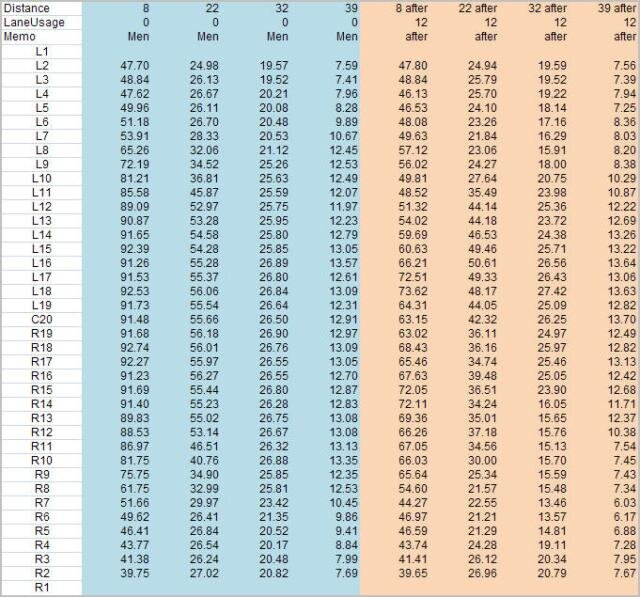
As you can plainly see, at the 8 foot distance of the pattern, after 12 games plus practice there was still over 60 units of oil on the lane. Only when the left-handers and right-handers lay down point became similar did we see the 50 unit barrier get broken, and that was only on a couple boards.
As we pointed out in the last feature article, the depletion towards the end of the oil pattern is what causes players to move left in today’s game, not “the fronts”.
Now the depletion tape data in percentages from the women’s side of the event, and as before, the square boxed area is a guide to show where the greatest depletion took place:
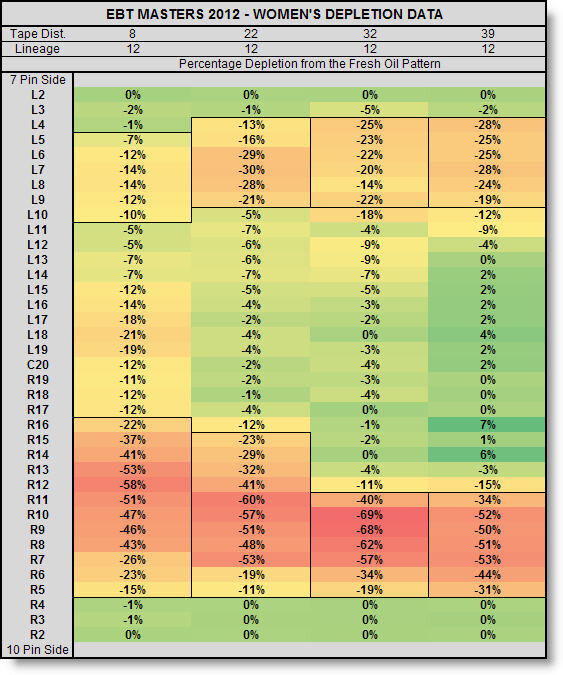
As you can see, because the women’s styles are more similar, as well as their rev rates, this group tends to play in a tighter area of the lane. This causes more depletion than when everyone is spread out all over the lane.
If you notice, the greatest percentage of depletion is at the 32 foot mark. The reason is, for the women players, all shots are starting to come together at this distance and there is more oil in that area than the end of the pattern - more oil equals more change.
Now let’s look at the same graph of the tape data in units of a women’s block after 12 games:
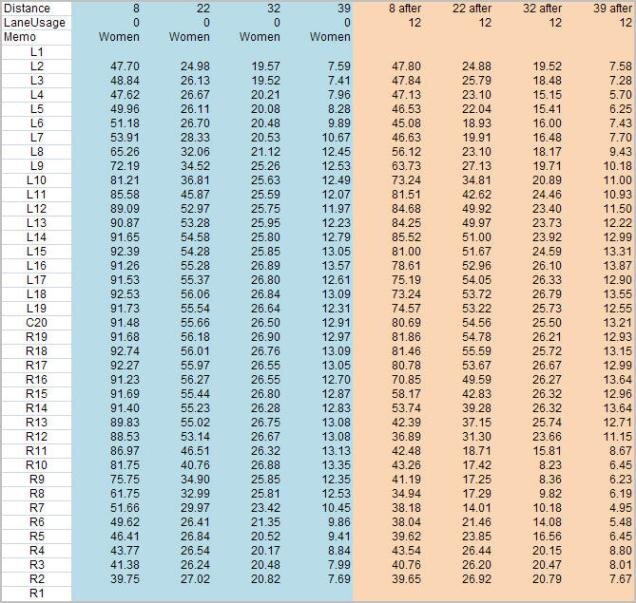
As you can see by this data, the women actually erased more oil off the lane in their lay down area (8’ tape) than the men did, yet still not enough to make the ball hook early, or make them move left because “the fronts have gone away”. The end of the pattern however is once again, another story.
The women have “ganged up” on the exit point of the pattern causing the 10-12 units of fresh oil at 39 feet become 5-6 units by the end of play. At 32 feet, the fresh 25-26 units of oil became 8 units after bowling.
This back-to-front oil pattern breakdown is the cause of the players moving left, not the old school front-to-back oil pattern breakdown we used to have before bowling ball track flare became a dominant force.
Also, to give you an idea how much oil is left on the lane by each group at each tape distance after bowling, here is what the tape data showed as an average amount of units at each tape distance:
- The men players at 8’ had an average of 54.35 units left on the lane, at 22’ an average of 31.73 units, at 32’ an average of 19.93 units, and at 39’ an average of 9.84 units.
- The women players at 8’ had an average of 58.79 units left on the lane, at 22’ an average of 30.79 units, at 32’ an average of 18.60 units, and at 39’ and average of 9.40 units.
Carrydown Data
This next graph and data might surprise some people, although it will make perfect sense once explained. I have been watching this in action over the last few years and it is something as lanemen we have no control over.
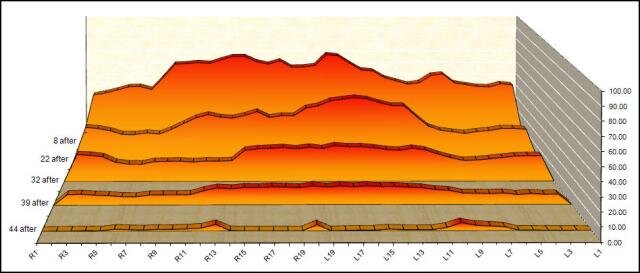
During this event we took carrydown tapes of the men and we will show the same percentage graphic as before with an additional twist, the carrydown tape in units. We do this so you can plainly see the exit points within the oil pattern of both the right-handed and the left-handed players.
Here is the graphic with carrydown tape visual (left side is right side of lane, right side of graphic is left side of lane – you are still looking at these graphs from the pins perspective!):
Here is the data, depletion percentages plus carrydown in units of oil:
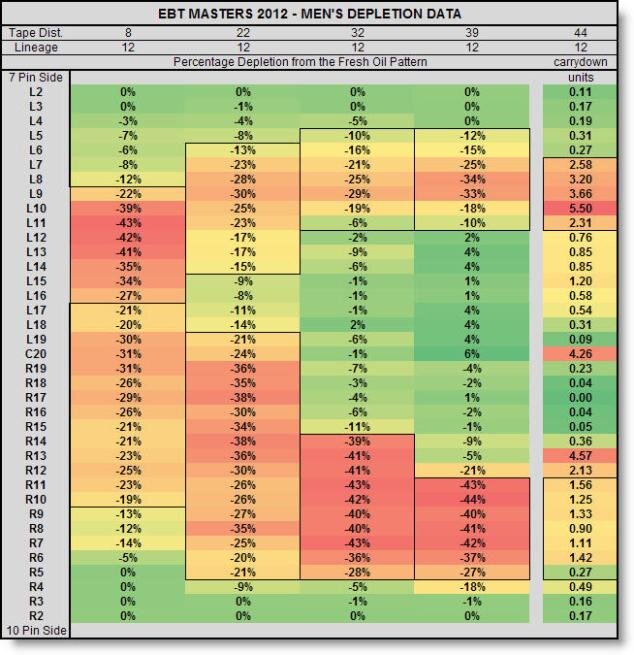
If we look at the blocks which show where both the left-handed and right-handed players played, you can plainly see how much carrydown is on the left side of the lane at the left-handers exit point of the pattern, yet not so much on the right-handers exit point. Why might you ask?
It is actually very simple once we think about it. We know that most spare balls in use today do not flare much, nor do they soak up oil like high flaring reactive resin strike balls that are in use today. So as right-handed players continually shoot spares on the left side of the lane, these non-flaring non-absorbent spare balls leave those long carrydown strips when they exit the oil pattern.
These ball types also do this when players are shooting spares on the right side of the lane, yet the carrydown tapes clearly do not show as much carry down at the end of the pattern.
The answer lies in the amount of high flaring balls going down the lane on the right side of the lane versus the left side of the lane.
Basically, the right-handers strike balls continually erase the carrydown left by the spare balls, but on the left side of the lane there is simply not enough high flaring absorbent balls going down the lane in that area to erase left side spare ball carrydown.
This lane condition change can be beneficial or detrimental to the left-hander. If these left side carrydown strips become dominate inside of target, like on patterns or conditions that allow the outside of the lane to play, it can give the left-hander hold area.
Yet if these spare ball carrydown strips become dominate left of target, or at their exit point, like many medium long or long patterns, it can result in a hang spot or reduced pin carry.
One more thing to be aware of with spare balls on today high volume oil patterns is how they can actually increase the amount of oil at the end of the oil pattern where high flaring balls are not traveling. We saw this happen often in the late 1980’s even where the traffic was when more aggressive coverstocks and larger core urethane balls were mostly in play. The end of the pattern after a couple blocks often had more oil on it than when fresh. It also shows up often in our after tapes in today’s game outside the track area (where most balls are being rolled), which can clearly be seen on the aforementioned data.
The reason for this today and back then is simple, by the mid to late 1980’s the amount of oil on the lane had to significantly increase in order to give the wood lane protection.
The by-product was more carrydown because more oil was being picked up by the ball in the fronts and re-deposited towards the end of the pattern and the dry back end.
This combination led to a great advantage after a few games by high rev big hook ball players as they could simply go around the carry down for return outside of target, and then the carrydown became hold area inside of target for this type player.
We see the same dominant style trend happening again today but for different reasons – this time it’s rapid depletion of the oil pattern from back to front and who can chase the oil inside of target on the lane the fastest.
Normally today, just like in the late 1980’s, it is often the high rev players who can create the largest margin of error and best angle for the best pin carry once the oil conditions are altered simply by bowling.
After reading all this you might be asking yourself what then is the best combination of ball versus lane versus oil that would minimize all this rapid lane condition change? That my friend is another article for another time…
Breakdown and Carrydown – Then and Now
We hear it all the time; “the heads are hooking”, “carrydown is happening quickly today”, “time to move again”, “my ball’s burning up – grab the fire extinguisher!”...ok maybe not the last one. But with the amount of oil needed in today’s environment in order to protect the lane surface and keep the modern ball from hooking into the gutter at the arrows, rapid and chaotic change is often the result. Even the best of players can get confused in today's game over the course of a few games.
In this month’s piece we'll try and give some sense of order to that chaos, but the first thing many will have to do is let go of what you’ve learned and experienced in the past – today’s pattern mutation, carrydown, and resulting bowling environment is different, very different.
Oil Pattern Change
The first thing we need to understand about oil pattern change is how bowling balls with different amounts of track flare change the oil pattern.
Prior to the 1980’s, when bowling balls did not significantly flare, the ball essentially picked up all the oil it could within the first couple revolutions - the first 8’ to 16’ of the oil pattern. It was in the head area where the oil pattern dried out the most, and after that, the oil pattern basically remained unchanged. Only once we got to a point of about 24 games per lane or more, did the rest of the pattern began to “dry out”.
As lower flaring more aggressive coverstock balls were introduced in the mid to late 1980’s, the amount of oil on the lanes had to increase, and oil pattern mutation changed because of that. John Davis' research showed the latter half of the oil pattern actually increased in volume during this era.
Back then the bowling ball picked up so much oil in the front part of the lane, it re-deposited some of that oil towards the end of the pattern, and then a lot more of that oil on the dry back-end. This is the time when carrydown quickly became a big problem.
When ball manufactures figured out that track flare increased the friction between the ball surface and the lane surface, bowling balls became unbalanced again - only this time it was by way of significant Radius of gyration (Rg) differential, It was then, oil pattern mutation, and the resulting ball motion, changed dramatically.
However, bowler "lingo" hasn't seemed to change as much as pattern mutation has, which can cause a lot of confusion and misinformation in our world of bowling.
Bowling balls with track flare (pictured below far right) pick up and erase oil off the lane with every revolution, causing a much different type of oil pattern breakdown. It’s not just the heads that breakdown down anymore, it’s the entire length of the oil pattern that breaks down, and it begins with the first ball thrown on the oil pattern.
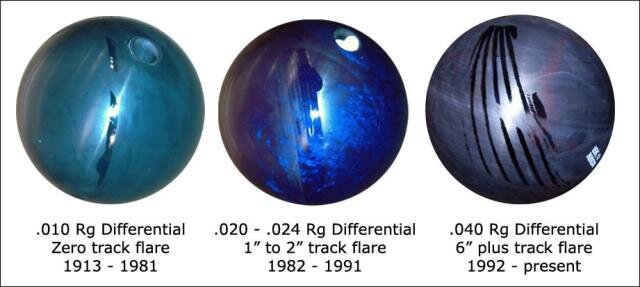
In our research, when starting with 80 units in the front part of the lane, our after tapes show that about half the oil has been depleted during a normal league session, which is 15 games per lane. We see the same trend in high level events bowling 12 games per lane.
That means there are still about 40 units left in the heads, but many in our industry still talk about the “heads hooking”. Anyone want to bowl on a pattern with 40 units on the outsides? Of course you don’t - your ball will never hook! So what causes the players to move left in today’s bowling environment? It’s more about the removal of oil from the mid-lane towards the end of the pattern.
Because of oil pattern taper, the mid and end part of the oil pattern has much less oil than the front part of the oil pattern. As the ball erases the oil off the lane, the modern “mountain range” like coverstock can easily poke through that thin film of oil towards the back part of the pattern. This causes the ball to read the friction much sooner there than in the front part of the pattern, and that is what makes players move left, not the oil pattern breaking down in the heads.
What this flaring ball pattern breakdown does to ball motion is simple – the ball simply slows down sooner and therefore hooks more. For high rev and high ball speed players, this pattern mutation falls right into their wheel house as finesse has been removed from the equation for them - its flat out every shot without having to worry about “throwing it through the break point”.
For rev challenged and slower ball speed players, this pattern mutation becomes more difficult to overcome – their bowling balls slow too early and begin to lose axis rotation too soon causing less room for error and decreased pin carry.
Of course this type player could switch to a less aggressive ball to combat the increased friction towards the end of the pattern, but then that type ball is more susceptible to carrydown. It’s a delicate balance for these styles of players.
Can the heads (the first 16 feet) still give the ball the perception it is hooking early? Sure they can, but in today’s bowling environment, more often than not it’s not because of the lack of oil.
With synthetic lanes it’s normally a side hill slope issue where the ball is thrown into a hill and trying to rotate up that hill. This topography issue will make the ball “check up” or move in the direction of the slope, which is more of a gravity issue, with a bit of friction thrown in for the banked curve affect.
For wood lanes or really old synthetics, it could be a severely roughed up lane surface, which therefore is a friction issue. However no reasonable amount of oil will significantly help in either of these situations simply because the depth of the scratches in the lane surface are deeper than the oil film – resurfacing or re-leveling the lane surface is the only solution to combat that kind of "early hook".
In short, bowling balls that do not flare tend to break an oil pattern down from front-to-back, and today's high flaring balls tend to break down oil patterns from back-to-front.
With high flare balls the oil pattern is literally getting shorter in the ball traffic area with every shot thrown, and by moving left we are increasing our launch angles to that area in order to give the ball more time to hook. Of course when missing inside of target, we are now in a "longer pattern" again so the ball holds pocket. This is why sport and challenge patterns get "easier" and scores often increase after a few games.
Carrydown
Carrydown is also much different by balls that don’t flare versus balls that do flare. Bowling balls that do not flare leave long three to four foot streaks of carrydown beyond the end of the pattern. Because the footprint of the bowling ball is so small, a shot hitting these long streaks of carrydown can all of a sudden make a pattern feel like it is much longer, mainly because to the bowling ball, on that single shot, the oil pattern has become longer!
With the amount in the middle of today's oil patterns, it is not uncommon for those streaks of oil to be in the 5-8 unit range.
As noted before, significant carrydown was not a problem in bowling until the 1980’s - especially towards the middle to end part of the decade. With the advent of ever stronger urethane balls, as well as increased dynamic weight blocks, an increased amount of oil was necessary as more and more customers bought these new balls.
And as players began sanding the covers and using drilling techniques to create more dynamic imbalance, more oil was needed to help protect the lane surface and keep these new higher friction balls on the lane, and of course, keep the customers who bought these new balls happy.
It was only then that we saw carrydown become such a significant part of the playing environment in so few games. Prior to that, when fairly dynamically balanced rubber and polyester balls were mainly in use, there was simply not enough oil needed nor used on the lanes to cause significant carrydown issues.
Sure there was carrydown after a few days of play, when lanes were not cleaned but once a week, but nothing like what happened in the 1980’s to tournament organizations like the PBA Tour, who cleaned the lanes every day.
Carrydown that is created with balls that flare however is much different, as well as how these much more aggressive and diverse internal dynamic balls allow players to play the lanes.
Meaning, because the amount of dynamic imbalance is much greater, this increases the range of available hook and allows players to play the lanes in a much wider area than in the past. When balls were more balanced and didn’t hook as much, everyone played the lanes near the same area, causing a much narrower spread of carrydown.
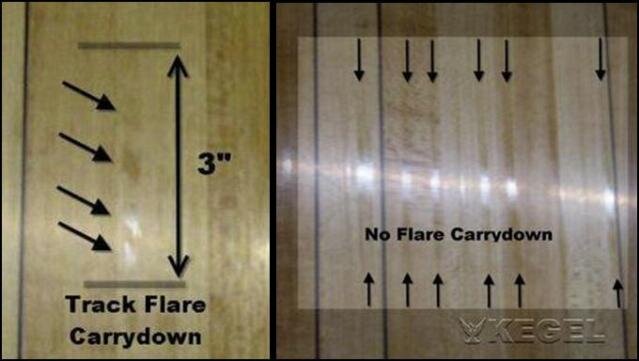
This dynamic imbalance causes track flare, and track flare creates what are called “bow ties” (where the flare rings come together) at only two points on the balls surface. Those two points are the only parts of the ball with oil on it that touches the lane every revolution.
The higher the differential Rg, the wider the track flare is, and the smaller those touching points are. This in turn creates random 2” to 3” strips of carrydown. For instance, using a 40’ pattern as an example, one track flare carrydown strip may be at 41’ to 41’ 3”, another small strip at 41’ 6” to 41’ 9”, and another one at 42’ to 42’ 3”, etc.
Therefore, when a fresh part of the modern flare balls surface comes in contact with these small strips of carrydown, ball motion is hardly affected at all. As these strips build up however, along with the longer three to four plus foot random strips of carrydown created by the many low flaring spare balls going down the lane, the back-ends will “tighten up” somewhat, but not as soon, or as much, as lanes did in the late 1980’s.
There was a very good article written by the PBA that represents what happened in the late 1980’s. It stated how after a few games of bowling the “fronts go away” and significant carrydown happens beyond the pattern at the balls exit point.
When this occurs, the player who greatly hooks the ball can move left and effectively “go around” the carrydown, creating an increased margin of area from that of a fresher oil pattern, and clean dry back ends. Low flare carrydown gives this style of player hold area inside of target.
On the PBA Tour in the mid to late 1980’s it was not uncommon for big hook ball players to average 20-30 pins a game more in the evening blocks versus the morning blocks.
Today however, even though high rev and high ball speed players can often struggle right out of the gate because their ball motion is too “skid-snappy” on the fresh, with today’s expeditious pattern breakdown, and high friction balls, high rev players can hit their stride much sooner. Today it doesn’t take more than a couple games to “smooth out” their ball motion from front to back.
In addition, as we stated before, carrydown at the end of the pattern with high flaring balls is not as defined as it was in the 1980’s, or when lower flaring urethane balls were in use. Therefore today there is simply not enough defined carrydown to go around and use as hold area.
High rev players tend to get their advantage today more from rapid pattern breakdown towards the mid and end part of the pattern, not carrydown. As most know, low to non-flaring balls today are most often regulated to shooting spares and therefore, those long strips of carrydown are more random across the lane surface - sometime you’ll hit a strip, and sometimes you won’t.
Remember, today you must think different. No longer are we using non-flaring balls on less than 5 milliliters of solvent based lane conditioner like we did in the 1970’s. No longer are we using low flaring balls on 12 milliliters of oil with massive carrydown like we did in the mid to late 1980’s. No longer are we bowling on lanes that are resurfaced every year like was mandated until deletion of the rule. No longer is levelness being maintained regularly like we did prior to advent of synthetic lanes.
The bowling environment today is much more varied, much more complex, and does not always make sense, or play “how it’s supposed to play”.
The best piece of advice we can give you is what the late great PBA National Tour tournament director Harry “Goose” Golden use to say to the players after every roll call; “bowlers, let your ball be your guide”.
JJ's Blog - 2012 Team USA Trials
Saturday December 31st
The alarm went off at 2:45 am. It was an early one but it was easy to get up because I was heading to Los Angeles and then Las Vegas to bowl the Team USA Trials. I’m an early-airport-guy so I like to be at the gate like 90-120 minutes before my flight. Since my flight was at 7:30am, that would get me to the airport to about 5:00am. I got up a little extra early just so I could go through my checklists to make sure I had everything.
I got to the airport at 5am and had a quick and painless check-in and run through security. I sat in the Delta Sky Club for about an hour and a half and then went to the gate. We boarded on time and everything was going as planned. I was supposed to get to Los Angeles at 10am and was going to spend the day shopping and also going to this cupcake place in North Hollywood that makes the best cupcakes. I wanted to share some of these with a few of my friends that were going to be bowling the tournament next week.
For those of you that don’t know me real well I have a real passion for two things: Clothes and chocolates/cookies/pastries/any kind of sweets.
We sat at the gate until about 8am when the pilot got on and said that they were having trouble with the fuel pump and they were having the mechanics come out and look at the plane so at this time we didn’t know how long it was going to take. Mind you, this plane just arrived from LA about 6:30am, so all they were doing was basically topping off the tank and cleaning it up and it was heading straight back to LA.
About 8:20am they were letting people de-plane but told them to check in to the gate every 10 minutes to make sure all was ok because when the plane was ready, we were leaving ASAP. About 8:35am the pilot said we were ready to go and at 8:45am we were all boarded. Well, 5 minutes went by, then 10 minutes, and then at 9am the pilot got back on the PA and said that the fuel pump was still not working and we were going to be re-routed because he had no idea how long this was going to take.
Next thing I knew that I was getting rerouted to Atlanta and my itinerary said I was going to get to LA about 6:40pm!
Since this was New Year’s Eve, most of the stores I wanted to shop at were going to be closed by 6 and when I called the cupcake place they were going to close around 5pm or maybe a little later depending on business and they were going to be closed on New Year’s Day, so it looked like my window for cupcakes was closing. This had all of the makings of a really bad day.
I got to Atlanta and I got on standby for the 1:20pm flight that was going to get into LA at 3:20pm. Fortunately, I got on! Things were looking up all of a sudden!
I got to LA at 3pm (even better) but since I flew on standby my luggage didn’t make it. That wasn’t a big deal since I was staying right across the street from LAX. The lady in baggage service said my bags were on the way to Salt Lake City and then LA and they should be there tonight. Well since I was there early, I got to the rental car place and off I went. I left the airport at 3:30pm and I was only about 30 minutes from the cupcake store. Since the guy I spoke to said that they were closing at 5pm, I should’ve had enough time to get a few cupcakes.
I got to the cupcake place at 4pm only to find a note on the door saying that they had already sold out of their inventory and they would be re-opening on Monday.
Happy New Year! Well isn’t that just flippin’ great! Cupcakes…..denied!
Since I was a little peeved about that I headed to Beverly Hills to do a little clothes shopping. It was about 25 minutes from North Hollywood to the “Hills”. I stopped at this one store on Melrose Avenue and looked around but found nothing I liked despite the sale that was going on. I then headed off to Rodeo Drive and got there right at 5pm. With my good fortune continuing, I found out that all of the stores on Rodeo closed at 5pm on New Year’s Eve as well as Neiman Marcus on Wilshire Blvd., the one department store I REALLY wanted to see today. Stay Hot!
Fortunately Saks Fifth Avenue and Barneys New York were still open as they weren’t closing until 7pm. I spent about a little more than an hour shopping at both stores, but still found nothing I liked. This was turning into a really bad day. What made it worse is Rodeo Drive is also closed on New Year’s Day. I found that out last year as the Team Trials were basically on the same week and I flew out New Year’s Day last year just to find out Rodeo Drive was shut down. So far, no cupcakes for me or my friends and only about 15% of the shopping done that I wanted to get done. This day has definitely been “no bueno” so far.
Being now about 6:30pm and being quite hungry I grabbed a quick bite at the Grill on the Alley and went to go check into the room. I first had to go back to the rental car facility because when I looked closer at my rental agreement they screwed up the coupon I was using for a free day at the end of the rental. It just keeps getting better.
After clearing up that mess, I got to the hotel about 7:15pm and my luggage still hadn’t arrived. Stay red hot!
The one thing that I did have to look forward to was my good friend Missy Parkin invited me to a New Year’s Eve party hosted by her friend Scott Norton at his mother’s house. After the day I’ve had so far, I really needed something to go right considering I was denied cupcakes, didn’t do hardly any shopping and didn’t have any luggage. I didn’t want to sit in the room and think about how the day went, so I got showered and headed to their party which was about an hour from my hotel. I got there about 8:45pm and stayed until about 12:30am. I had a GREAT time as we talked, played some Password and ate some really good food. I got back to the hotel about 1:30am and lo and behold my luggage arrived! Woo-hoo! Things finally were looking up today. Well actually it was already Sunday, but it was a good way to sleep on a high note.
Sunday January 1st
I headed out about 8am to the Desert Hills Premium Outlets. It was about a 2 hour drive from LAX since the outlets were over near Palm Springs. I got there with no problems but I spent an hour there and still found nothing I liked. The bad part was the one store that I REALLY wanted to go see…….closed…..permanently. So far I was 0 for 3 on the shopping establishments, however I did get a nice ice cream cone at Haagen-Dazs which helped relieve some of my retail distress.
Since I found nothing there I made the 4 ½ hour trek to Vegas since practice session was on Monday. I was going to stop at the Outlets at Primm, NV but when I got there I figured that would be a really BAD idea.
Being New Year’s Day and around 3pm at this time, a lot of the people from LA who drove to Vegas for New Year’s Eve were heading home…….I mean…….A LOT of people were heading home. I could see at times on the southbound lanes on I-15 there were stretches where the traffic was backed up for miles. As I got closer to the exit for Primm where the outlets were at, I could see all the cars backed up on the road underneath the overpass and how they were backed up at the couple of gas stations on the southeastern corner of the exit ramp. I realized this would be a bad idea if I tried to get off so I kept going.
When I passed the overpass for the exit I noticed the southbound exit ramp (as well as the other three lanes) was backed up for about a mile and a half. It was a good call on my part since it probably would’ve taken me an extra 15 minutes to get in and probably another 20 minutes to get out, however that made me 0 for 4 on shopping. I hope the bowling goes better because the shopping has pretty much sucked so far.
I went straight to the City Center and looked around and then went to the Fashion Show Mall and then to the Forum Shops at Caesars’ Palace. I did find a nice shirt at the Forum Shops and a nice tie at the Fashion Show Mall. The shirt and tie were 60% and 70% off respectively so it was a big score to end the day. After grabbing a bite to eat at one of my favorite restaurants in the Forum Shops (Spago), I headed to Texas Station to go check into the room and call it a night.
Monday January 2nd
I woke up about 7am and spent a little time riding the stationary bike at the hotel because my right hamstring was a little tight. I felt it the night before at the end of the day and I thought if I slept on it, it would be a little better in the morning. Well……I was wrong. After about 30 minutes on the bike I felt a little better, so I went out to Panera Bread and got some breakfast. I noticed there was a cupcake store in the same plaza that Panera was in. They opened in like 15 minutes so I stuck around and grabbed a couple. They were pretty good. The day was starting off pretty well.
I came back to the room about 8:30am and then took a shower. I then left about 9:30am with Jessica Baker to go pick up Diandra Asbaty and her son Madden at the airport who was getting in about 10:30am. I made a quick stop to the Forum Shops on the way to pick up some unbelievable chocolate chip cookies at a restaurant called Max Brenner’s that I discovered the night before and then we went to go pick up Dee.
After picking her and Madden up I then made a quick trip to my good friend David Haynes’ pro shop to pick up a case of balls I had shipped there (Thanks Dave!) and then headed back to Texas Station to get ready for the one and a half hour practice session.
The practice session went well but the 90 minutes went really quick. Texas Station is 60 lanes and since we were bowling on 4 patterns over the next 4 days, they had all the patterns spread throughout the center in blocks of 14-16 lanes.
When you’ve got 13 bowling balls with you for all different patterns and you’re trying to practice on all of the patterns, it takes a little bit of time just switching bowling balls from one bag to another and then walking to one end of the house and then back to get bowling balls for another pattern and then walking back, etc. You lose quite a few minutes of practice session just walking back and forth in a 60 lane center and switching equipment from one bag to another.
I felt pretty good on all of the patterns though. Afterward we had orientation and then I went back to the Strip for some shopping and some food. Tonight was back to City Center where I had a nice Mushroom Pizza at Wolfgang Puck’s Cucina at the Crystals Mall. I found a couple of shirts I liked but they didn’t have my size, so that made me at about 2 for 7 now on shopping malls. I’m only batting a little under .300, but not too bad. At least that’s good on my wallet. The tournament begins tomorrow so I headed back to the room about 9pm and was out by 10pm.
Tuesday January 3rd
Today the tournament begins. We are going to be bowling on the 39’ Seoul pattern. This week we’re bowling on all WTBA patterns.
The pattern schedule will be as follows:
Tuesday: 39’ Seoul
Wednesday: 47’ Paris
Thursday: 34’ Stockholm
Friday: 45’ Mexico City
The Team USA Trials is also a little different this year in a couple of ways. First, we’re only bowling 7 games a day instead of last year’s 9. Also, this year’s champion will be determined by points and not total pinfall. Basically if you lead the squad by total pins, you get one point. If you’re second in total pinfall you get 2 points. If you’re third you get three points and so on down the line.
So, the person with the LEAST amount of points over 4 days is the Team USA Trials champion, the 2nd least amount of points is 2nd, and so on. It’s supposed to reward the player who is the most consistent on all 4 days which is definitely a trait of a great bowler: Versatility. The player who is really good at one pattern but mediocre/sub-par on another will definitely stick out in this format.
The day really wasn’t a real good day. My ball roll didn’t really match up too well and I was slow on reading a few transitions. Texas Station has a little more early hook than the lanes at Sunset Station (which has hosted the Team USA Trials for the last 3 years). Since my ball roll reads the fronts a lot naturally, this isn’t a real good combination for good ball motion when they break down, which started for me in game 3. I felt like I threw the ball well overall, but being a little behind on transitions kind of hurt me. I thought the scoring pace was going to be a little lower so I wasn’t quite as aggressive when I had to move inside the track and needed to start opening up the lane a little more. I was trying to “trap” the ball just inside the track from games 3-5 instead of just moving deeper and really trying to open it up. I only went +68 for 7 games which put me in 39th place for the day, especially not good considering I was +72 for the first 2 games.
I figured one point for every year that I’m old will not be acceptable for the rest of the tournament. I was kind of depressed as I wasn’t sure I’d be able to make up that many points considering this is the first time they’ve used this points system. I went back to the Forum Shops and drowned my sorrows on another Smoked Salmon Pizza at Spago and more cookies at Max Brenner’s. I knew though……..tomorrow was going to be new day.
Wednesday January 4th
Today we were bowling on the 47’ Paris. I started out the first game with a pretty good line to the pocket but I think my ball was still burning up a little quick and not getting into a roll down the lanes as I never missed the pocket for 218. I think the Rapid Fire Pearl I was using was probably flaring a little too much combined with my ball roll reading the fronts too much. I tried switching balls to an Anarchy and that wasn’t much better ball motion-wise though I did manage to shoot 230 somehow. I then switched to a Mission X in game 3 and since that flared a little less but still had a strong cover it got through the fronts and rolled through the pins much better. Now I was able to do some striking.
From here I was just trying to chase it left and stay ahead of the moves. The 6th game I was getting a little too deep as I was starting to get the big wet-dry from side to side as I was shooting a 200 game which wasn’t very good with par being around 225. I tried to move back right on the fill ball and use loft so I could keep the ball on line as I knew that if I stayed where I was at I was only going to shoot another 200 game which wasn’t going to cut it at the scoring pace that was set. It looked like it would work based on the fill ball, I just needed to move a little farther left with the same Mission X. Lo and behold, it worked! 268 to finish the day!
That put me at 7th place for the day which moved me up from 39th to 16th in the standings. Things were looking up for tomorrow for the short pattern, which has either been really good or really bad for me the last few years in this tournament.
Went back to the Crystals Mall at City Center and grabbed a pizza and some chocolates to take back for later. I then went to use Kaitlin Mayall’s ball spinner to do some ball work (Thanks Kaitlin!) and then called it a night.
Thursday January 5th
I brought two urethane balls with me to combat the short. I figured if anything it will give me more control and get me around the pocket until I see how the scoring pace is going to be and then go from there. It sounded like a solid game plan going in.......however……..then we started bowling, haha!
I think the combination of the early roll of the urethane balls, the early hook built into the surface and my roll which reads the fronts too much as it is…..was a bad combination. I shot 203 the first game which wasn’t terrible but not up to pace. I had trouble keeping it on line when I went direct but the ball had trouble cornering when I gave it some room.
After 4 frames of the next game only hitting the pocket twice with one open, I realized that urethane wasn’t cutting it. Since the loft worked out really well the last game yesterday, I thought I’d try that again. It made sense since it would help eliminate some of the early roll my release naturally gets since the ball won’t hook in the air, haha!
I switched to pretty strong bowling balls and between the same Mission X and Rapid Fire Pearl I used yesterday, I shot +204 the last 5 to vault me to 6th place in the standings for the day which shot me to 4th place overall.
It was a good day so it was time to back to the Strip at the Forum Shops at Caesars. I went with my good friend Katie Thornton to have a meal at the Cheesecake Factory and more of those good cookies at Max Brenner's and walked over to the Bellagio and bought some really good pastries at the Jean Philippe Patisserie. I brought those back to the hotel and Katie and I shared the pastries with Kaitlin Mayall and her Dad while she let me use her ball spinner again (Thanks again Kaitlin!) to prepare surfaces for the Mexico City pattern the next day.
Friday January 6th
This pattern is on paper one of the most difficult in the WTBA series. It has the potential to be pretty ugly so I felt like I kind of needed to play smart on the fresh and not try to “swing for the fences” so to speak. I was fortunate shooting 256 the first game out of the box. I threw a Red Mission playing between 10-13 really straight and had a good look. I also had the good fortune of tripping a 2-pin, a Brooklyn and a “trip 3-9” for a 5-bagger, but I took every one of them because goodness knows I might need them later. Sadly, I was really going to need them later.
I shot 196 the next game which I was still in good shape but as we made the turn to the low end I could see that there actually was some ball reaction developing between 20 and 25. After 4 frames of really bad ball reaction (and seeing some strikes from a fair amount of other people) I knew it was time to move inside. I went to the Mission X and it was the right ball but it took me a few frames to get lined up and combining that with another open frame I shot 176. I got lined up and shot 223 the next game but the next few games were a struggle. I was slipping on the approach which was resulting in a half a game of adjusting slide soles and heels and I was also seeing that my ball roll really wasn’t right.
I’m a fair amount up the back of the ball and I see that I needed more tilt and more rotation but with a softer hand. All the guys that were bowling well had that. I can get more rotation, but my tilt is still low so that makes my ball read earlier which forces me farther left which is part of the problem since I’m already about 5 boards too far left to begin with. I can get more tilt, but not with a soft enough hand. My ball roll forces me farther left (because it rolls sooner) so I get less hold when I miss in and when I get it to the right (since it burns up earlier) it doesn’t roll through the pins the right way thus it doesn’t strike as much. I’ve been fighting this all week, but it was magnified today on this pattern.
It was a disappointing way to finish with (2) 170 games in the last 3 games and that put me 35th for the day and 6th place overall. From here I needed to get picked for the Team since only the top 3 spots were automatically on the Team.
Fortunately, I got picked but I realized that I needed to work on developing this softer hand with more rotation and more tilt. That’s going to be one of the first things I’ll be working on when I get home. We had Team USA Orientation that night and then I went to get a bite to eat afterward even though it was near 10pm at that point. Overall, it was a week with some ups and downs but in the end it all turned out good. Looking forward to a good year on Team USA!
Saturday January 7th
I took Diandra, her son Madden, Jessica Baker and Jazreel Tan to the airport in the morning and then it was back to the hotel to check out and then back to Los Angeles for a couple of days of R & R. I met with Missy Parkin for lunch at South Coast Plaza in Costa Mesa (nice call on the fish tacos at Wahoo’s!) and then went to Beverly Hills for some shopping on Rodeo. I didn’t buy anything at either place, but it was just good to walk around and relax. It was a reasonably low-stress day ending with a nice juicy “Double-Double” cheeseburger at In-N-Out.
Sunday January 8th
I met up with my cousin who lives in Santa Monica in the morning and we spent most of the day together with her and her boyfriend. We did some shopping and lunch at the 3rd Street Promenade, watched the NFL playoff games at their house and then went to a few cupcake stores that were right nearby. Los Angeles is big on cupcake stores….my kind of town.
Speaking about cupcakes, I wanted to go back to the cupcake store that I wanted to go to originally the weekend before that closed early. I saw on their website that they were open until 8pm on Sunday. I thought to myself……Perfect! I’ll get there about 6pm and I’ll get some cupcakes to bring back. I said goodbye to my cousin about 5:45pm and then got to the cupcake store in North Hollywood about 6:15pm.
I get there…….and they’re closed! There’s a sign on the door saying that they close at 6pm on Sunday, but their freaking website says they’re open until 8pm on Sunday.
Ironically, this trip ended the exact way it started. Fortunately I bought a few cupcakes from one of the other stores in Santa Monica so I had some cupcakes to take home for my friends, but not the ones I REALLY wanted. It was then off to the airport to catch the 10:50pm red-eye flight and back to work on Monday morning.
At least the bowling part went well. :-)))
Kegel’s Revolutionary Slope Graphs
With the invention of the Kegel LaneMapper™, came a greater than ever extensive study of bowling lane topography. With that study, came a stark realization that gravity randomly affects the bowling ball much more on synthetic lanes versus regularly resurfaced wood lanes.
The reason gravity and topography comes into play more today is because synthetic lanes deviate from flatness more than wood lanes ever did.
Also, although a dry synthetic lane has more friction than a wood lane (smoother surface causes a greater footprint from the bowling ball), a conditioned synthetic lane has less friction than a conditioned (oiled) wood lane, making it easier for an object to move “off line” in a non-flat situation.
For years, people in the game of bowling only talked about thousands of an inch with regard to the level specifications of a bowling lane. In short, a certified bowling lane can not deviate from +/- .040” over the width of the lane (cross-tilts), nor can any crowns (hills) or depressions (valleys) along the surface be greater than the +/- .040” specification. This specification was implemented in 1939 by the American Bowling Congress along with the Annual Resurfacing Requirement, which was made for wood lanes.
Sometime before 1964, the Annual Resurfacing Requirement became the Bi-Annual Resurfacing Requirement. But in 1964 by pressure from the for-profit bowling industry, resurfacing requirements on any time line by sanctioned bowling centers was removed by the ABC, yet the level specifications remained.
The deletion of that rule created a huge asymmetric lane wear issue, which culminated with the PBA creating their own lane maintenance division, and implementing their own lane surface policies for PBA Tour events.
But today, with the large number of synthetic lanes, we have not only asymmetric wear issues, we found bowling lanes can also have severe asymmetric level issues. For Kegel and the LaneMapper project, our next challenge was to find a way to easily show the affects gravity had on a bowling ball on any one lane at any specific distance.
The breakthrough came by creating and defining a brand new term in bowling - Slope per Board™.
Although we explained Slope Per Board in our last Inside Line article, Lou Trunk's What a Shock - Newton Correct, we can't stress enough the importance of looking at a bowling lane in this manner. Remember, the bowling ball only reacts to the board it's on, and could care less about the boards it's not on.
Once we compile all the data of a lane the Kegel LaneMapper is able to give us, cross-tilt numbers and each board’s crown or depression values, we are able to calculate the individual side slope of any one board at any point the lane is measured at.
For instance, we know a bowling lane consists of 39 boards, and if a bowling lane is tilted high right 40/1000” (1 mm), which is the maximum allowable amount under the specification rules, that would give us a slope per board value of about 1/1000” (.025 mm) for each board on the lane (.040”/39=~.001”).
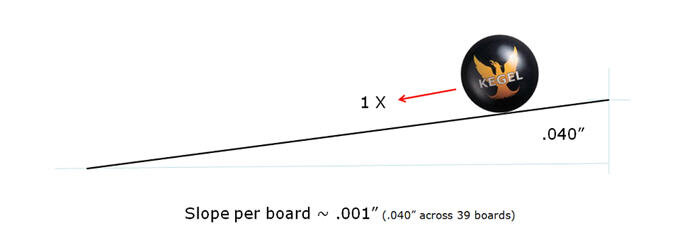
If we double that cross-tilt to be .080”, which is two times the allowable amount under the specification rules, that would give us a Slope per Board value of .002” for each board (.080”/39=~.002”).
Another instance that would give us that same .002” Slope per Board value, but be within current specification, would be a .040” V-Shaped depression, or crown, directly to the center of the lane. The calculation is a .040” slope over 20 boards, which equals a .002” Slope per Board as well (.040”/20=.002”).
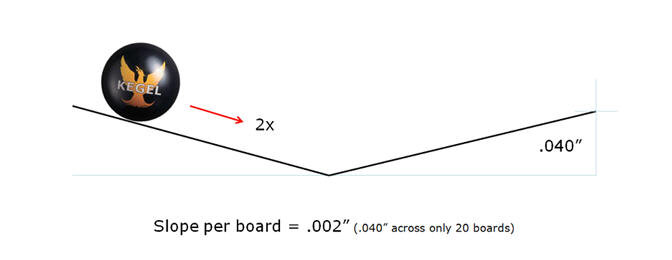
Understand, the ball doesn’t care about the lane being in specification or out of specification. The ball feels the exact same gravitational influence of .002” under each scenario – one scenario twice the allowable amount, and one perfectly within specifications.
However, as soon as we introduce crowns and depressions into the equation, that cross-tilt slope per board value can increase or decrease significantly, and depending on which way the gravitational slope is, it will influence the bowling ball to the left or to the right as it travels down and across the lane surface.
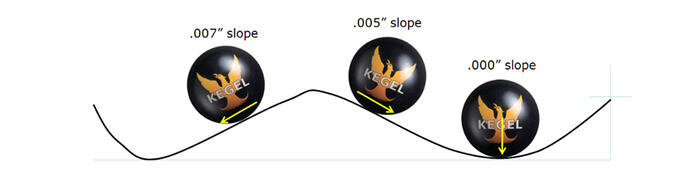
With synthetic lane installations, it is common to see crowns or depressions combined with tilts to produce Slope per Board values well over .005”, which is equal to a cross-tilt that is five times (.200”) the legal specification limit.
“The breakthrough came by creating and defining a brand new term in bowling - Slope per Board.”
The Slope Graph
Now that we realized the random deviation from levelness of a synthetic bowling lane, we began to experiment with different graphical representations of the data. After some experimentation, we settled on a seven color overhead graph, with varying shades of blue being right gravitational influence (the darker the color, the more influence), varying shades of red being left gravitational influences, and green being neutral to very little gravitational influence on the bowling ball (arrow graphic below).
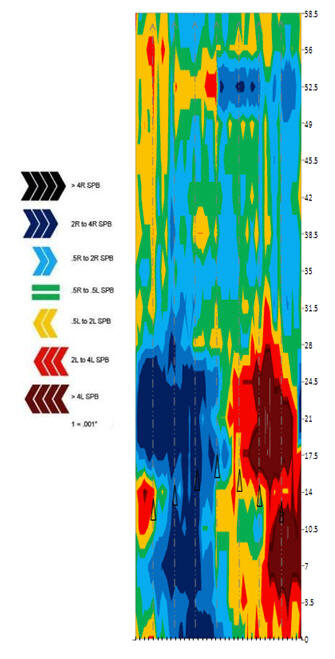
Our current LaneMap Slope Graphs (pictured left) have been scaled to be much wider than an actual bowling lane so to easily see the left-to-right definition of the lane when a pair of lanes is on one sheet of paper.
To the left is an example of a bowling lane that has some severe depressions the first 28’ of the lane; this is very common with aging synthetic lanes installed over existing wood lanes.
After the 28’ mark, the lane becomes slightly crowned. This is evident from the blue colors outside on the right side of the lane, and the red spectrum colors on the outside on the left side of the lane.
To give you an example how much those front lane depressions affect a bowling ball; if a 15 pound ball is placed on the right side 8th board at the foul line, and it is straightly rolled end-over-end at 18 mph, by the time it reaches the 28 foot mark, based upon this actual lanes levelness in that area, the ball will have moved almost 3” to the left!
After 28’, and the ball being almost to the 11th board, the forces on this lane are basically non-existent, or cancel each other out, keeping the ball near the 11th board the rest of its journey to the pins.
Remember Andy Varipapa's “double hook trick” where he spin rolls the ball at the foul line to the right side of the lane, and then it rolls to the left side of the lane, and then back to the right again to make the 10 pin? This is most likely gravity at work on a depressed lane surface - all wood lanes were cut with a depression. It’s only a trick because many assume slopes that are not visible to the naked eye will not affect a bowling ball’s path.
However, our testing has shown these "invisible slopes" can affect the path of the ball significantly. It's possible Andy also knew that, and he might have known spinning the ball would decrease the friction between the ball surface and the lane surface, helping gravity “do its thing”. After all, the Laws of Motion were around long before Andy Varipapa.
It must be noted, in accordance to the Laws of Physics, that a side slope on an oiled lane (low friction) will make a ball move off line more than on a perfectly dry lane because less force is needed to move the ball offline. Think of a car on a side hill on an icy road versus dry pavement; the same physical forces apply to bowling balls.
We have also been studying how a rotating bowling ball is affected by these different side hill slopes, and with all the varying degrees of axis rotation, axis tilt, and rev rates of different styles, along with varying amounts of friction, ball weights, and ball speeds, it is very complicated math.
But basically, the Laws of Physics still apply - a ball rotating against the slide slope will deplete energy quicker than a ball rotating with a side slope.
For example, a player like Pete Weber, who has a high degree of axis rotation on his normal delivery, will be affected more on a side hill slope perpendicular to his axis of rotation than a player like Jason Belmonte, whose axis of rotation is much less. It could be a positive or negative effect depending on which way that side slope is and how the players must attack the lanes to find the most room for error and best pin carry.
However, with Kegel's Slope Graphs none of that matters because we are comparing different lanes to one another, with all those rotational and friction properties being near the same for any particular player.
So far the Kegel Slope Graphs have been spot on in real world situations. Not only have we been watching and proving them in action at many high level events and championships over the past two years, from a thousand miles away, after fully measuring a bowling center with the Kegel LaneMapper™ and creating a Kegel LaneMap™ Report and Guide, we can tell a proprietor what lanes in their bowling center have certain characteristics, or which pairs are the highest and lowest scoring, without ever steeping foot inside their center. Every time they are amazed what we can tell them from this data.
In addition, when having these Slope Graphs compiled into a full Kegel LaneMap Report of any bowling center holding a tournament or championship, we can also predict what lane is tighter, what lane hooks more, where a lane will play the fairest, and what pair topography will be least influential, or be the fairest for most styles, and therefore, to hold the finals on.
From our formal and concourse educational seminars, we find understanding these graphs and how it relates to ball motion takes very little time. But to this day, and with all the education on oil patterns, most still don’t understand oil patterns and how they relate to ball motion,
How many times have you heard, “the oil pattern didn’t play anything like it did at home”, or “the oil pattern says we should play here, but it seems to be better over there”?
With Kegel’s LaneMapper and the reports and Slope Graphs it generates, we now know exactly why that happens.
ADDITIONAL INFORMATION
Below are links to download Kegel LaneMap Guides for a few bowling centers so we can show you real world examples on how lanes differ from one another.
The proprietors of these two centers, Werner Knoebl of Dream Bowl Palace in Munich, Germany and Ronald Dol of Dolfijn Bowling in Tilburg, The Netherlands, are very progressive and sport oriented bowling proprietors. It is their feeling that sharing this information makes for a more level playing field.
As any proprietor knows, one of the biggest challenges for the weekly bowler is trying to adjust to radically different lanes.
Kegel LaneMap Guide Downloads:
31 January 2012 - Dolfijn Bowling - Tilburg, The Netherlands: 1.3MB PDF - this report was made available to all players by the organizers of the 2012 European Bowling Tour's Hammer Bronzen Schietspoel International.
2 February 2011 - Dream Bowl Palace BEFORE the March 2011 re-leveling. After the re-leveling, lane play became very similar from lane to lane.
This example is one of the absolute best new synthetic installations we've seen: 20121015 LaneMap Report from Bowl for Fun in Langen, Germany
RELATED ARTICLES
Weather, Topography, and Ball Motion
What a Shock - Newton Correct!
Topography: What does it all mean?
What a Shock - Newton Correct!
By Lou Trunk – Professional lane installer
Two time winner of BPAA Special Projects Award
USBC National Tournament Lane Installer and/or Stand-By Service Manager since 1987
Over the past 24 months, along with the staff at Kegel, we have stepped up the topography testing of years prior by performing revolutionary experiments and gathering data from all over the world. We have been closely studying different lane shapes, creating formulas, having late night jams sessions, and watching 1000’s of bowling balls go down the lane trying to prove, and disprove, how topography affects the motion and the direction of the bowling ball as it rolls from foul line to off the end of the pin deck. Notice we didn’t write head pin. As you read the full series, you’ll come to understand why.
This series of articles may be the most important subject players, proprietors, tournament organizers and administrators of the game have ever read regarding the technical side of the modern day sport of bowling.
Newton Correct!
The “thought experiments” we, along with a very few others, have been executing in our minds for over 20 years, finally took to the lanes early November 2009 in the form of actual measured real life situations of lane topography, on which actual real life bowlers of various styles threw shots, which produced observable and CATS™ measured ball reactions.
The initial tests were exciting and invigorating to John Davis, Bill Mongeau, Ted Thompson and me, but probably not so shocking to Sir Isaac. Indeed, it appears that Newton’s First and Second Laws in fact apply to the game of Bowling.
In layman’s terms, these experiments involve three basics:
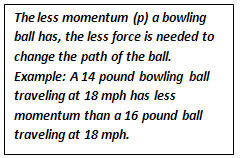
1. Momentum, (and the law of conservation of momentum): a body’s momentum equals it’s mass times it’s velocity p=mv (p is the symbol for Momentum).
2. Newton’s First Law of Motion, which states in the absence of force, a moving body will move in a straight line at constant speed.
3. Newton’s Second Law of Motion, which states when a force is applied to a body,acceleration will result in the direction of the force.
Most important with regard to Newton’s Second Law for our experiments, is that the net force on an object is equal to the time rate of change of its linear momentum.
For example, the more momentum a ball has, the more force will be needed to act upon the ball, in order to change the ball’s path by a certain distance.
In bowling, the gravitational force on a bowling ball comes from a lane’s tilts, depressions and crowns. And mind you, there is not a perfectly flat lane anywhere on this planet.
Most everyone in the bowling industry considers the lane surface as a two dimensional surface. A flat plane, or an X and Y axis, with the X axis being the width of a lane, and the Y axis being the length of a lane. If the lane was merely two dimensional, gravity would simply be a constant throughout any bowling ball’s journey down any lane. That is simply never the case, and the often unconsidered Z axis – the change in elevation – has a significant amount of influence on ball motion.
For our experiments we considered the force, momentum and inertia situations. The constants on repeated shots were mass (ball weight), lane surface, gravity, oil type and oil pattern; which combine to produce a certain ball path shape for a certain bowler with a certain ball on a flat surface. Then we changed only the topography, and that’s where the “shock” began. And it was shocking to us, but not to Sir Isaac Newton.
Slope per Board is the Key!
The first thing we must explain is the creation of a brand new term in bowling called, Slope per Board. With the invention of the Kegel Lane Mapper, by taking crown and depression readings of each and every board across the lane, and then adding the single crosstilt reading to each board, we can calculate the slope of each board at any distance on the bowling lane.
To fully understand the significance of this reading, we must understand that as the bowling ball travels down the lane from foul line to pin deck, it simply reacts to whatever gravitational force is acting on the ball on whatever specific board it is on at any one moment in time, and it doesn’t care about the slope of surrounding boards.
For instance, we know a bowling lane consists of 39 boards, and if a bowling lane is tilted high right 40/1000” (1 mm), which is the maximum allowable amount under the specification rules, that would give us a slope per board value of about 1/1000” (.025 mm) for each board on the lane.
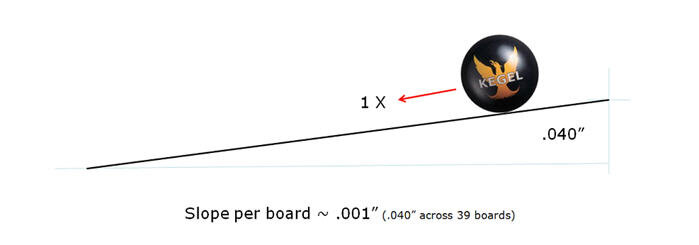
If we double that crosstilt to be 80/1000” (2 mm), which is two times the allowable amount under the specification rules, that would give us a slope per board value of 2/1000” (.050 mm) for each board.
Another instance that would give us that same 2/1000" slope per board value, but be within current specification, would be a 40/1000” v-shaped crown or depression directly to the center of the lane (.040” slope/20 boards = .002” slope/board.)
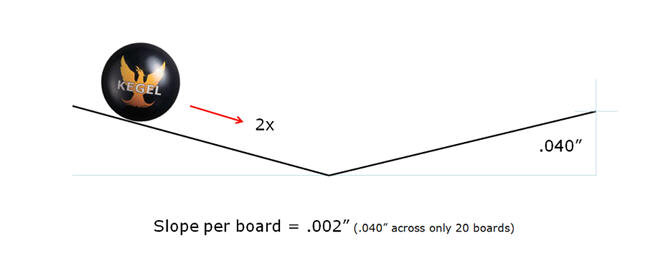
The ball doesn’t care about the specification. It feels the exact same gravitational influence of .002” under each scenario – one scenario twice the allowable amount, and one perfectly within specification.
Further, as soon as we introduce crowns and depressions into the equation, that crosstilt slope per board value can increase significantly, or even decrease, and depending on which way the gravitational slope is, it will influence the bowling ball to the left or to the right as it travels down and across the lane surface.
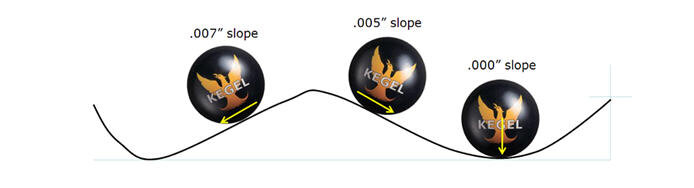
What did we do?
We, so far had introduced a “force” to the ball, a Gravitational Force. We shaped a few of the adjustable Kegel Training Center lanes with consistent gravitational shapes relative to the lane, yet contradicting gravitational forces relative to the ball’s inertial path.
On one pair of lanes, we created as near a non-imbalanced gravitational force as we could, as flat as possible. This gives us a benchmark ball motion reaction where there is constant gravitational force on the bowling ball as it rolls down the lane.
On another pair, we created two opposite shapes.
One lane had a legal gravitational imbalance of approximately .003” slope per board (SPB) low left for a right-hander playing anywhere from 1-20 board. We did this by creating a .040” low left crosstilt (.001”SPB), plus a .040” smooth V-shaped depression from both 1 boards to the 20 board (.002” SPB) which gives us that .003” per board slope effect toward the center of the lane for a right-handed player.
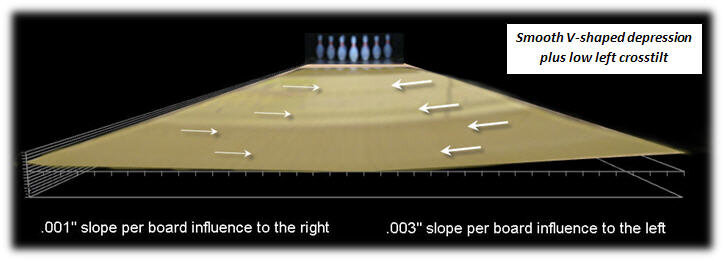
On this lane’s mate, we created the low right equivalent. We did this by reversing what we did on the companion lane.
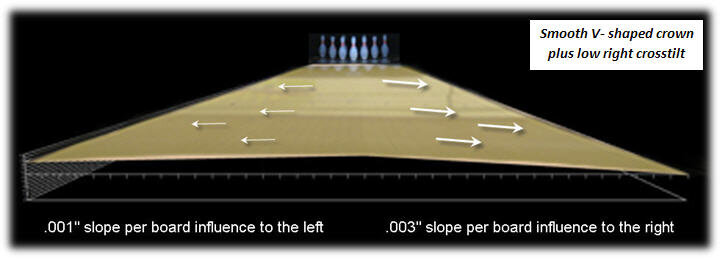
It is important to note that this very shape yields only a .001” slope for a left-hander playing anywhere from boards 1-20 on his side, since the combination of the tilt and the crown/depression compound the slope for the right-hander but are partially counterbalancing for the left-hander.
And finally, just like the pictures above, we created two lanes with real world situations of a net gravitational imbalance of approximately .005” slope per board. One lane with a gravitational force towards the center of the lane, and the other gravitational force towards the right gutter for a right-handed player, which was again opposite but nearly flat for the left-hander because of the counter-balancing combination of the crosstilt plus the crown and depression.
What did we see?
Newton would be proud. The left-handers had all pairs about the same. The right-handers certainly did not. The relative effect on the bowling ball was proportional in three ways. First, there was nearly double the effect on a ball’s path at .005” slope per board as there was at .003” slope per board in the direction of the slope.
Secondly, the effect was proportionally less for higher ball speeds and greater for slower ball speeds. The faster the ball was thrown, the less boards the ball missed the intended breakpoint because of the gravitational effects of the lane topography.
Remember that the displacement caused by a gravitational influence is a function of the time spent on the influence, so it stands to reason: faster speed = less time on the influence = less displacement.
Sure enough, the differences in the two opposite gravity force lanes were proportionally greater for slower ball speed players. And third, lighter weight balls were proportionally more effected by a certain slope.
“Displacement caused by a gravitational influence is a function of the time spent on the influence.”
So at this point, what we had tested so far, were bowling lanes with a consistent gravitational force, either inward or outward, and bowlers of various speeds and ball weights relative to themselves – comparing a bowler’s data to his own data on the various shapes. Then we gathered data comparing bowlers to other bowlers. Bowler A playing straight up the 5 board and Bowler B playing 20 to a break point of 5.
For Bowler A, where the ball hit the pins was greatly different since his ball’s translation was almost continuously at a 90 degree angle to the gravitational force vector. The net change in impact position was greatest with this style on these opposite lane shapes.
Bowler B’s net change in impact position was not as significantly different as Bowler A’s, because Bowler B had the gravitational force displacing his ball at a slightly more obtuse angle (an angle greater than 90° and less than 180°).
The results for the two launch angles are very different and very significant.
It would appear that the nightmare pair for the down-and-in type player is one lane tilted left all the way and one lane tilted right all the way, because his ball is continuously influenced near perpendicular to his ball’s path throughout its travel from foul line to pins, so the impact point change is huge. As much as hitting the pocket on one lane and hitting only the 3 off the right (6-9-10 pins) on the other.
The boomer’s ball (Bowler B) had less perpendicular gravitational effects on its way down the lane both to and from the breakpoint in this all left slope or all right slope situation. The impact point doesn’t change as much as Bowler A, but the hitting power and shape of the ball path does.
Bowler B’s ball path shape was more of a curve on the all left slope covering far less boards. It was easier to control the shot, and it was less speed sensitive, but incurred a lower percentage pocket carry. On the all right slope Bowler B’s ball path shape was more of a skid-snap type reaction covering more boards but with less control. The ball was also more speed sensitive however it had a higher pocket carry percentage.
Newton would certainly agree, that to be fair to all players, all ball weights, all speeds, and all launch angles, FLAT is the only fair situation, and the further we deviate from flat, the more unfair the game becomes.
Lighter bowling balls and slower ball speeds are influenced more in non-flat situations than heavier bowling balls and faster ball speeds.
Further, the gravitational effects of depressions, crowns and tilts have widely varied effects on varied launch angles. The more a bowling lane strays away from flatness, the more those gravitational effects influence different styles of play in different ways.
So now it’s time to continue our testing by redoing each test over and over. The story continues.
Newton…what a guy.