The Truth About Tournament Oil Patterns and Conversions
At Kegel we get many requests for converting oil patterns to and from different lane machine technologies. Sometimes it can be for a specific tournament pattern or it may be a named oil pattern. Although we fully realize the intent, we also know that there are many factors other than the oil pattern that determine ball motion, and how easy or difficult lanes play.
One technical reason some oil patterns cannot be converted is simply because some lane machines do not have the capability to apply an oil pattern exactly like the machine it was made for. A few of the new longer Landmark Patterns are good examples as these patterns were designed specifically for the FLEX lane machine.
For example, the Eiffel Tower is a 48 foot Sport pattern and with the variable buffer speed upgrade feature the FLEX has, the last seven feet utilizes a buffer speed of 200 rpm which applies a very light film of conditioner in this zone. If a lane machine does not have the variable buff option the buffer will be rotating at 500 rpm, and apply more conditioner to that zone, making the pattern play much tighter that it was intended to play. That doesn’t mean you can’t have fun if applied with other lane machine technology or the pattern will be terrible, it just won’t “play the same”.
However, even if the oil pattern is matched up perfectly from one technology to the next, there can still be differences in types of conditioners used, cleaner type, cleaner dilution, lane surface friction, and lane surface topography. Even bowler differences (who you will follow at the tournament) from your home center to wherever that tournament pattern will be used at can have a huge impact.
For instance, some lane conditioners play slicker or allow the ball to pick up earlier than other conditioners, some conditioner’s carrydown affect ball motion more than other conditioners, and some lane cleaners leave more residue behind than others causing different amounts of back-end hook. The dilution ratio, the amount of cleaner to water mixture, also affects ball motion, especially at the back-end.
For lane surfaces, conditioned wood lanes tend to hook more and earlier than conditioned synthetic lanes. Higher textured synthetic lanes tend to have an “arcing” ball motion, while smoother synthetic lanes tend to be more “skid-snappy”.
When practicing on a tournament pattern at home, you may be all alone or with a small group with similar styles. We know in today’s bowling environment using today’s equipment, it doesn’t take very long to change that oil pattern into something else simply by rolling balls down the lane. Once at the tournament site however you will be following a much more diverse group of styles, which may very well transform that oil pattern into something different.
It’s not even uncommon for us to see the scoring pace change from different squads in the same tournament using the exact same oil pattern just by the style of bowlers on specific squads, or even by the type of bowling balls used by the participants on different squads!
Topography is also a huge variable when it comes to how a ball hooks (how a ball depletes energy) and how much it hooks. A portion of a lane sloped opposite the rotation of the ball will cause the ball to lose energy quickly, while a portion of a lane sloped with the rotation of the ball will cause the ball to lose energy slower. These slopes on the lane surface can also help the ball move more easily towards the pocket, or make it more difficult for the ball to move towards the pocket.
A textbook example of how lane surface and topography can affect scoring pace is from the 2014 and 2015 Teen Masters. In this event, many of the participants played both years, all players use the same type balls, the same oil and cleaner were used, and the long oil pattern was exactly the same both years, so we can discount all those variables.
However, in 2015, the event was held at a newer installation and the lanes are predominately shaped with a certain type topography that is known to produce high scores; the overall scoring pace was 20 pins higher in 2015 than in 2014 and an abnormal amount of 300 games were bowled. The 2015 environment also benefited some players more than others as averages between the two events were 40 pins higher per game in 2015 versus 2014, for certain styles of play.
Kegel has mapped thousands of bowling lanes around the world and we have yet to find two lanes that have the exact same measurements with regard to lengthwise tilts, crosstilts, crowns, and depressions. We also have yet to find a perfectly level lane. It could be said that bowling lanes are like finger prints; no two are the same.
Therefore, perfect and exact pattern oil patterns, or conversions, GUARANTEE that ball motion will be different at home versus where you will play on that pattern at whatever event you are going to.
A good coaching tip is to practice on a competitive type oil pattern that has a similar distance to the tournament pattern you will be bowling on. This type of preparation will help you to keep an open mind and to be flexible when you arrive at the tournament site. It is easy to get overly caught up in oil patterns with all the information and focus on oil patterns today. Unfortunately, more often than not, this closes the mind and shifts focus to “what should be” instead of “what might be”.
In conclusion, if you are practicing at home on a tournament oil pattern, and planning on competing or coaching in that tournament, take that oil pattern with a grain of salt and keep your mind open - very open. We can just about guarantee things will be different at the tournament site than at your home center.

2015 USBC Open Championship Oil Pattern Program Sheet
This month’s Inside Line feature article is about key items on the KEGEL FLEX program sheet of both the Team event and the Singles and Doubles event oil patterns for 2015 USBC Open Championships.
Oil Pattern Distance
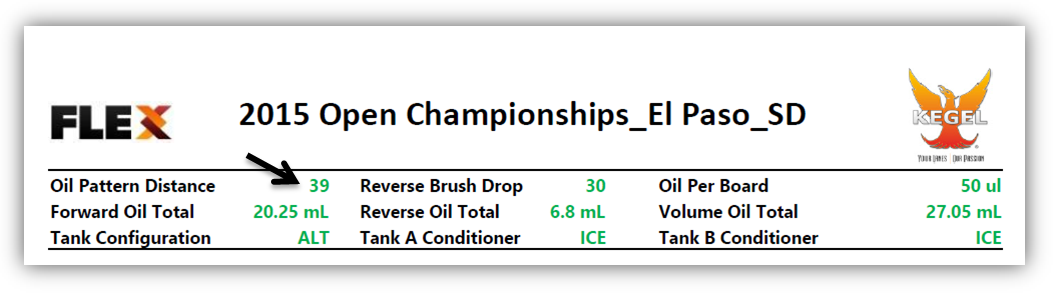
Oil pattern distance is one of the main key items to look for on any program sheet. The distance tells us how much dry back-end area is within any one pattern and can give us a good idea of where to play on the lane, providing the lane surface is fairly neutral. Essentially, the shorter the oil pattern is, the farther towards the outside portion of the lane one should play, and the longer the oil pattern is, the farther inside a pattern might play. Of course there are other variables that can affect this theory; like the amount of conditioner on the outside portion of the lane, the shape (topography) of the lane surface, and the friction of the lane surface. However, knowing the distance of the oil pattern, and how it affects your particular style of play, can help you line up quicker than not knowing this important pattern detail.
The distance of the oil pattern can be found at the top left corner of the KEGEL FLEX program sheet.
Oil Per Board Value Number
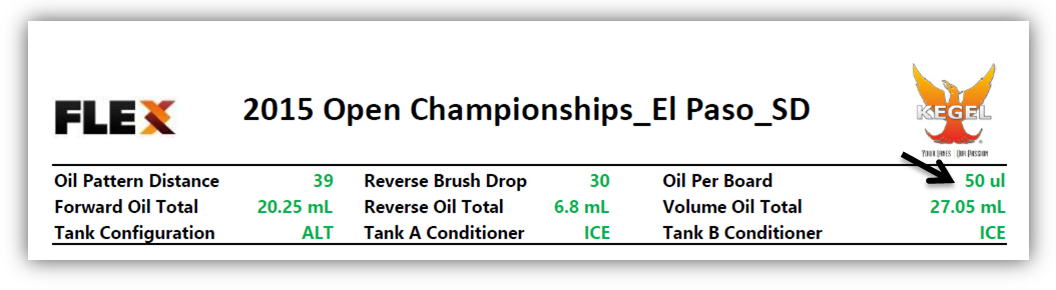
The Oil Per Board value, found at the top right of the FLEX oil pattern program sheet, is the size of the oil stream in microliters - the higher the value, the larger the oil stream, and the larger the stream, the more conditioner is applied to the lane.
Number of 2-2 Loads
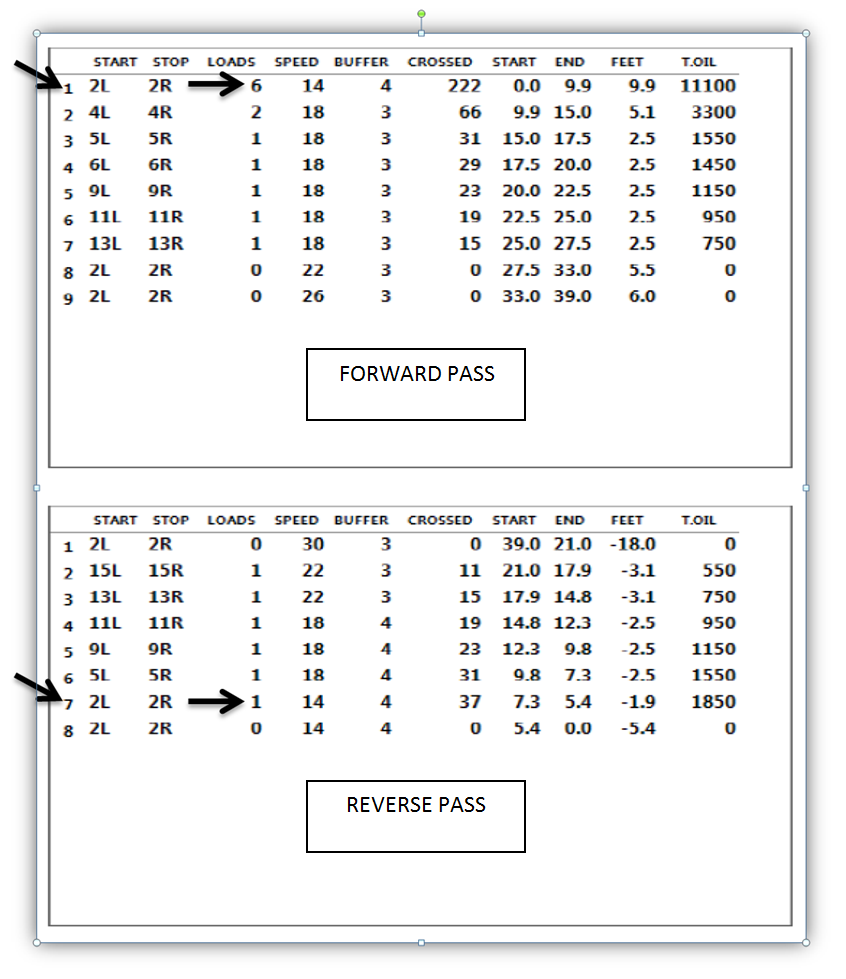
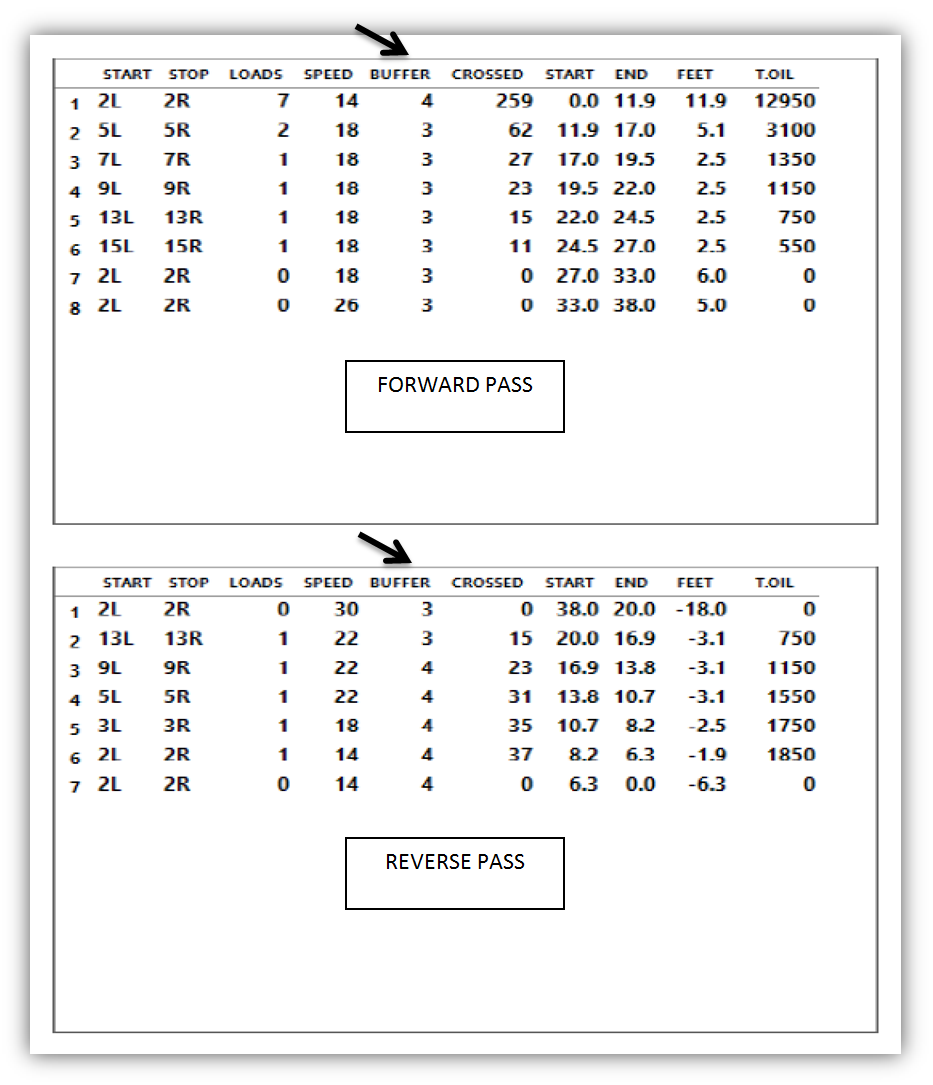
The Number of 2-2 loads can often be a measure of difficulty. Think about these loads as the base of the oil pattern and all loads inside of the 2-2 loads are the shape of the oil pattern. The more 2-2 loads the more difficult an oil pattern will play because once there is a certain amount of conditioner across the entire lane surface, the shape of the oil pattern becomes less relevant.
At this year’s Open Championships, the 2-2 loads make up 12.95 milliliters of the total volume of the 27.05 singles/doubles oil pattern and 14.80 milliliters of the total volume of the 26.90 milliliters team event pattern. In comparison, in most house patterns the 2-2 loads make up 3.7 milliliters of the total volume of the pattern which is in the 22 milliliter range.
The 2-2 loads are normally the first loads on the forward pass and the last load before the buff line in the reverse pass.
Buffer RPM
The FLEX lane machines in use at this year’s championship have four buffer speed options, which are noted on the program sheet by the numbers 1, 2, 3, and 4. Number 1 is what we call slow buff, and it has a speed of 100 RPM. Number 2 is medium buff and has a speed of 200 RPM. Number 3 buffs at 500 RPM and is the default speed that is used on previous models such as the Kustodian ION and Kustodian Walker. Number 4 is high buff and has a speed of 720 RPM. (Note: Individual FLEX owners can customize the buffer RPM settings for their needs, so you may see different numbers on different program sheets.)
The different buffer speeds on the FLEX allow us to do a couple things; one is it allows us to fine tune the front to back taper of the oil pattern without changing lane machine drive speeds. The other is it allows us to condition the lanes in less time by allowing us to apply more conditioner in the front part of the lane without slowing the machine down, as we would have to do in machines with single speed buffer motors.
In short, the faster the speed of the buffer brush, the more conditioner can be applied in any one section of the oil pattern. Conversely, the slower the speed of the buffer brush, less conditioner will be applied to the lane surface.
You will notice on this year’s championship patterns the choice of using buffer speed 4 in the front part of the oil pattern on both the forward and reverse pass of the pattern. Medium and slow buff is not used in this year’s patterns.
The Load Structure
As previously mentioned, once there is a certain amount of conditioner on the lane the load structure becomes less relevant. However, one thing to note this year compared to recent years, and a house pattern, is how none of the loads are “stacked up”. This means the inside load streams are spread out across the oil pattern which makes the pattern a simple blend, or crowned oil pattern (See graphics above).
Because of this type load structure there is not a defined oil line anywhere throughout either the Team or Doubles/Singles event patterns which places a premium on consistent shot making and accuracy. Only once bowling begins, and depletion takes place, can an oil line be developed if, and that is a big if, everyone plays in the same place from the beginning of practice to at least through the first few frames of game one. This is called “managing the oil pattern” in modern bowling vernacular.
This year’s USBC Open Championship should prove out to be one of the lower scoring championships in recent years simply because of the flatness of the patterns. However, it should also prove out to be one of the most competitive because when scores are lower, the gap between the higher scores and lower scores is much narrower.
In closing, if you have not already made the trip to El Paso, practice your spare game, have a good game plan with your teammates, and let your ball be your guide.
How can a simple water filter become so clogged?
Anyone that maintains lane machines knows how critical routine maintenance is. But one item that often gets overlooked in lane machine upkeep are supply tank filters - the filters in the oil supply tank, filters in the cleaner supply tank, and now with the FLEX lane machine, the water supply tank filter (see help video below). In this feature article of the Inside Line, we’ll focus on the water supply tank and how those filters can become clogged over time, even though it’s "just water".
Most people are aware that all water is not created equal. Water can be hard or soft, and have different levels of calcium, phosphates, nitrates, sodium, potassium, and chloride, along with some uninvited guests depending on the water treatment plants. These substances are known as Total Dissolved Solids (TDS).
TDS is a measure of the “combined content of all inorganic and organic substances contained in a liquid in molecular, ionized, or micro-granular suspended form.” In layman’s terms, TDS is a measure of the amount of the stuff in the water you can’t see.
Knowing the TDS is all well and good but, how will this affect your lane machine filter?
Well, when water sits around, you know that mold and fungus can grow on the water’s surface. The water can become very pungent; you can actually see things growing and the water color changing. Think about bird baths and small fountains that don’t have running water; the stagnant water eventually turns rancid from mold and fungus growth.
When water sits in a container for long periods of time, a bio-film will eventually begin to form. Bio-films form on surfaces like tank walls and filters. Actually, they will form on virtually every non-shedding surface in a non-sterile or very humid environment.
On your teeth, plaque is a bio-film. In your cooling and heating system, bio-film forms reducing the effectiveness of the system. The slimy stuff you see on rocks and pebbles in streams is bio-film. In stagnant pools of water, bio-films can form on the surface.
Basically, a bio-film can form just about anywhere as long as there is a place for the cells to attach; the cells can attach to a solid surface or to each other.
So bio-films form in water, right? Well, why don’t bio-films form in bottled water at the grocery store?
Bottled water is packaged to prevent bio-films from forming. The bottled water you buy from the store is packaged under nitrogen pressure to force out the air. This prevents bio-films from forming in the water while it sits on the shelf. Once the bottle is opened and air is introduced to the system, the bio-film can begin forming. This is one reason why you shouldn’t reuse bottles from bottled water without thoroughly cleaning them.
Bio-film goes through five stages of development:
1. Initial attachment,
2. Irreversible attachment,
3. Maturation I,
4. Maturation II,
5. Dispersion.
The picture below shows how a bio-film develops through each of the different stages.
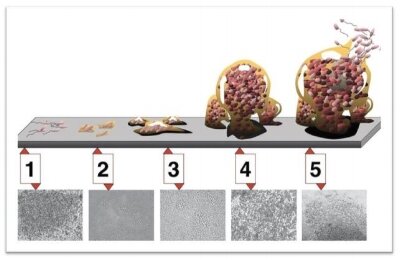
Five stages of bio-film development
Water quality in a specific location will dictate how fast a bowling center will have bio-film develop. TDS and the specific treatment methods used at the local water treatment facilities will change the water quality. Eventually though, every center will have to clean and/or replace their lane machine water filter at some time.
Just like your coffee maker at home, the water filter and supply tank should be cleaned periodically to prevent the problem. If you never clean your coffee maker, eventually the pump will fail. If you never clean your water supply tank in your single cup machines, a bio-film can form in the water tank.
At Kegel, we recommend removing and cleaning the water supply tank filter once a month. We also suggest flushing out the water supply tank at least every couple months, no matter how often you use your lane machine. The water is sitting in the supply tank the same amount of time no matter how many lanes you are doing a day – always.
This is what happens when filters are not maintained regularly:
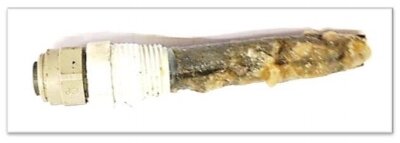
A filter that has not been maintained.
If periodic maintenance is not being performed on a simple item like your water supply tank and filter, or any filter for that matter, the liquid in the tank will not flow properly and that will change your dilution ratios. We know changing dilution ratios will change ball motion. But, improper cleaning can also lead to a host of other issues.
Just like Sanction Technology has done for the oil system with process verification, with Kegel’s sprayless cleaner system it's easy to check volume output for water and cleaner. As we always say, “it’s better to know than to hope”, and as any lane person will tell you, it's also better for you to find any issues before your bowlers do.
Who do you follow? We're not talking about Twitter...
In previous Inside Line articles, we showed how oil pattern breakdown happens with today's high flaring bowling balls and how different styles of play can affect an oil pattern in different ways. In this article, we will show how different groups of players with similar styles can greatly affect an oil pattern by strategically "managing the oil pattern" during practice time and the first game, and the resulting scoring pace for all those that follow these skillful "pattern managers."
The scene was the Men's Team event second block on the WTBA Seoul oil pattern during the 2013 WTBA World Championships in Las Vegas. The WTBA rule for practice time for 5 person team event is 15 minutes, then all teams bowl 3 games moving lanes every game. This gives us about 4-5 games per lane by the time each team finishes the 3rd frame of game one.
Our testing and after tapes at many modern day events show that when players play a similar line each and every shot during this time on a fresh oil pattern, over 50 percent of the lane conditioner can be removed from that area throughout the ENTIRE length of the applied oil pattern. This is significant and something all competitive players and coaches must be aware of in today's game.
Here was a test showing how much conditioner was removed in the area of play after each 3 games:
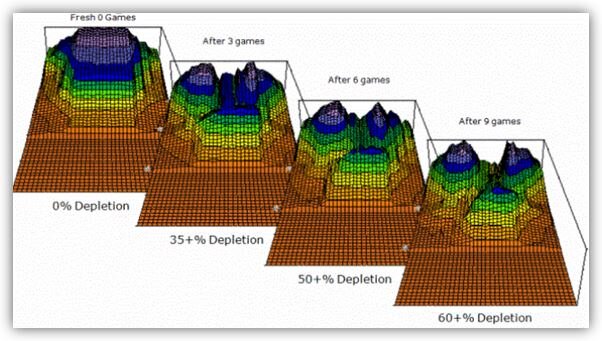
The significance and rapid pattern change is so prevalent in today's game that some Federations even employ multiple coaches during championships- one coach on the lanes helping the players during competition, and another coach "scouting out" the pair of lanes they will be moving to. Just knowing how and where the teams are playing on the lanes in front them can give them valuable information and help them get lined up quicker. In championship events, this can be the difference between winning, losing, or not even getting a chance to win. This played out exactly this way during the 2013 World Championships this year in the men's division.
Here is a graphic of the Seoul oil pattern just before the men's second squad of team event took the lanes - the graphic is with the perspective of looking at the oil pattern from the pins, so the 10 pin side is the left side of the graphic. Also shown below are the Sport Bowling ratios at multiple tape distances before the players took to the lanes:
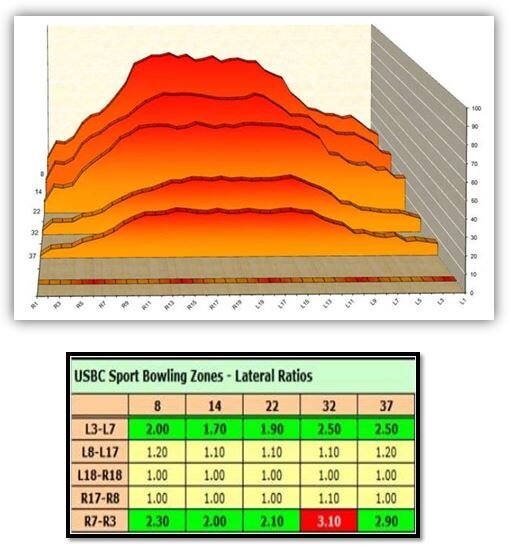
As a side note, the WTBA Seoul oil pattern is asymmetrical with more oil outside on the left side than the right side, hence the lower ratios on the left side. You may also notice that at 32' this pattern does not fall within the 3 to 1 ratio parameters, but Sport Bowling ratios only use 22' and 2' before the end of the pattern to calculate whether it meets USBC Sport Bowling requirements, and the WTBA does not have any ratio requirements.
During this second block of team play, with these pairs of lanes being right in front of the tournament office, I was able to watch and see how each of the teams on these pairs were breaking down the lanes during the 15 minutes of practice. While watching Puerto Rico and Brazil on 57-58 play more outside, and the teams on 55-56 play more inside, I was wondering how much an effect that might have on the teams coming to these pair of lanes in games 2 and 3, so I planned on taking after tapes as soon as the block was over. Little did I know at the time, the way the teams on 57-58 broke down that pair would help Team Finland make history.
After 15 minutes of practice and three 5-man team games (15 plus games per lane), here is what the Seoul pattern morphed into on lanes 55-56:
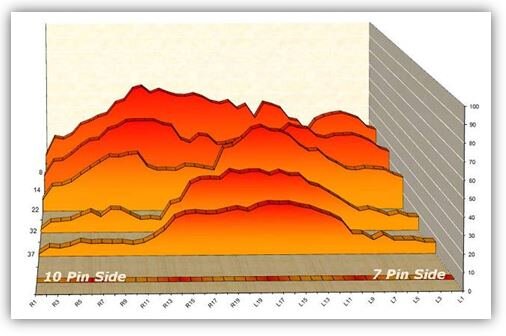
From looking at these after tapes, it is clear how deep inside the bowlers on this pair ended up playing the lanes, which all came from how the initial teams decided to play the lanes in practice and game 1.
Here are the after ratios of lanes 55-56, calculated the same way as before:
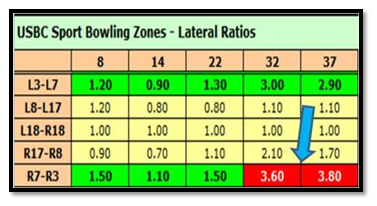
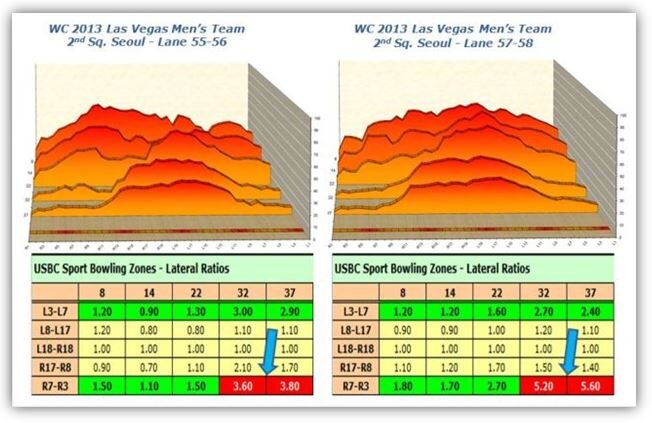
The ratios normally get lower up front as the oil pattern gets depleted from the middle of the lane. What makes scoring pace rise as players break down the oil pattern is when all balls come together towards the end part of the oil pattern, which raises the ratios from outside to the middle. In this example the ratios from the fresh oil pattern went from about 3:1 to 3.6:1 at 32 feet and from 2.9:1 to 3.8:1 at 37 feet. This is enough for world class players to increase the scoring pace, and this block was no exception.
Here is the resulting scoring pace of each team for each game of this particular block of games on lanes 55-56::
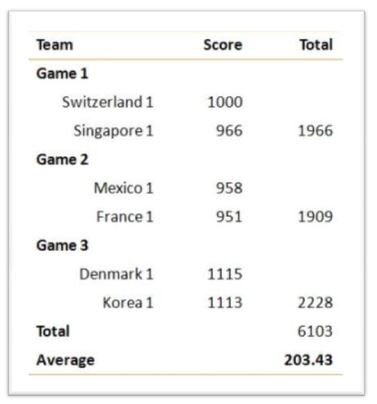
As you can see by game 3 that pair became more playable because of oil pattern development with both Team Denmark and Team Korea breaking the 1100 barrier. It took longer because of how deep the previous teams played that pair. The reason it took longer is because when teams start in the deeper amount of oil, it takes longer for the ball to reach the "spark point", or in other words, break down the oil pattern enough for the ball to poke through the oil film and get to the lane surface. Once the ball sees the lane surface, it also sees friction. The earlier the ball sees friction within the oil pattern, the easier that pattern becomes because left of that is the created oil line.
And now the pair of lanes where the Seoul pattern was changed into something else, which helped Team Finland make history. The mutated Seoul oil pattern on lanes 57-58:
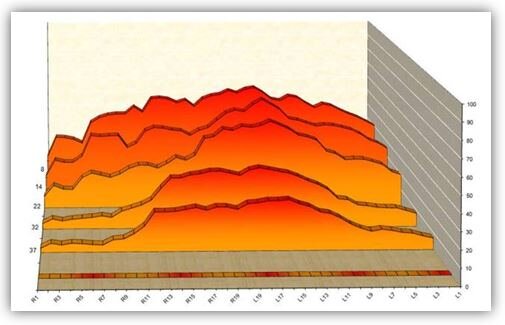
From looking at these after tapes, it is clear how much more outside the bowlers on this pair ended up playing the lanes, which also was decided because of how the initial teams decided to play the lanes in practice and game 1.
Here are the after ratios of this pair, calculated the same way as before:
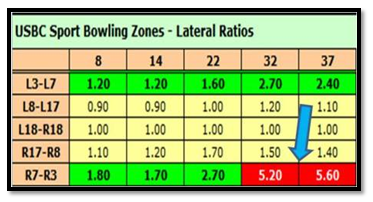
While lanes 55-56 went to 3.6 and 3.8 to 1 towards the end of the oil pattern, the players on lanes 57-58 took the ratios to 5.2 and 5.6 to 1! This is borderline what many house shots are in today's game, but like I said before, most of the change happens within practice and the beginning of game one.
Here is the resulting scoring pace on lanes 57-58 of each team for each game during this block of games:
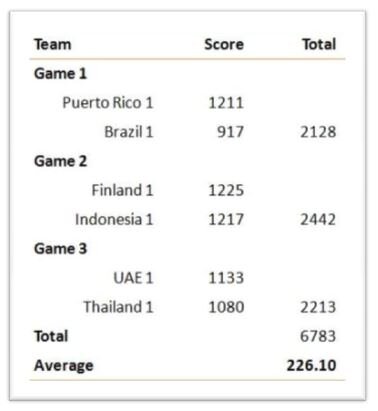
As you can see by the team game total scores, the teams that were fortunate enough to follow Puerto Rico and Brazil benefited greatly, but none more than Team Finland. This second team game with a score of 1225, along with the momentum that gave them and another 1200 plus score in game 3, catapulted them into the Team finals. After winning their semi-final match they defeated Team USA in the finals for the first team Gold medal for Finland in 30 years.
Fortunately, during this championship we also had available Kegel's LaneMap Guide of Sunset Station which shows the gravity influence on the ball based upon topography so we were able to see if one pair was significantly different causing that to be the reason for higher scores this block on 57-58, but that proved to be not the case, as the below graphic will clearly show. Both pairs have very similar characteristics.
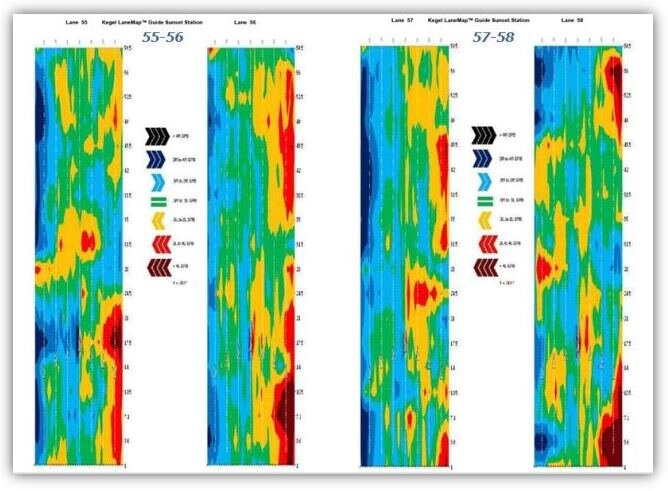
Finally, one more look an after bowling graphic of both patterns and the resulting ratios side by side:
A well renowned Kegel laneman and now National Team Coach for Indonesia, John Forst, had a saying; "the applied oil pattern is only the pattern until the bowlers start bowling on it. After that, they are the ones that decide what happens, not the laneman."
In today's vernacular, the Seoul oil pattern, or any other named oil pattern for that matter, is only the intended pattern until players start rolling balls over it, and then that named pattern becomes something else. Some players can turn it into Easy Street, and some can turn it into the Highway to Hell. Keep your fingers crossed you follow players that can turn things into Easy Street.
Oh No! My pattern is not playing the same as last year!

By Doug Dukes - Kegel Technical Sales Specialist and Kegel Pinsetter Parts
"My pattern is the same as last year but it is not playing the same" is one of the #1 lines we hear this time of year. As one of the techs at Kegel that has the privilege to not only help all of you on the phone, but to also work on lane machines in the field, let’s take a look at some overlooked parts and adjustments to your lane machine.
CLEANING - “You can’t paint the Mona Lisa on a piece of toilet paper.”
The number one overlooked problem on a lane machine is its ability to clean. Anytime a pattern adjustment is requested because they don’t play the same, our first question is “have you done a clean only”.
On Spray Jet machines, the screen check valves (153-0220) should be taken out regularly and cleaned. Lint build up on these can wreak havoc on the jet's ability to spray properly and as the check valves get weak, your spray tips can drip. If you notice that your machine is using less cleaner, it may be a good time to take these screens out and clean them. There are also two filters that cleaner passes through before it gets to the screen check valves, one in the tank (154-0212B) and one inline filter before the pump (154-8867A or 154-8887). It is always good to replace these filters every summer.
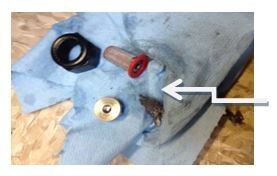
On Sprayless Cleaning Systems, you need to replace the two filters talked about above, but also your Norprene tubing in your cleaner pump (154-0861B). This style cleaner pump operates by using a set of rollers that press cleaner through this tubing every time the motor turns on. Over time, this tubing can lose its ability to allow cleaner to be pushed through it, and your volumes can be significantly reduced. Many times I have run a cleaner volume check on a lane machine and looked at the touchscreen only to realize that I was the last one to run the test during the yearly service last year!!! You guessed it……the volume was significantly lower than what it should have been.
Once you change the tubing, run a volume check and set it to your desired output and monitor this for a few weeks as the tubing breaks in. It will vary a bit during this time and a readjustment may be required, but it will settle in quickly. This should be checked on a regular basis throughout your season as well.
The cushion roller (153-8838 standard roller and 153-8839 roller with wrap), is another frequently overlooked piece to the cleaning puzzle. The size of the cushion is the key to your cleaning. If we think about how the cushion roller works, when the cloth unwinds, the cushion roller drops onto its stop bolts. When the machine is pushed onto the lane, the cushion actually lifts up off the stop bolts, and the weight of the cushion is what helps clean the lane. Simple right? If your cushion has gotten smaller over time, now it is not making full contact with the lane surface. This means it will not clean well. Mona Lisa and toilet paper soon to follow.
If you look at your cushion roller and see the “alligator skin” look, the ends are flaring out or torn and the cloth is visually pulling into the roller, or if you can wrap your hand completely around it, it is probably time to send it to greener pastures. One trick I show during service stops is releasing the tension on the cushion roller when you finish your lanes.
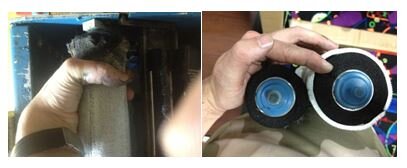
On machines that have the take up roll on the top, you can stand the machine in the transport position when finished and open the duster compartment. Slide the take up roll to the side and turn it 180 degrees and lock it back in place. This will relieve the pressure on the roller and when you turn the machine on to run lanes the next day, the machine will find “home” and wind the cloth back up for you. This can extend the life of your cushion and save you from headaches mid-season.
Squeegee blades (153-8204E Blue or 153-8834 Brown) normally are not overlooked, but why leave them out. Your squeegees should be flipped every six months, and changed once a year. You don’t want to leave any cleaner behind. Always check for your 1/8 to 3/16 adjustment as well, once you change or flip your blades and adjust accordingly.
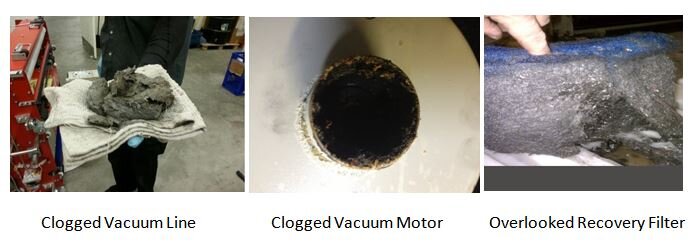
Recovery tank filters are another overlooked item in the cleaning process. Waste tank a little lighter than normal? Check your filter and change it regularly. This is the perfect time to flush out your vacuum hoses and check for small pin holes that may affect suction, along with cleaning your vacuum motor and checking the motor brushes.
Conditioning - “The best canvas deserves a worthy brush.”
A few minor adjustments in your transfer system that have been overlooked can also make you pull your hair out when you’re dialing in your pattern.
Have you checked your crush adjustments on your brush? Most people check the crush from the buffer brush to the lane and set their buffers at 1/8 to 3/16. What most people don’t check is the crush to the transfer brush or roller depending on the machine type. If it can’t pick it up off the transfer brush or roller it can’t get it to the lane!
As the brush wears, it may lose some contact with the transfer brush or roller. When getting ready for the fall season with an existing brush, or when putting in a new brush, always check this adjustment. We like to see 1/8 inch of crush to the roller or transfer brush.
On a transfer brush system, if you turn the buffer on while the brush is in the down position, you should see a thin light colored line where the transfer brush and buffer brush meet. This is from the bristles on the buffer brush being pushed together as they push against the transfer brush. Adjust accordingly.
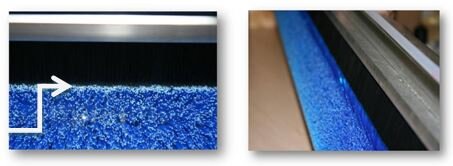
Your pressure gauge can tell you a lot about your lane machine as well. If your pressure gauge fluctuates as you are applying loads or your pressure seems much higher than normal, you may need to clean your oil control valve. Dirt can accumulate in your valve over time and cause pressure fluctuations while applying loads. If the valve is dirty, take a good look at your filter inside your oil tank as well (154-0212). Replacing it once a year will keep you in top running order.
Your lane machine is one of the most important machines in your center. My final example I tend to give to proprietors and mechanics alike goes something like this…….
If one of your pinsetters happens to go down during a league, you may upset at most the 10 people that are bowling on that pair. But you probably have the parts to be able to fix this later that evening. If your lane machine goes down, and you have a 32 lane center that is full, you’ve now made 160 people upset, and you may NOT have the parts to fix it. You next day air the parts, but your still down the next night, and 160 turns into 320. It is extremely important that you keep your machine clean, do your daily and monthly preventative maintenance, and not take your lane machine for granted. Always keep a few parts on hand. One of every relay, two of every fuse, a fuse holder, a head drive belt, check valves, etc.
This minimal list of low-cost items can be the difference between a full house of happy bowlers, or a lynch mob and a quick backdoor exit of the center. Spend ten minutes a day, 20 minutes once a week, an hour a month and a half day every six months on your machine, and you will be able to keep it clean, and inspect the machine for wear on a regular basis. Always remember we are only a phone call away 24 hours a day 7 days a week from anywhere in the world. We are ALWAYS here to help.
Good luck and good scoring on your new season.
Oil Pattern Graphs: KOSI Composite Graphs
How many times have you gone to a bowling tournament, or even a bowling league, and seen a lane pattern graph and not known what in the world you were looking at? I was at a collegiate bowling tournament where lane graphs were given to the teams at check-in and I heard many a team trying to decipher what the lane graphs meant. Over and over, I heard teams trying to decide where to play based on the lane graph. It actually surprised me how many people didn’t know what to look for.
If you are like me, and I know there are many of you out there, when you look at a lane pattern graph, you don’t really know how to extract information from it. Basically, you’re just looking at a picture of a lane or worse, some lane tapes that might as well be written in an ancient language. To help you, I have consulted some of the top minds in pattern theory for a little lesson in how to read and understand the various types of lane graphs.
To begin, we must first understand that there are different types of lane graphs. Some are related to the lane machine program sheet and some are related to the actual oil pattern on the lane.
Calculated from the lane machine settings (the program that is entered into the lane machine), we have the overhead graph and the composite graph. From lane tape readings (taken directly off the lane from the oil itself), we might see the 3D graph or the 2D graph. Each of these graphs look different and provide different ‘views’ of the oil pattern, but ultimately they all give you the same basic information – the shape of the oil pattern.
Some of the information you should look for, regardless of the graph type, is pattern distance, pattern volume, inside/outside ratios (don’t get confused, we’ll discuss) and pattern shape. All of these things will provide clues about what to expect from the oil pattern.
Pattern distance tells you how long (or short) the lane pattern is; in other words, how far down the lane from the foul line the oil is applied. A short pattern will play much different than a long pattern simply because there is longer part of the dry lane to deal with.
Pattern volume tells you how much total oil is applied to the lane. It does not tell you where that volume is; only how much oil is there. The total volume of oil is measured in milliliters and per board values are measured in microliters.
When you see a graph with units as the value, it is a calculated measurement based upon the ultra violet additive (UV) that is mandated to be in each batch of lane oil. The UV additive allows the optical lane reader to “see” the oil. Units of oil should not be confused with volume of oil.
Ratios tell you the difference in the amount of oil from left to center and right to center. Pattern shape is the shape of the oil on the lane. Some examples of shape are top hat, block, Christmas tree, or flat.
The first type of graph we’ll study, the composite graph, is one that most people will see most often. The composite graph is also called a volume per board chart. The composite graph, shown below, gives us the total amount of forward and reverse oil that is applied to the lane. The total amount of applied oil is calculated based on the program that is entered into the lane machine.
In actuality, the composite graph shows us the amount of oil on each board. The best way to understand the composite graph is to imagine taking all of the oil that was applied to the lane, then drag it back to the foul line and stack it up. This would look like the composite graph.
Take a look at the composite graph example below.
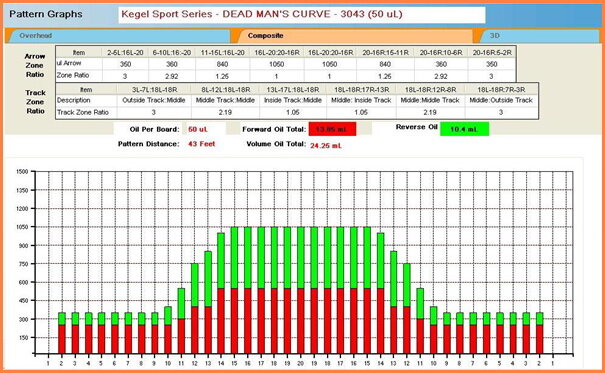
Along the bottom, or the ‘x’ axis for you math people, you can see the lane boards labeled; board one on the left to 20 in the center to the one board on the right.
Along the side, or the ‘y’ axis, the amount of oil is measured in micro liters.
This particular example is the composite graph for Dead Man’s Curve, a Sport pattern in the Kegel Navigation Series. Sport Bowling uses ratios to describe (or define) the level of difficulty of a pattern; a lower ratio is more difficult than a higher ratio. The Sport Bowling ratio is defined as the average amount of oil (in units) between boards Left 18 to Right 18 divided by the average amount of oil (in units) between boards R3-R7 & L3-L7, respectively.
While this graph does NOT give us units, nor does it tell us exactly where the ratios are within the oil pattern, it is still a good reference. In this graph, we can see that there is about three times as much conditioner in the middle of program as there is on the left and right side of the program; a 3 to 1 ratio.
The chart area above the graph, which you may or may not see on a composite graph as it depends on how the graph was generated (which computer software program generated the graph), also gives information on ratios in different parts of the pattern program. It may be somewhat difficult to read in this example due to the size of the picture; however, some information about ratios around the track area is given.
The track area is generally defined around the 10-board on either side of the lane (typically a bowler will play the track on a house shot). In this example, ratios are given for outside the track (boards 3-7 on either side of the lane), middle track (boards 8-12 on either side) and inside track (boards 13-17 on either side). In general, the lower the ratio of the oil, the more difficult the pattern will be to play.
In this example, the inside track (boards 13-17) would be very difficult as it is basically flat with a 1:1 ratio whereas the outside track (boards 3-7) would be somewhat easier at a 3:1 ratio. To put the ratios into perspective, a house pattern might be 6:1 or even higher. A high ratio program, like many house patterns are, will give the bowler a defined “ridge” to play against within the oil pattern.
This difference can help you determine how best to play the lane. Don’t misconstrue that; the composite graph can give you an idea of how to play the lane, but a common misconception is that it can tell you where to play the lane. This isn’t always true since the topography of the lane surface can often be more dominant than the oil pattern.
The composite graph is more of an idea of how difficult, or how easy, the oil pattern may play. Again, generally the lower the ratio of conditioner from the inside to the outside, or the flatter the oil pattern, the more challenging the oil pattern will be.
The last things to note in this graph, and they may be difficult to read because of the graph size, are the pattern distance and pattern volume. In this particular example, the pattern distance is 43 feet and the total volume is 24.25 mL.
Since a lane is 60 feet from foul line to head pin, there is 17 feet of ‘dry lane’ after our 43 foot Dead Man’s Curve pattern. That basically means there is 17 feet of friction that the ball must move through before it hits the pins.
We hope this information has helped you understand how to read a Composite Graph. It is important to remember that the information is only as useful as your interpretation. The graph isn’t telling you where to play; it is only providing you with some information to help you make an informed decision regarding lane play.
Next time, we’ll see another type of graph, learn about how to read it, and extract useful information from it. Until then, Happy Bowling!
Breakdown and Carrydown - By The Numbers
In our last Inside Line feature article, Breakdown and Carrydown – Then and Now, we discussed the reasons why breakdown and carrydown are different today. For this edition’s feature article, we will add some data and visuals to support the previous article. The data was taken from the recently concluded European Bowling Tour Masters in Munich, Germany and it shows the same thing we often see in bowling tournaments today.
The event consisted of the top 16 men and women from the 2011 European Bowling Tour point list. On the men’s side there was a mix of styles; high rev players, medium rev players, and low rev players, with fourteen right-handed players and two left-handed players. On the women’s side there was also a good mix of styles, even though most fall into the medium to low rev rate category, with 15 right-handed players and one left-handed player.
The players on the men’s side were: Martin Larsen (RH), Mika Koivuniemi (RH), Karl Wahlgren (RH), Sean Rash (RH), Gery Verbruggen (LH), Dominic Barrett (RH), Perttu Jussila (RH), Syafiq Ridhwan (RH), Osku Palermaa (RH), Mik Stampe (RH), Paul Moor (LH), Dennis Eklund (RH), Jesper Agerbo (RH), Robert Andersson (RH), Thomas Larsen (RH), and Stuart Williams (RH).
The players on the women’s side were: Rebecka Larsen (RH), Clara Guerrero (RH), Mai Ginge Jensen (RH), Krista Pöllänen (RH), Nina Flack (RH), Patricia Luoto (RH), Wendy Kok (RH), Bianca Wiekeraad (LH), Britt Brøndsted (RH), Joline Persson-Planefors (RH), Jacqueline Sijore (RH), Zandra Aziela (RH), Lisanne Breeschoten (RH), Nicole Sanders (LH), Heidi Thorstensen (RH), Sascha Wedel (RH).
The Data and Graphics - Breakdown
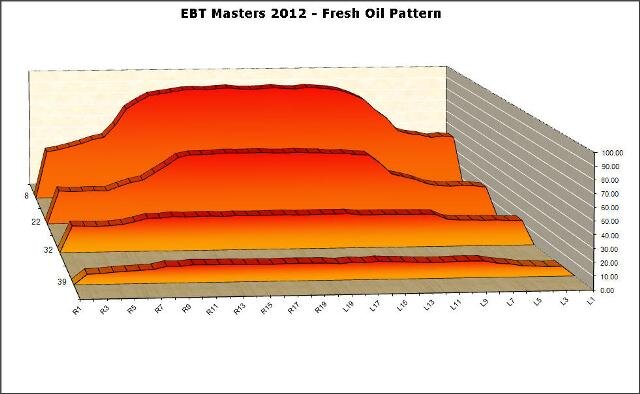
The oil pattern used for the event was Kegel’s Navigation Sport Series pattern The Turnpike. This pattern is almost flat from the midlane to the end of the pattern because the forward application consists of only 2L-2R loads. The shape from the mid portion of the oil pattern to the foul line is built on the return pass.
Here is a graphic of the fresh oil pattern with tapes taken at 8’, 22’, 32’ and 39’ (left side of the graphic is the right side of lane, right side of graphic is left side of lane – you are looking at these graphs from the pins perspective):
As we have known for many years, apart from the type of equipment being used, how the oil pattern breaks down is dependent on where the players play on the lane. When styles or rev rates are more similar, players tend to play in a more similar area of the lane, causing a much different type of pattern breakdown than when styles and rev rates are more diverse.
During the EBT Masters, all blocks consisted of 6 games with four players per pair, which equals 12 games per lane, plus ten minutes of practice. In comparison, a five person league would be 15 games per lane, plus 10 minutes of practice.
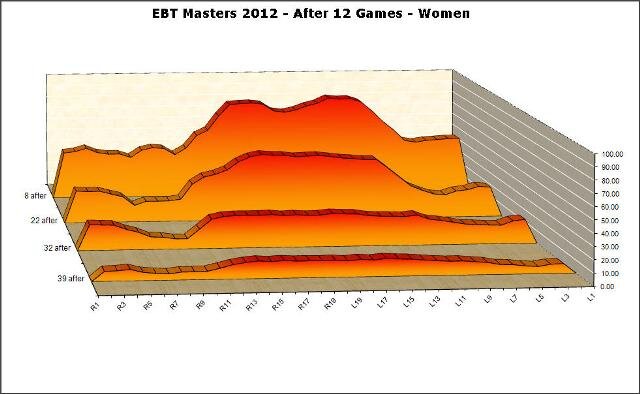
Here is the graphic of the EBT Masters pattern after one block of play by the women:
Here is the same graphic of the men’s pattern breakdown after one block of play:
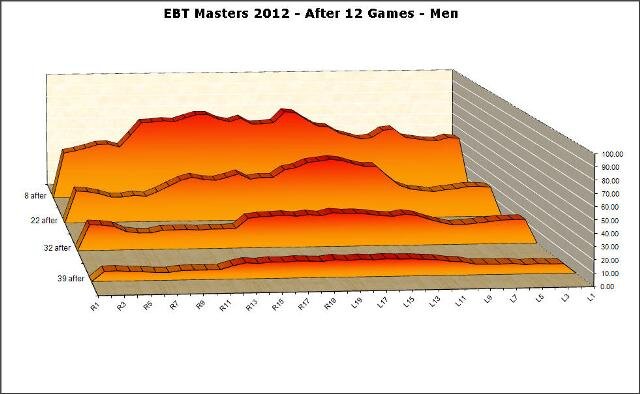
You can plainly see (I hope!) that the pattern breaks down significantly different when styles/rev rates are more similar versus when styles/rev rates are more diverse.
Here is a graphic of the before to after bowling between the men players and the women players at each tape distance, 8’, 22’, 32’ and 39’ (fresh oil is behind the after bowling tape):
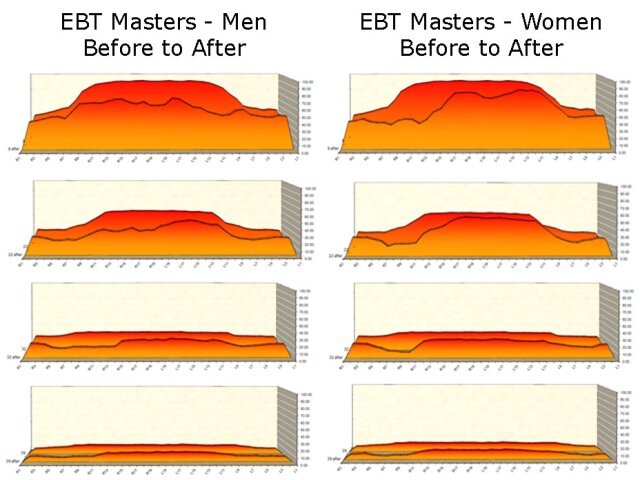
This graphic clearly shows how the lower rev rate women players “cliff” the oil pattern much more than the men players simply because the women play in a more similar area.
But now comes the interesting part of this breakdown pictorial and data article – the numbers.
What we often track is the oil depletion in percentages from that of the fresh oil pattern. As you will see, the percentages match up to the above graphics. What might surprise you is how much each group depleted. Common thought is high rev players deplete much more conditioner than lower rev players, but is it really so?
Here is the depletion by percentage on the men’s side of the event, with the square boxed area being a guide to show where the greatest depletion took place:
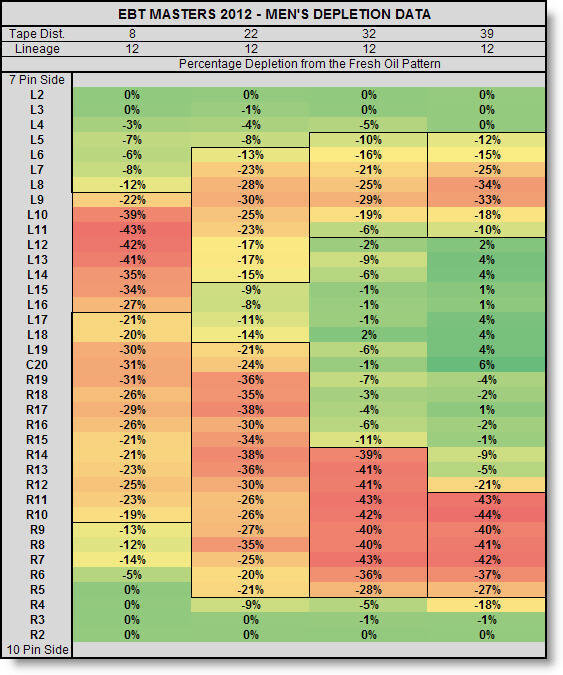
As you can see, the men took off about 40 plus percent at each distance throughout the oil pattern. After about 4 games of play, the right-handed players and the left-handed players came together in the fronts (8 feet) from boards L10 to L15, causing the greater depletion numbers in that area.
Before that move left, the right-handed men players continually moved towards the inside portion of the lane in their lay down area, yet they were still playing to near the same exit part of this 41’ oil pattern, between boards R5 and R11.
So how many units were left in the oil pattern after play? And what area of the depletion caused them to move left?
Here is a graphic of the before, on the left side of the graphic, and after tape data, on the right side of the graphic:
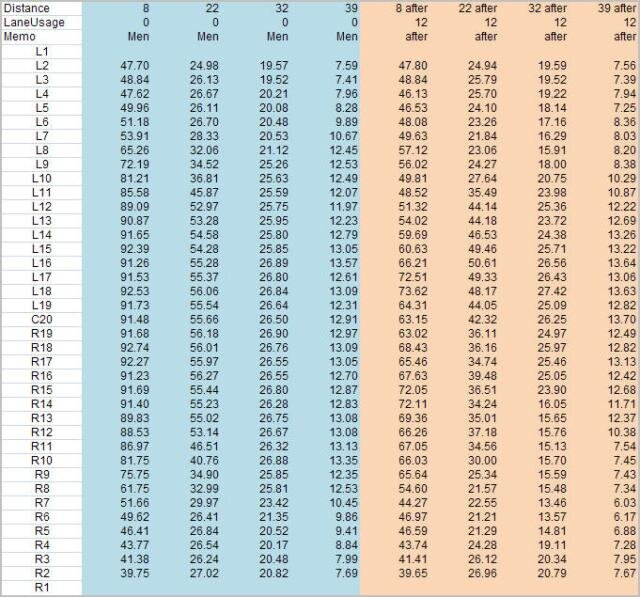
As you can plainly see, at the 8 foot distance of the pattern, after 12 games plus practice there was still over 60 units of oil on the lane. Only when the left-handers and right-handers lay down point became similar did we see the 50 unit barrier get broken, and that was only on a couple boards.
As we pointed out in the last feature article, the depletion towards the end of the oil pattern is what causes players to move left in today’s game, not “the fronts”.
Now the depletion tape data in percentages from the women’s side of the event, and as before, the square boxed area is a guide to show where the greatest depletion took place:
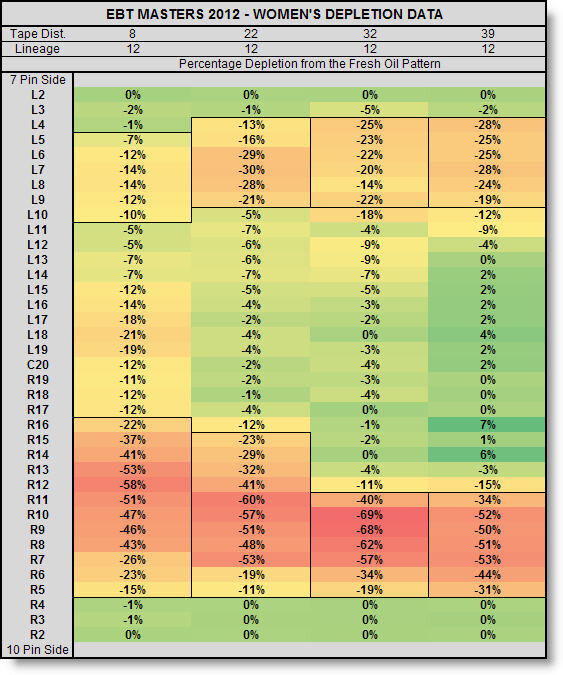
As you can see, because the women’s styles are more similar, as well as their rev rates, this group tends to play in a tighter area of the lane. This causes more depletion than when everyone is spread out all over the lane.
If you notice, the greatest percentage of depletion is at the 32 foot mark. The reason is, for the women players, all shots are starting to come together at this distance and there is more oil in that area than the end of the pattern - more oil equals more change.
Now let’s look at the same graph of the tape data in units of a women’s block after 12 games:
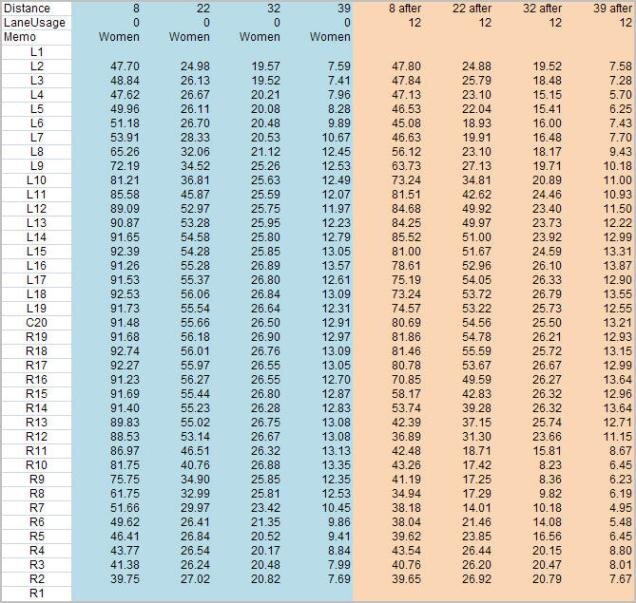
As you can see by this data, the women actually erased more oil off the lane in their lay down area (8’ tape) than the men did, yet still not enough to make the ball hook early, or make them move left because “the fronts have gone away”. The end of the pattern however is once again, another story.
The women have “ganged up” on the exit point of the pattern causing the 10-12 units of fresh oil at 39 feet become 5-6 units by the end of play. At 32 feet, the fresh 25-26 units of oil became 8 units after bowling.
This back-to-front oil pattern breakdown is the cause of the players moving left, not the old school front-to-back oil pattern breakdown we used to have before bowling ball track flare became a dominant force.
Also, to give you an idea how much oil is left on the lane by each group at each tape distance after bowling, here is what the tape data showed as an average amount of units at each tape distance:
- The men players at 8’ had an average of 54.35 units left on the lane, at 22’ an average of 31.73 units, at 32’ an average of 19.93 units, and at 39’ an average of 9.84 units.
- The women players at 8’ had an average of 58.79 units left on the lane, at 22’ an average of 30.79 units, at 32’ an average of 18.60 units, and at 39’ and average of 9.40 units.
Carrydown Data
This next graph and data might surprise some people, although it will make perfect sense once explained. I have been watching this in action over the last few years and it is something as lanemen we have no control over.
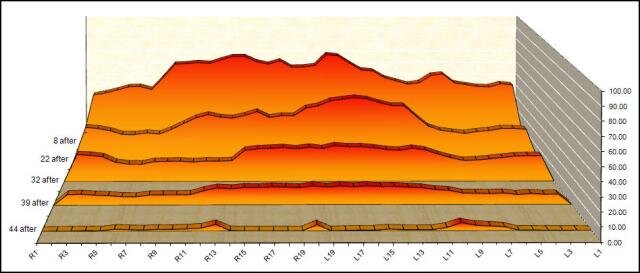
During this event we took carrydown tapes of the men and we will show the same percentage graphic as before with an additional twist, the carrydown tape in units. We do this so you can plainly see the exit points within the oil pattern of both the right-handed and the left-handed players.
Here is the graphic with carrydown tape visual (left side is right side of lane, right side of graphic is left side of lane – you are still looking at these graphs from the pins perspective!):
Here is the data, depletion percentages plus carrydown in units of oil:
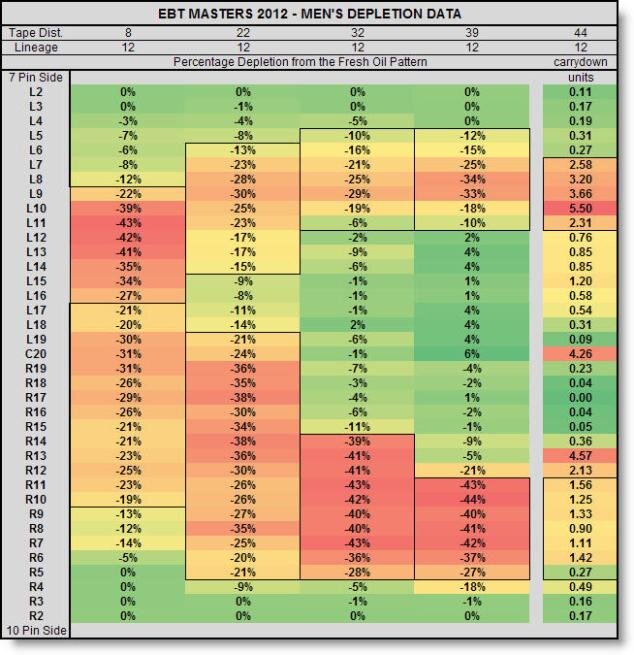
If we look at the blocks which show where both the left-handed and right-handed players played, you can plainly see how much carrydown is on the left side of the lane at the left-handers exit point of the pattern, yet not so much on the right-handers exit point. Why might you ask?
It is actually very simple once we think about it. We know that most spare balls in use today do not flare much, nor do they soak up oil like high flaring reactive resin strike balls that are in use today. So as right-handed players continually shoot spares on the left side of the lane, these non-flaring non-absorbent spare balls leave those long carrydown strips when they exit the oil pattern.
These ball types also do this when players are shooting spares on the right side of the lane, yet the carrydown tapes clearly do not show as much carry down at the end of the pattern.
The answer lies in the amount of high flaring balls going down the lane on the right side of the lane versus the left side of the lane.
Basically, the right-handers strike balls continually erase the carrydown left by the spare balls, but on the left side of the lane there is simply not enough high flaring absorbent balls going down the lane in that area to erase left side spare ball carrydown.
This lane condition change can be beneficial or detrimental to the left-hander. If these left side carrydown strips become dominate inside of target, like on patterns or conditions that allow the outside of the lane to play, it can give the left-hander hold area.
Yet if these spare ball carrydown strips become dominate left of target, or at their exit point, like many medium long or long patterns, it can result in a hang spot or reduced pin carry.
One more thing to be aware of with spare balls on today high volume oil patterns is how they can actually increase the amount of oil at the end of the oil pattern where high flaring balls are not traveling. We saw this happen often in the late 1980’s even where the traffic was when more aggressive coverstocks and larger core urethane balls were mostly in play. The end of the pattern after a couple blocks often had more oil on it than when fresh. It also shows up often in our after tapes in today’s game outside the track area (where most balls are being rolled), which can clearly be seen on the aforementioned data.
The reason for this today and back then is simple, by the mid to late 1980’s the amount of oil on the lane had to significantly increase in order to give the wood lane protection.
The by-product was more carrydown because more oil was being picked up by the ball in the fronts and re-deposited towards the end of the pattern and the dry back end.
This combination led to a great advantage after a few games by high rev big hook ball players as they could simply go around the carry down for return outside of target, and then the carrydown became hold area inside of target for this type player.
We see the same dominant style trend happening again today but for different reasons – this time it’s rapid depletion of the oil pattern from back to front and who can chase the oil inside of target on the lane the fastest.
Normally today, just like in the late 1980’s, it is often the high rev players who can create the largest margin of error and best angle for the best pin carry once the oil conditions are altered simply by bowling.
After reading all this you might be asking yourself what then is the best combination of ball versus lane versus oil that would minimize all this rapid lane condition change? That my friend is another article for another time…
Breakdown and Carrydown – Then and Now
We hear it all the time; “the heads are hooking”, “carrydown is happening quickly today”, “time to move again”, “my ball’s burning up – grab the fire extinguisher!”...ok maybe not the last one. But with the amount of oil needed in today’s environment in order to protect the lane surface and keep the modern ball from hooking into the gutter at the arrows, rapid and chaotic change is often the result. Even the best of players can get confused in today's game over the course of a few games.
In this month’s piece we'll try and give some sense of order to that chaos, but the first thing many will have to do is let go of what you’ve learned and experienced in the past – today’s pattern mutation, carrydown, and resulting bowling environment is different, very different.
Oil Pattern Change
The first thing we need to understand about oil pattern change is how bowling balls with different amounts of track flare change the oil pattern.
Prior to the 1980’s, when bowling balls did not significantly flare, the ball essentially picked up all the oil it could within the first couple revolutions - the first 8’ to 16’ of the oil pattern. It was in the head area where the oil pattern dried out the most, and after that, the oil pattern basically remained unchanged. Only once we got to a point of about 24 games per lane or more, did the rest of the pattern began to “dry out”.
As lower flaring more aggressive coverstock balls were introduced in the mid to late 1980’s, the amount of oil on the lanes had to increase, and oil pattern mutation changed because of that. John Davis' research showed the latter half of the oil pattern actually increased in volume during this era.
Back then the bowling ball picked up so much oil in the front part of the lane, it re-deposited some of that oil towards the end of the pattern, and then a lot more of that oil on the dry back-end. This is the time when carrydown quickly became a big problem.
When ball manufactures figured out that track flare increased the friction between the ball surface and the lane surface, bowling balls became unbalanced again - only this time it was by way of significant Radius of gyration (Rg) differential, It was then, oil pattern mutation, and the resulting ball motion, changed dramatically.
However, bowler "lingo" hasn't seemed to change as much as pattern mutation has, which can cause a lot of confusion and misinformation in our world of bowling.
Bowling balls with track flare (pictured below far right) pick up and erase oil off the lane with every revolution, causing a much different type of oil pattern breakdown. It’s not just the heads that breakdown down anymore, it’s the entire length of the oil pattern that breaks down, and it begins with the first ball thrown on the oil pattern.
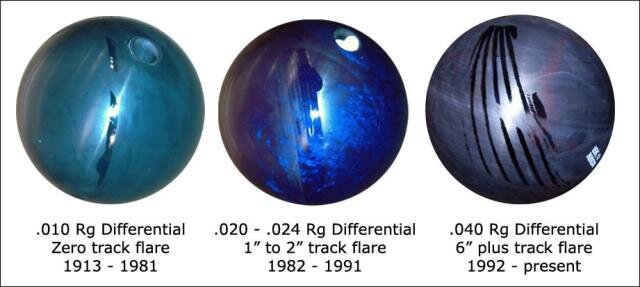
In our research, when starting with 80 units in the front part of the lane, our after tapes show that about half the oil has been depleted during a normal league session, which is 15 games per lane. We see the same trend in high level events bowling 12 games per lane.
That means there are still about 40 units left in the heads, but many in our industry still talk about the “heads hooking”. Anyone want to bowl on a pattern with 40 units on the outsides? Of course you don’t - your ball will never hook! So what causes the players to move left in today’s bowling environment? It’s more about the removal of oil from the mid-lane towards the end of the pattern.
Because of oil pattern taper, the mid and end part of the oil pattern has much less oil than the front part of the oil pattern. As the ball erases the oil off the lane, the modern “mountain range” like coverstock can easily poke through that thin film of oil towards the back part of the pattern. This causes the ball to read the friction much sooner there than in the front part of the pattern, and that is what makes players move left, not the oil pattern breaking down in the heads.
What this flaring ball pattern breakdown does to ball motion is simple – the ball simply slows down sooner and therefore hooks more. For high rev and high ball speed players, this pattern mutation falls right into their wheel house as finesse has been removed from the equation for them - its flat out every shot without having to worry about “throwing it through the break point”.
For rev challenged and slower ball speed players, this pattern mutation becomes more difficult to overcome – their bowling balls slow too early and begin to lose axis rotation too soon causing less room for error and decreased pin carry.
Of course this type player could switch to a less aggressive ball to combat the increased friction towards the end of the pattern, but then that type ball is more susceptible to carrydown. It’s a delicate balance for these styles of players.
Can the heads (the first 16 feet) still give the ball the perception it is hooking early? Sure they can, but in today’s bowling environment, more often than not it’s not because of the lack of oil.
With synthetic lanes it’s normally a side hill slope issue where the ball is thrown into a hill and trying to rotate up that hill. This topography issue will make the ball “check up” or move in the direction of the slope, which is more of a gravity issue, with a bit of friction thrown in for the banked curve affect.
For wood lanes or really old synthetics, it could be a severely roughed up lane surface, which therefore is a friction issue. However no reasonable amount of oil will significantly help in either of these situations simply because the depth of the scratches in the lane surface are deeper than the oil film – resurfacing or re-leveling the lane surface is the only solution to combat that kind of "early hook".
In short, bowling balls that do not flare tend to break an oil pattern down from front-to-back, and today's high flaring balls tend to break down oil patterns from back-to-front.
With high flare balls the oil pattern is literally getting shorter in the ball traffic area with every shot thrown, and by moving left we are increasing our launch angles to that area in order to give the ball more time to hook. Of course when missing inside of target, we are now in a "longer pattern" again so the ball holds pocket. This is why sport and challenge patterns get "easier" and scores often increase after a few games.
Carrydown
Carrydown is also much different by balls that don’t flare versus balls that do flare. Bowling balls that do not flare leave long three to four foot streaks of carrydown beyond the end of the pattern. Because the footprint of the bowling ball is so small, a shot hitting these long streaks of carrydown can all of a sudden make a pattern feel like it is much longer, mainly because to the bowling ball, on that single shot, the oil pattern has become longer!
With the amount in the middle of today's oil patterns, it is not uncommon for those streaks of oil to be in the 5-8 unit range.
As noted before, significant carrydown was not a problem in bowling until the 1980’s - especially towards the middle to end part of the decade. With the advent of ever stronger urethane balls, as well as increased dynamic weight blocks, an increased amount of oil was necessary as more and more customers bought these new balls.
And as players began sanding the covers and using drilling techniques to create more dynamic imbalance, more oil was needed to help protect the lane surface and keep these new higher friction balls on the lane, and of course, keep the customers who bought these new balls happy.
It was only then that we saw carrydown become such a significant part of the playing environment in so few games. Prior to that, when fairly dynamically balanced rubber and polyester balls were mainly in use, there was simply not enough oil needed nor used on the lanes to cause significant carrydown issues.
Sure there was carrydown after a few days of play, when lanes were not cleaned but once a week, but nothing like what happened in the 1980’s to tournament organizations like the PBA Tour, who cleaned the lanes every day.
Carrydown that is created with balls that flare however is much different, as well as how these much more aggressive and diverse internal dynamic balls allow players to play the lanes.
Meaning, because the amount of dynamic imbalance is much greater, this increases the range of available hook and allows players to play the lanes in a much wider area than in the past. When balls were more balanced and didn’t hook as much, everyone played the lanes near the same area, causing a much narrower spread of carrydown.
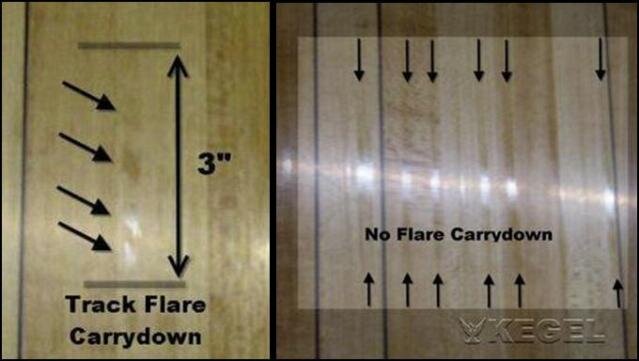
This dynamic imbalance causes track flare, and track flare creates what are called “bow ties” (where the flare rings come together) at only two points on the balls surface. Those two points are the only parts of the ball with oil on it that touches the lane every revolution.
The higher the differential Rg, the wider the track flare is, and the smaller those touching points are. This in turn creates random 2” to 3” strips of carrydown. For instance, using a 40’ pattern as an example, one track flare carrydown strip may be at 41’ to 41’ 3”, another small strip at 41’ 6” to 41’ 9”, and another one at 42’ to 42’ 3”, etc.
Therefore, when a fresh part of the modern flare balls surface comes in contact with these small strips of carrydown, ball motion is hardly affected at all. As these strips build up however, along with the longer three to four plus foot random strips of carrydown created by the many low flaring spare balls going down the lane, the back-ends will “tighten up” somewhat, but not as soon, or as much, as lanes did in the late 1980’s.
There was a very good article written by the PBA that represents what happened in the late 1980’s. It stated how after a few games of bowling the “fronts go away” and significant carrydown happens beyond the pattern at the balls exit point.
When this occurs, the player who greatly hooks the ball can move left and effectively “go around” the carrydown, creating an increased margin of area from that of a fresher oil pattern, and clean dry back ends. Low flare carrydown gives this style of player hold area inside of target.
On the PBA Tour in the mid to late 1980’s it was not uncommon for big hook ball players to average 20-30 pins a game more in the evening blocks versus the morning blocks.
Today however, even though high rev and high ball speed players can often struggle right out of the gate because their ball motion is too “skid-snappy” on the fresh, with today’s expeditious pattern breakdown, and high friction balls, high rev players can hit their stride much sooner. Today it doesn’t take more than a couple games to “smooth out” their ball motion from front to back.
In addition, as we stated before, carrydown at the end of the pattern with high flaring balls is not as defined as it was in the 1980’s, or when lower flaring urethane balls were in use. Therefore today there is simply not enough defined carrydown to go around and use as hold area.
High rev players tend to get their advantage today more from rapid pattern breakdown towards the mid and end part of the pattern, not carrydown. As most know, low to non-flaring balls today are most often regulated to shooting spares and therefore, those long strips of carrydown are more random across the lane surface - sometime you’ll hit a strip, and sometimes you won’t.
Remember, today you must think different. No longer are we using non-flaring balls on less than 5 milliliters of solvent based lane conditioner like we did in the 1970’s. No longer are we using low flaring balls on 12 milliliters of oil with massive carrydown like we did in the mid to late 1980’s. No longer are we bowling on lanes that are resurfaced every year like was mandated until deletion of the rule. No longer is levelness being maintained regularly like we did prior to advent of synthetic lanes.
The bowling environment today is much more varied, much more complex, and does not always make sense, or play “how it’s supposed to play”.
The best piece of advice we can give you is what the late great PBA National Tour tournament director Harry “Goose” Golden use to say to the players after every roll call; “bowlers, let your ball be your guide”.