
JJ's Blog - 2012 Team USA Trials
Saturday December 31st
The alarm went off at 2:45 am. It was an early one but it was easy to get up because I was heading to Los Angeles and then Las Vegas to bowl the Team USA Trials. I’m an early-airport-guy so I like to be at the gate like 90-120 minutes before my flight. Since my flight was at 7:30am, that would get me to the airport to about 5:00am. I got up a little extra early just so I could go through my checklists to make sure I had everything.
I got to the airport at 5am and had a quick and painless check-in and run through security. I sat in the Delta Sky Club for about an hour and a half and then went to the gate. We boarded on time and everything was going as planned. I was supposed to get to Los Angeles at 10am and was going to spend the day shopping and also going to this cupcake place in North Hollywood that makes the best cupcakes. I wanted to share some of these with a few of my friends that were going to be bowling the tournament next week.
For those of you that don’t know me real well I have a real passion for two things: Clothes and chocolates/cookies/pastries/any kind of sweets.
We sat at the gate until about 8am when the pilot got on and said that they were having trouble with the fuel pump and they were having the mechanics come out and look at the plane so at this time we didn’t know how long it was going to take. Mind you, this plane just arrived from LA about 6:30am, so all they were doing was basically topping off the tank and cleaning it up and it was heading straight back to LA.
About 8:20am they were letting people de-plane but told them to check in to the gate every 10 minutes to make sure all was ok because when the plane was ready, we were leaving ASAP. About 8:35am the pilot said we were ready to go and at 8:45am we were all boarded. Well, 5 minutes went by, then 10 minutes, and then at 9am the pilot got back on the PA and said that the fuel pump was still not working and we were going to be re-routed because he had no idea how long this was going to take.
Next thing I knew that I was getting rerouted to Atlanta and my itinerary said I was going to get to LA about 6:40pm!
Since this was New Year’s Eve, most of the stores I wanted to shop at were going to be closed by 6 and when I called the cupcake place they were going to close around 5pm or maybe a little later depending on business and they were going to be closed on New Year’s Day, so it looked like my window for cupcakes was closing. This had all of the makings of a really bad day.
I got to Atlanta and I got on standby for the 1:20pm flight that was going to get into LA at 3:20pm. Fortunately, I got on! Things were looking up all of a sudden!
I got to LA at 3pm (even better) but since I flew on standby my luggage didn’t make it. That wasn’t a big deal since I was staying right across the street from LAX. The lady in baggage service said my bags were on the way to Salt Lake City and then LA and they should be there tonight. Well since I was there early, I got to the rental car place and off I went. I left the airport at 3:30pm and I was only about 30 minutes from the cupcake store. Since the guy I spoke to said that they were closing at 5pm, I should’ve had enough time to get a few cupcakes.
I got to the cupcake place at 4pm only to find a note on the door saying that they had already sold out of their inventory and they would be re-opening on Monday.
Happy New Year! Well isn’t that just flippin’ great! Cupcakes…..denied!
Since I was a little peeved about that I headed to Beverly Hills to do a little clothes shopping. It was about 25 minutes from North Hollywood to the “Hills”. I stopped at this one store on Melrose Avenue and looked around but found nothing I liked despite the sale that was going on. I then headed off to Rodeo Drive and got there right at 5pm. With my good fortune continuing, I found out that all of the stores on Rodeo closed at 5pm on New Year’s Eve as well as Neiman Marcus on Wilshire Blvd., the one department store I REALLY wanted to see today. Stay Hot!
Fortunately Saks Fifth Avenue and Barneys New York were still open as they weren’t closing until 7pm. I spent about a little more than an hour shopping at both stores, but still found nothing I liked. This was turning into a really bad day. What made it worse is Rodeo Drive is also closed on New Year’s Day. I found that out last year as the Team Trials were basically on the same week and I flew out New Year’s Day last year just to find out Rodeo Drive was shut down. So far, no cupcakes for me or my friends and only about 15% of the shopping done that I wanted to get done. This day has definitely been “no bueno” so far.
Being now about 6:30pm and being quite hungry I grabbed a quick bite at the Grill on the Alley and went to go check into the room. I first had to go back to the rental car facility because when I looked closer at my rental agreement they screwed up the coupon I was using for a free day at the end of the rental. It just keeps getting better.
After clearing up that mess, I got to the hotel about 7:15pm and my luggage still hadn’t arrived. Stay red hot!
The one thing that I did have to look forward to was my good friend Missy Parkin invited me to a New Year’s Eve party hosted by her friend Scott Norton at his mother’s house. After the day I’ve had so far, I really needed something to go right considering I was denied cupcakes, didn’t do hardly any shopping and didn’t have any luggage. I didn’t want to sit in the room and think about how the day went, so I got showered and headed to their party which was about an hour from my hotel. I got there about 8:45pm and stayed until about 12:30am. I had a GREAT time as we talked, played some Password and ate some really good food. I got back to the hotel about 1:30am and lo and behold my luggage arrived! Woo-hoo! Things finally were looking up today. Well actually it was already Sunday, but it was a good way to sleep on a high note.
Sunday January 1st
I headed out about 8am to the Desert Hills Premium Outlets. It was about a 2 hour drive from LAX since the outlets were over near Palm Springs. I got there with no problems but I spent an hour there and still found nothing I liked. The bad part was the one store that I REALLY wanted to go see…….closed…..permanently. So far I was 0 for 3 on the shopping establishments, however I did get a nice ice cream cone at Haagen-Dazs which helped relieve some of my retail distress.
Since I found nothing there I made the 4 ½ hour trek to Vegas since practice session was on Monday. I was going to stop at the Outlets at Primm, NV but when I got there I figured that would be a really BAD idea.
Being New Year’s Day and around 3pm at this time, a lot of the people from LA who drove to Vegas for New Year’s Eve were heading home…….I mean…….A LOT of people were heading home. I could see at times on the southbound lanes on I-15 there were stretches where the traffic was backed up for miles. As I got closer to the exit for Primm where the outlets were at, I could see all the cars backed up on the road underneath the overpass and how they were backed up at the couple of gas stations on the southeastern corner of the exit ramp. I realized this would be a bad idea if I tried to get off so I kept going.
When I passed the overpass for the exit I noticed the southbound exit ramp (as well as the other three lanes) was backed up for about a mile and a half. It was a good call on my part since it probably would’ve taken me an extra 15 minutes to get in and probably another 20 minutes to get out, however that made me 0 for 4 on shopping. I hope the bowling goes better because the shopping has pretty much sucked so far.
I went straight to the City Center and looked around and then went to the Fashion Show Mall and then to the Forum Shops at Caesars’ Palace. I did find a nice shirt at the Forum Shops and a nice tie at the Fashion Show Mall. The shirt and tie were 60% and 70% off respectively so it was a big score to end the day. After grabbing a bite to eat at one of my favorite restaurants in the Forum Shops (Spago), I headed to Texas Station to go check into the room and call it a night.
Monday January 2nd
I woke up about 7am and spent a little time riding the stationary bike at the hotel because my right hamstring was a little tight. I felt it the night before at the end of the day and I thought if I slept on it, it would be a little better in the morning. Well……I was wrong. After about 30 minutes on the bike I felt a little better, so I went out to Panera Bread and got some breakfast. I noticed there was a cupcake store in the same plaza that Panera was in. They opened in like 15 minutes so I stuck around and grabbed a couple. They were pretty good. The day was starting off pretty well.
I came back to the room about 8:30am and then took a shower. I then left about 9:30am with Jessica Baker to go pick up Diandra Asbaty and her son Madden at the airport who was getting in about 10:30am. I made a quick stop to the Forum Shops on the way to pick up some unbelievable chocolate chip cookies at a restaurant called Max Brenner’s that I discovered the night before and then we went to go pick up Dee.
After picking her and Madden up I then made a quick trip to my good friend David Haynes’ pro shop to pick up a case of balls I had shipped there (Thanks Dave!) and then headed back to Texas Station to get ready for the one and a half hour practice session.
The practice session went well but the 90 minutes went really quick. Texas Station is 60 lanes and since we were bowling on 4 patterns over the next 4 days, they had all the patterns spread throughout the center in blocks of 14-16 lanes.
When you’ve got 13 bowling balls with you for all different patterns and you’re trying to practice on all of the patterns, it takes a little bit of time just switching bowling balls from one bag to another and then walking to one end of the house and then back to get bowling balls for another pattern and then walking back, etc. You lose quite a few minutes of practice session just walking back and forth in a 60 lane center and switching equipment from one bag to another.
I felt pretty good on all of the patterns though. Afterward we had orientation and then I went back to the Strip for some shopping and some food. Tonight was back to City Center where I had a nice Mushroom Pizza at Wolfgang Puck’s Cucina at the Crystals Mall. I found a couple of shirts I liked but they didn’t have my size, so that made me at about 2 for 7 now on shopping malls. I’m only batting a little under .300, but not too bad. At least that’s good on my wallet. The tournament begins tomorrow so I headed back to the room about 9pm and was out by 10pm.
Tuesday January 3rd
Today the tournament begins. We are going to be bowling on the 39’ Seoul pattern. This week we’re bowling on all WTBA patterns.
The pattern schedule will be as follows:
Tuesday: 39’ Seoul
Wednesday: 47’ Paris
Thursday: 34’ Stockholm
Friday: 45’ Mexico City
The Team USA Trials is also a little different this year in a couple of ways. First, we’re only bowling 7 games a day instead of last year’s 9. Also, this year’s champion will be determined by points and not total pinfall. Basically if you lead the squad by total pins, you get one point. If you’re second in total pinfall you get 2 points. If you’re third you get three points and so on down the line.
So, the person with the LEAST amount of points over 4 days is the Team USA Trials champion, the 2nd least amount of points is 2nd, and so on. It’s supposed to reward the player who is the most consistent on all 4 days which is definitely a trait of a great bowler: Versatility. The player who is really good at one pattern but mediocre/sub-par on another will definitely stick out in this format.
The day really wasn’t a real good day. My ball roll didn’t really match up too well and I was slow on reading a few transitions. Texas Station has a little more early hook than the lanes at Sunset Station (which has hosted the Team USA Trials for the last 3 years). Since my ball roll reads the fronts a lot naturally, this isn’t a real good combination for good ball motion when they break down, which started for me in game 3. I felt like I threw the ball well overall, but being a little behind on transitions kind of hurt me. I thought the scoring pace was going to be a little lower so I wasn’t quite as aggressive when I had to move inside the track and needed to start opening up the lane a little more. I was trying to “trap” the ball just inside the track from games 3-5 instead of just moving deeper and really trying to open it up. I only went +68 for 7 games which put me in 39th place for the day, especially not good considering I was +72 for the first 2 games.
I figured one point for every year that I’m old will not be acceptable for the rest of the tournament. I was kind of depressed as I wasn’t sure I’d be able to make up that many points considering this is the first time they’ve used this points system. I went back to the Forum Shops and drowned my sorrows on another Smoked Salmon Pizza at Spago and more cookies at Max Brenner’s. I knew though……..tomorrow was going to be new day.
Wednesday January 4th
Today we were bowling on the 47’ Paris. I started out the first game with a pretty good line to the pocket but I think my ball was still burning up a little quick and not getting into a roll down the lanes as I never missed the pocket for 218. I think the Rapid Fire Pearl I was using was probably flaring a little too much combined with my ball roll reading the fronts too much. I tried switching balls to an Anarchy and that wasn’t much better ball motion-wise though I did manage to shoot 230 somehow. I then switched to a Mission X in game 3 and since that flared a little less but still had a strong cover it got through the fronts and rolled through the pins much better. Now I was able to do some striking.
From here I was just trying to chase it left and stay ahead of the moves. The 6th game I was getting a little too deep as I was starting to get the big wet-dry from side to side as I was shooting a 200 game which wasn’t very good with par being around 225. I tried to move back right on the fill ball and use loft so I could keep the ball on line as I knew that if I stayed where I was at I was only going to shoot another 200 game which wasn’t going to cut it at the scoring pace that was set. It looked like it would work based on the fill ball, I just needed to move a little farther left with the same Mission X. Lo and behold, it worked! 268 to finish the day!
That put me at 7th place for the day which moved me up from 39th to 16th in the standings. Things were looking up for tomorrow for the short pattern, which has either been really good or really bad for me the last few years in this tournament.
Went back to the Crystals Mall at City Center and grabbed a pizza and some chocolates to take back for later. I then went to use Kaitlin Mayall’s ball spinner to do some ball work (Thanks Kaitlin!) and then called it a night.
Thursday January 5th
I brought two urethane balls with me to combat the short. I figured if anything it will give me more control and get me around the pocket until I see how the scoring pace is going to be and then go from there. It sounded like a solid game plan going in.......however……..then we started bowling, haha!
I think the combination of the early roll of the urethane balls, the early hook built into the surface and my roll which reads the fronts too much as it is…..was a bad combination. I shot 203 the first game which wasn’t terrible but not up to pace. I had trouble keeping it on line when I went direct but the ball had trouble cornering when I gave it some room.
After 4 frames of the next game only hitting the pocket twice with one open, I realized that urethane wasn’t cutting it. Since the loft worked out really well the last game yesterday, I thought I’d try that again. It made sense since it would help eliminate some of the early roll my release naturally gets since the ball won’t hook in the air, haha!
I switched to pretty strong bowling balls and between the same Mission X and Rapid Fire Pearl I used yesterday, I shot +204 the last 5 to vault me to 6th place in the standings for the day which shot me to 4th place overall.
It was a good day so it was time to back to the Strip at the Forum Shops at Caesars. I went with my good friend Katie Thornton to have a meal at the Cheesecake Factory and more of those good cookies at Max Brenner's and walked over to the Bellagio and bought some really good pastries at the Jean Philippe Patisserie. I brought those back to the hotel and Katie and I shared the pastries with Kaitlin Mayall and her Dad while she let me use her ball spinner again (Thanks again Kaitlin!) to prepare surfaces for the Mexico City pattern the next day.
Friday January 6th
This pattern is on paper one of the most difficult in the WTBA series. It has the potential to be pretty ugly so I felt like I kind of needed to play smart on the fresh and not try to “swing for the fences” so to speak. I was fortunate shooting 256 the first game out of the box. I threw a Red Mission playing between 10-13 really straight and had a good look. I also had the good fortune of tripping a 2-pin, a Brooklyn and a “trip 3-9” for a 5-bagger, but I took every one of them because goodness knows I might need them later. Sadly, I was really going to need them later.
I shot 196 the next game which I was still in good shape but as we made the turn to the low end I could see that there actually was some ball reaction developing between 20 and 25. After 4 frames of really bad ball reaction (and seeing some strikes from a fair amount of other people) I knew it was time to move inside. I went to the Mission X and it was the right ball but it took me a few frames to get lined up and combining that with another open frame I shot 176. I got lined up and shot 223 the next game but the next few games were a struggle. I was slipping on the approach which was resulting in a half a game of adjusting slide soles and heels and I was also seeing that my ball roll really wasn’t right.
I’m a fair amount up the back of the ball and I see that I needed more tilt and more rotation but with a softer hand. All the guys that were bowling well had that. I can get more rotation, but my tilt is still low so that makes my ball read earlier which forces me farther left which is part of the problem since I’m already about 5 boards too far left to begin with. I can get more tilt, but not with a soft enough hand. My ball roll forces me farther left (because it rolls sooner) so I get less hold when I miss in and when I get it to the right (since it burns up earlier) it doesn’t roll through the pins the right way thus it doesn’t strike as much. I’ve been fighting this all week, but it was magnified today on this pattern.
It was a disappointing way to finish with (2) 170 games in the last 3 games and that put me 35th for the day and 6th place overall. From here I needed to get picked for the Team since only the top 3 spots were automatically on the Team.
Fortunately, I got picked but I realized that I needed to work on developing this softer hand with more rotation and more tilt. That’s going to be one of the first things I’ll be working on when I get home. We had Team USA Orientation that night and then I went to get a bite to eat afterward even though it was near 10pm at that point. Overall, it was a week with some ups and downs but in the end it all turned out good. Looking forward to a good year on Team USA!
Saturday January 7th
I took Diandra, her son Madden, Jessica Baker and Jazreel Tan to the airport in the morning and then it was back to the hotel to check out and then back to Los Angeles for a couple of days of R & R. I met with Missy Parkin for lunch at South Coast Plaza in Costa Mesa (nice call on the fish tacos at Wahoo’s!) and then went to Beverly Hills for some shopping on Rodeo. I didn’t buy anything at either place, but it was just good to walk around and relax. It was a reasonably low-stress day ending with a nice juicy “Double-Double” cheeseburger at In-N-Out.
Sunday January 8th
I met up with my cousin who lives in Santa Monica in the morning and we spent most of the day together with her and her boyfriend. We did some shopping and lunch at the 3rd Street Promenade, watched the NFL playoff games at their house and then went to a few cupcake stores that were right nearby. Los Angeles is big on cupcake stores….my kind of town.
Speaking about cupcakes, I wanted to go back to the cupcake store that I wanted to go to originally the weekend before that closed early. I saw on their website that they were open until 8pm on Sunday. I thought to myself……Perfect! I’ll get there about 6pm and I’ll get some cupcakes to bring back. I said goodbye to my cousin about 5:45pm and then got to the cupcake store in North Hollywood about 6:15pm.
I get there…….and they’re closed! There’s a sign on the door saying that they close at 6pm on Sunday, but their freaking website says they’re open until 8pm on Sunday.
Ironically, this trip ended the exact way it started. Fortunately I bought a few cupcakes from one of the other stores in Santa Monica so I had some cupcakes to take home for my friends, but not the ones I REALLY wanted. It was then off to the airport to catch the 10:50pm red-eye flight and back to work on Monday morning.
At least the bowling part went well. :-)))

Fine Tuning your House League Pattern
This is the time of year when new seasons have begun and pattern decisions are being put to the test. You’ve made your choice, laid out the pattern, and now things aren’t going exactly as planned. You’ve verified that your machine is in perfect working order, now what do you do?
Once the bowlers take to the lane, lots of problems can come to light. If a majority of your bowlers are experiencing the same problem, it may be time to make adjustments to the pattern. Common complaints could be: too much carrydown, back ends too strong, not enough hold area, heads hooking, no swing, track dries up too quickly, or no taper. How do you trouble-shoot your pattern and fine-tune it to get the ideal conditions for this year’s league? Here are some tips for common problems with patterns which should help you make proper adjustments.
Too Much Carrydown
Too much conditioner at the end of the pattern can cause excessive carrydown. This can be rectified by not loading as far down lane on the forward pass or increasing the machines buff out speed, which decreases the amount of conditioner on the lane towards the end of the pattern.
If your machine has our reverse brush drop feature, this is another fine tune adjustment you can make to bring the amount of conditioner farther back towards the foul line, or limit the amount of conditioner towards the end of the pattern. Poor cleaning can also cause carrydown issues. This can come from an incorrect mixture of cleaner or improper machine performance. It can never hurt to double check to make sure your machine is cleaning properly. To do this, perform a clean-only run on a few lanes and see if all the conditioner and cleaner are removed from each lane.
Back Ends Are Too Strong
Lengthen the pattern or create more taper to tone down the back end reaction. Tamer back ends provide predictable ball reaction and make spare shooting much easier.
Different types of cleaner provide different back end motions; this is another “condition” adjustment you can try. You could also experiment with a weaker ratio of cleaner to water mixture, but be careful; there is a fine line between getting the lane clean, and not clean enough.
Not Enough Hold Area
Make no mistake about it, as much as bowlers think they like swing area, what creates the highest scoring environment is hold area. The hold area is created by the amount of shape in the pattern towards the end as well as some friction outside of target. Without both, it is just about impossible to have the other.
If your lane machine has reverse oiling capabilities, starting the reverse oil loads farther down the lane will help increase hold without fear of getting too much conditioner at the end of the pattern, which as we said before, can cause carrydown issues.
Lane topography can increase hold area, a side slope away from the pocket at the break point area for instance, but topography can also minimize hold area if the side slope is towards the pocket at the break point area. Before you start searching for hold area by way of the oil pattern, get to know your lanes to make sure your lanes will allow the type of shot you are searching for.
Heads are “Hooking”
The amount of oil in the lay down area, or a lane surface in poor condition, can cause the heads to hook. In both instances, the lane machine should run slower in the heads, 10 or 14 inches per second on Kegel machines. The slower the machine travels, the more brush strokes per distance traveled which increases the amount of conditioner to any one area. This is better controlled on the return oil due to the direction of travel and the rotation of the buffer brush. Apply oil loads during the return travel that finish closer to the foul line (but not less than 4 feet).
Another thing that will give the perception that the heads are hooking is when the lay-down point of the bowling ball is on the upslope of severely depressed heads. No amount of oil in the world can fight a significant gravity influence towards the headpin in this situation.
No Swing Area
The amount of oil on the outside boards or adverse lane topography can affect swing area. Reducing the length of your oil pattern, or decreasing the amount of the applied oil on the outside boards, will increase the amount of swing area. But be cautious, even though bowlers like to swing the ball, your lanes just may not allow that to happen with the success you, and they, are looking for. Just know, however, our highest scoring patterns are the ones where most styles can go up the lane and have hold area.
A recent example is the 2011 WTBA Women's World Championship where many scoring records were set on the 47' Paris oil pattern. Note: the 2011 version of the Paris pattern tapes out at 4.2:1 at 22', so be aware if you try and use this in your Sport Bowling league.
Another example of a high scoring pattern is our Kegel Navigation Challenge pattern Route 66. This 45’ pattern routinely outscores many higher ratio shorter recreation patterns.
If you have topography issues, or side slopes that go towards the outside portion of the lane, the pattern should be adjusted by stacking up your inside oil line, applying conditioner farther towards the end on the forward and reverse passes, and allow the bowlers to play a more direct line to the pocket. This should create more area where ball reaction is concerned on a longer pattern.
Another topographic issue that can decrease swing area is depressed heads. Depressed heads cause the ball to quickly lose energy which makes down lane recovery (swing area) very difficult no matter how little oil you apply to the outside boards, or how much you apply to the heads.
Track Area Dries Up Too Quickly
Many bowling centers do not apply enough oil to the mid-lane track area on both the forward and return passes. Applying oil to the track on the return pass can help provide more longevity and stability without drastically affecting the forward oil readings and ball motion at the end of the oil pattern. Another adjustment is widening your pattern slightly. As balls hook more, the track area is becoming wider and farther down-lane. Take your middle loads and try widening them out a board or two and see if this adjustment gives you more longevity to your track area.
No Taper to My Pattern
The easiest way to create taper in the pattern is to make adjustments to your lane machine’s drive speeds during the forward pass only. Increasing the drive speeds on your forward run towards the end of the pattern will apply less oil in that area which increases front to back taper.
If your machine has Kegel's reverse brush drop capability, dropping the buffer brush farther back into the pattern on the reverse pass can also give you more front to back taper within your pattern.
Conclusion
With these tips, tricks, and troubleshooting techniques, you should be able to tweak your pattern and make it playable for most of your league bowlers. However, even with excellent lane conditions, you may still not be able to please everyone. If you reach the point where the majority of the bowlers are happy and bowling well, then it may be time to leave the lanes alone.
As always, it is important to remember that the pattern is not the only factor contributing to your lane conditions. You are competing against the lane topography, the other bowlers who share the lane, and Mother Nature herself. With topography, we cannot stress enough how important it is for you to know the shape of your lanes. When that information is known, finding that right oil pattern for your center is much easier. Without it, it's just a trial and error exercise.
Bowling is about skills and technique, but it is also about versatility and one’s ability to read the lanes and make adjustments to account for those factors which are out of your control.
Warning: Managing lane conditions may result in the loss of sanity. If it occurs, please contact our free Kegel Tech Support at (800) 280-2695 and we’ll help you get it back.
Oil Pattern Depletion
Oil pattern depletion (breakdown) is much different with today’s high flaring balls versus the low flaring balls of the past. Oil pattern depletion also happens much quicker and much more with today’s bowling balls.
When bowling balls had essentially balanced weight blocks, or differential Rg values of .010” or less, the ball basically rolled over the same place every revolution. When this happens, the ball picks up all the oil it can within the first couple revolutions and oil pattern depletion only happens in the head area, or only in the first 16’. The rest of the oil pattern remained intact, but not with today’s high differential Rg weight blocks.
Most bowling balls today have differential Rg values in the .040” to .060” range. The maximum differential Rg value is now .060”, according to USBC specifications. These high differential Rg values create a dynamic imbalance within the bowling ball. When a ball is drilled to maximize this imbalance, this causes track flare and results in the bowling ball rotating on a fresh part of the cover every revolution. This erases oil off of the lane every revolution, causing oil pattern depletion throughout the entire length of the oil pattern, instead of only the heads as when bowling balls were more dynamically balanced.
Kegel performs many tournaments every year and one of the things we are constantly measuring is oil pattern depletion. We do this because the main goal for the laneman in tournaments is to try and create a playing condition that has the best opportunity for fair play; in other words, give as many styles a chance as possible. If massive oil pattern change continues to make this task difficult, we need to find ways to help Lanemen do their job better.
How much oil is erased with today’s balls?
During a recent seminar tour, we got a group of bowlers’ together and measured oil depletion after 10 minutes of practice, and then every three games of play. At the end of this test, we had 9 games per lane. To put it in comparison, a 5 person team bowling a 3 game league has 15 games per lane.
To follow are the results of that test:
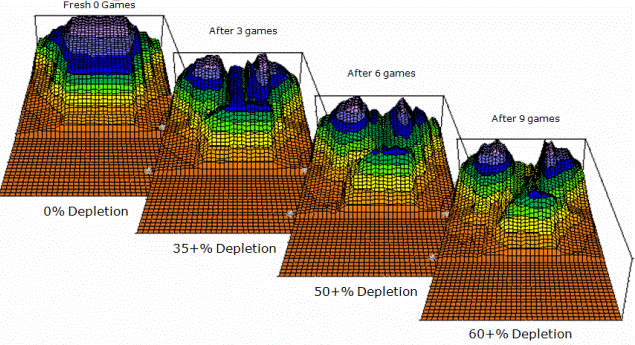
The greatest amount of depletion occurs during the early stages of play because the ball creates a larger footprint within the oil pattern. In the head area, there were 80 units of oil before bowling. After 9 games, there were about 35 units in that same head area. The move left by the players was not the lack of head oil; it was the ‘spark point’ being reached in the mid lane and the back part of the pattern causing the ball to hook more and forcing the players left.
Now we show why this massive depletion of the oil pattern can affect fair play. The following graphics are a comparison on how different styles of players break down oil patterns.
The event was the 2009 European Bowling Tour Masters featuring the top 16 players, men and women, from the 2008 European Bowling Tour point list. Both groups had 3 bowlers per pair and they played 8 games. So the lanes had 12 games per lane plus 10 minutes of practice on them. There was also an equal amount of lefties and righties on both the men’s side and the women’s side, and every player bowled on each pair of lanes twice within the block, so it was a very good comparison.
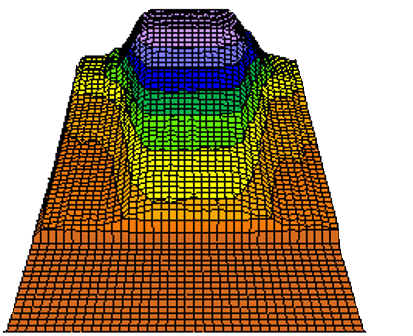
The fresh oil pattern was 44’ in length with the same pattern used for both the men and women. Below is the graphic of that pattern:
The first depletion example is the women’s side of the event. They were bowling by themselves and as with most lower rev players, because of the decreased motion on the back end, these type players tend to play in the same area on the lane and in a tighter line to the pocket.
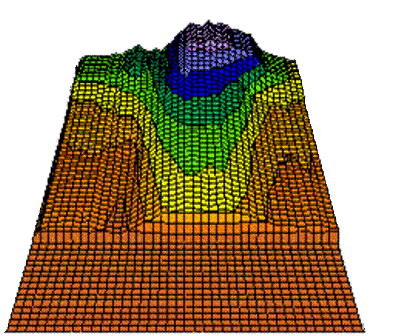
As you can see in the above graphic, the women essentially started at the slope of the oil pattern, the rise from the least amount of conditioner to the greatest amount of conditioner, and broke the oil pattern down in a very logical manner. When oil patterns are broken down this way, scoring pace can increase greatly.
The men played on lanes right next to the women players. Here we had players like Jason Belmonte, Osku Palermaa, Dominic Barrett, and several Scandinavian players with fairly high rev rates. Below is the graphic of how the men broke that same fresh oil pattern down.
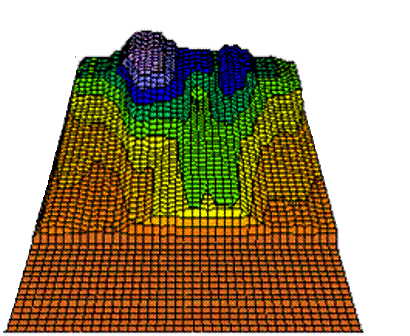
Because of the great amount of potential hook we have in the game today, and especially with the higher rev players, the slope of the oil pattern is not always followed as it used to be when bowling balls hooked less.
What is interesting, is the area where the bowling balls roll throughout the pattern, both groups depleted the same amount; over 60%. Testing has shown depletion is not significantly greater with higher rev rates, depletion is only more spread out. Towards the end of the pattern where all balls meet, both groups depleted the same amount, over 60%.
Here is the tape data and depletion percentages at comparable distances throughout the above patterns.
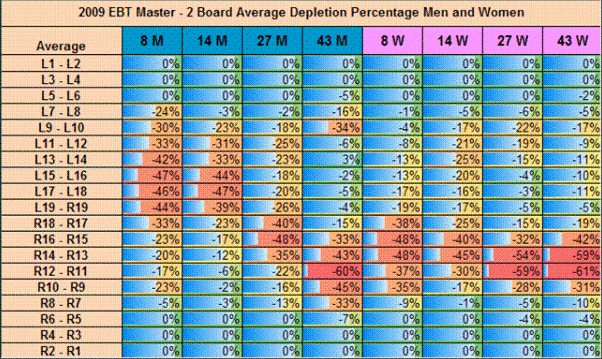
Most bowlers still believe “the heads” breakdown the most and therefore affect ball motion the greatest. This was the case with balls that did not flare, but that’s not the case with balls that flare.
When flaring balls are rolled over an oil pattern, the oil pattern is erased near the same amount,percentage wise, from the lay down point to when the ball exits the end of the oil pattern. The most oil is depleted where the footprint is the greatest, but at each distance, the percentage of depletion is essentially the same.
Once the oil pattern is depleted enough for the ball to reach the “spark point” in the mid lane and back part of the pattern, players start moving inside. And they move until the modern practice of lofting the gutter cap comes into play.
If depletion continues to happen at such a rapid rate, lofting could become the modern way to play the game. After all, we have yet to see a ball hook while it is in the air.
The Weather’s Changing…Are Your Lane Conditions?
It’s that time of year again. Leagues began towards the end of summer, the pattern gets tweaked, and everyone starts to get back into the swing of things. Everything is going great and then boom, the weather gets colder and all of a sudden things are different. Then comes the question every manager and mechanic has heard more than they can count - "What happened?"
The products that a bowling center uses to create optimal lane conditions; like lane machines, conditioners, cleaners, and even the lanes themselves, are all physical in nature and therefore temperature dependent. So as temperature changes, the properties and performance of all those products will change as well.
So how do changes in those physical properties show up in the bowling center? They show up in lane machine performance, oil pattern differences, lane topography changes, and of course, what the bowlers feel and see in ball reaction. As the temperature of the conditioner gets colder, the viscosity, surface tension, and density all increase which not only affects ball motion, this also affects different lane machines in different ways.
For this article, we will discuss these changes and offer advice on how to minimize the effects of cold weather on lane conditions. We will focus on the products used to condition the lanes, and in the next issue, we will move on to discuss the topographical changes the lane surface goes through as the climate changes.
Lane Conditioner
In early 1997, we conducted several tests to see how much conditioners changed when the temperature was raised or lowered. What we found was eye-opening. The viscosity of some conditioners changed 2 cps (centipoises) for every 1° F of temperature change. That means if you start with a 20 cps (viscosity) conditioner and the temperature drops from 80° F to 70° F, the viscosity of that conditioner would be 40 cps.
This is not true for all lane conditioners. Some only change 1 cp for every 2° F of temperature change. That is only 25% the change as some of the others, but regardless of how much they change, it's important to know that all of them do.
To minimize this change, look for a conditioner with a higher viscosity index (VI). VI is a way of assigning a value to a conditioner’s resistance in viscosity variation as the temperature changes. The manufacturer of your conditioner should be able to give you this value and guide you accordingly.
Lane Machines
For centers using wick technology lane machines, if the conditioner or lane machine is not kept at normal room temperature, or if stored near a cold wall, the oil will “thicken” and impede the wicking action which reduces conditioner flow onto the lane. As it gets colder, the capillaries in wicks shrink, also restricting flow. Therefore the oil pattern that you started out with at the end of summer might not be the same oil pattern as the weather gets colder.
For centers using Kegel Sanction Technology™, like the IKON, FLEX, and Kustodian line of lane machines, temperature decrease will not affect the output of conditioner like it will in a wick machine. However, if the conditioner gets colder, what you may see is the pressure in your oil pump gauge increase. Fortunately, this does not change the output of conditioner; that’s the beauty of Kegel’s Sanction Technology.
For Sanction Technology lane machine owners, Kegel’s Steve Cross suggests the following when seeing slight pressure fluctuations:
- DON'T PANIC! Expect pressure fluctuations because it is normal with temperature changes.
- Do not change the tubing (pressure regulator). Many people will try to put in a shorter tube to decrease the pressure, but this is not necessary. We have designed a large margin for psi and still have the machine perform as intended. Pressure alone does not affect oil output in Sanction Technology machines.
- Do not adjust the fluid metering pump to adjust pressure. Adjusting the fluid metering pump will increase and decrease the amount of conditioner output (volume).
- Get the machine out early, turn on the oil pump motor, and let it run for about 10 minutes. You should see the psi gauge go back to normal.
Our tech support department receives many calls this time of year with temperature related concerns and we recommend the following no matter what lane machine or lane conditioner you are using:
- Keep the lane conditioner in a temperature controlled environment. The office, front desk, or wherever the temperature is most constant.
- Keep on top of your chemical orders; try to place orders a few weeks in advance to give the chemicals a chance to “acclimatize.”
- Keep the lane machine in a temperature controlled environment so the machine functions properly. If that is not possible, look for other solutions like an electric blanket, packing blanket, or a space heater to help keep the machine warm.
Ball Motion
As we stated before, when conditioner gets colder, the viscosity, surface tension, and density increase. With the increase of these physical properties, more resistance is created on the bowling ball as it rolls through the conditioner. This, in return, usually causes the bowling ball to slow down faster which means it will hook a little more.
Another byproduct of colder weather is the conditioner tends to “stay in place” more which reduces carrydown and therefore, helps the backends stay stronger longer.
Not every bowling center is affected by outside temperature changes but if yours is, our technicians have a couple tips you can employ:
- If when the weather gets colder you notice the bowling balls are hooking more, increase your oil pattern by one foot. This will help bring back the hold area you had when the season began. Once the weather warms back up, decrease the pattern length back to what it was when the season began. Note: Wood lanes with overlays can change in shape which may increase this affect; read about "Changing Lanes".
- If you find temperature changes tend to affect your lane conditions, try to use a lane conditioner that is more resistance to temperature change (higher VI index). Kegel’s Offense HV (for Sanction Technology machines only) is such a product. Offense HV was created when Kegel was entrusted with lane maintenance for the PBA Tour. It was designed to minimize the difference in ball motion from the weekly competition to the TV Show. The TV Show uses many very hot lights that are not present during the rest of the week’s competition. To this day we use Offenses HV when we perform tournaments in venues with less than ideal climate control.
Keep in mind there is no magic lane conditioner or oil pattern that is best for every lane surface or bowling center. Finding a conditioner and oil pattern that is best for your center takes some research and a lot of patience. However, as a Kegel customer you have something going for you; award winning, industry leading tech support by Kegel’s 24/7 Tech Support. Best of all, it’s only a phone call away, and it’s free!
Dual Oil Patterns are here! What’s next?
The European Bowling Tour has recently announced it will have two tournaments in the 2009 schedule where players will compete on dual oil patterns. Following the lead of Ronald Dol and Luc Jensen, organizers of the EBT Hammer Bronzen Schietspoel Tournament which will use dual oil patterns for the third year in a row, the Brunswick Aalborg International will also be contested on dual oil patterns for the second straight year.
Although dual oil patterns have been a mainstay of international championship competition for the last several years, most other high level singles events still use a single oil pattern, but times are changing.
Even the 2008-09 PBA Tour season is testing the waters with an event that utilizes six different oil patterns and another event will employ dual oil patterns on each pair during the PBA Match Play Championship in Norwich, CT.
The format of the recently concluded PBA National Bowling Stadium Championship followed past Foundation Games, the WTBA World Ranking Masters, the EBT Masters and the ETBF European Champions Cup.
In all those events, one qualifying block is played on a short oil pattern and the other qualifying block is played on a long oil pattern. During the match play rounds, all games are played on pairs where every left lane is conditioned with the long oil pattern and every right lane conditioned with the short oil pattern.
How did this all come about?
There are two major reasons why dual oil patterns came into existence. One seemingly clear but not so obvious reason is the technological advancement of the modern lane machine. In the not so distant past, conditioning bowling lanes was done by hand or by machines that could only condition the lane. The challenge however was the time consuming cleaning of bowling lanes. Today’s combination lane machines can consistently condition and clean a bowling lane in less than two minutes making it possible for dual oil pattern events to become a reality.
The other and most significant reason is a group of people came together with a vision and were not afraid to depart from status quo. In the year 2000, then WTBA President PS Nathan called for a World Symposium in Malaysia to address many of the perceived problems related to the sport of bowling.
Out of that symposium, which included the likes of Sid Allen, Tom Kouros, John Davis, Len Nicholson, the late Bill Wasserberger along with other highly respected people in bowling, the WTBA Technical Committee concluded “that a single oil pattern format was unfair, since it overly favored a particular style of play regardless of how the lane was oiled.”
During that same symposium, the WTBA Technical Committee also felt the question of “who is the best bowler” needed to be examined further. Through much discussion and digging deeper into the question, the WTBA defined what they feel are the most important traits that should make up a World Class bowler.
The committee agreed to and created the synonym V-PARK which stands for; Versatility, Power, Accuracy, Repeatability and Knowledge. There was one trait however that was at the very top of every members list, Versatility.
The Technical Committee felt that “the ability to bowl over a wide range of conditions elevated a player from one of quality to that of greatness” and therefore led to the conclusion “that WTBA’s present oiling procedures were not conducive to identifying and rewarding great players, but instead only identified specialists.”
Then committee member Craig Woodhouse suggested the concept of multiple oil patterns and it was unanimously agreed that this would be the standard for all future World Championships.
From where does it go from here?
There is no question that every winner of a dual oil pattern event has garnered the respect of their peers for that week’s competition. It would be reaching pretty far for anybody to say “so-and-so” only won because “they matched up” to both oil patterns. In that regard, the WTBA Technical Committee’s vision about versatility held true but that doesn’t mean dual oil patterns doesn’t have it detractors.
There is no debating the fact that airlines have decreased the allowable weight limits and travel by way of air has been a challenge for the modern bowler. Automobile travel has even been impacted by the modern game and the number of bowling balls competitors need, or feel like they need, to travel to any one tournament even in single oil pattern events.
So one can only imagine that one of the more common negatives of these dual oil pattern events is the perception that the players need to travel to tournaments with an increased amount of equipment to combat this extra oil pattern.
Although dual oil pattern events solely utilizing very long and very short oil patterns actually limit the number of ball choices because optimal ball motions are very similar and the best line is normally very defined, as tournaments move towards dual oil patterns in the medium distance range, that perceived issue will most likely become more reality than perception. When competitive oil patterns are in the medium distance range, all the other variables that make up the playing field come into play more and optimum ball motion becomes an unknown until a player is onsite.
Another remarkable trend in the competitive bowling world the last few years is tournaments being organized and played with severely limited equipment rules or utilizing less frictional bowling balls. The 2005-2007 Dutch DVA Open, the 2006 WTBA World Challenge, the 1997 Scandinavian Plastic Only tournament and multiple Foundation Game events have been held with strict equipment limitations. Some events allowed only one ball while others allowed only one type of ball.
In the Scandinavian Plastic Only event, organizer Ulf Hämnäs stated that “many players in the region had the perception that the higher level players were the best because of their unlimited access to high tech equipment.”
Once the results were tallied however, those same high level players not only still finished at the top of the leader board, they far outpaced the field. Hämnäs said “the equipment advantage perception was replaced with the surprise that the amount of time spent on the lanes practicing actually made the difference, not just getting new balls.”
Hämnäs further stated, “I think this was the time when a lot of bowlers actually understood the greatness of bowlers like Tomas Leandersson.”
So did the winner “match up” best in these events? Much like the 1997 Scandinavian Plastic ball event, according to the other organizers the winners of their events received the same accolades from the competitors as the dual oil pattern event winners, respect from their peers for a job well done. The overall feelings were it was not that the winner matched up the best; it was that the winner bowled the best.
Now in the year 2009, even the PBA Tour is going to hold an event using only one type of bowling ball, the 50th Anniversary PBA plastic ball. In this historic PBA Tour event, all competitors will be limited to two of the special 50th Anniversary plastic balls for the entire event. The main idea is to level the playing field by taking the perceptual equipment advantage, or disadvantage, away so success is determined solely by a player’s physical and mental skill.
In other words, the event goal is to “ensure that the abilities of the athlete, first and foremost, will determine the outcome of the competition.”
Sound familiar?
Bowling Bedlam - Oil
The playing environment of bowling today may be as complex, unpredictable and chaotic as any time in the history of the game. We're not talking about the weekly league or club game where the participants just want to have fun. We're talking about professionally maintained and controlled tournament environments where bowling sports people compete.
It is in this type of sporting environment, along with the basic premise of playing well both physically and mentally, that the decisions the modem player makes will ultimately determine whether they perform up to their expectations or have to wait until the next event comes around.
This is the second in a series of articles that will try to shed some light on many of the variables in the current game of bowling and why the players of today need to be very open minded and aware of the total environment at all times when competing. The supplied information is all in the quest of understanding and to increase performance, not to create excuses.
Oil (Conditioner)
There are low viscosity oils and high viscosity oils. There are oils with different amounts of additives such as friction modifiers and flow agents for different types of lane machines. There are oils with varying surface tensions which help the oil bond to the lane surface.
Mineral oil is used in most lane conditioners as the base oil but over the years lane conditioner has evolved. Today's conditioners are now mixed with a percentage of specialized additives to increase the performance and durability of the conditioner.
All these different types of conditioners will make your bowling ball react differently on the lane. At the same time, different types of conditioner can make the same pattern play different.
If using a wick machine, some conditioners will flow through the wicks more than others making the same pattern settings apply a different pattern. With wick machines, temperature will affect the flow rate since temperature not only affects viscosity or the thickness of the conditioner, it will affect the size of the capillaries of the wicks as well.
If using spray type machinery, different conditioners will either peel off or hold onto the buffer brush more or less which can change the shape of any specific pattern even though the machine settings remain constant. Different lane surfaces will do the same thing so add that into the equation also.
There is a very good online article by Kegel's Chris Chartrand on lane conditioner (oil), "10 Things That Everyone Should Know about Lane Conditioners" which you can view by clicking on the title. Therefore we won't go into specific details on all conditioner properties but one thing we will touch base on is viscosity since the USBC has just made a new specification on this lane conditioner property.
The new viscosity rule the USBC has implemented "requires that lane conditioners used during USBC competition read between 12 and 81 centipoises at 70 degrees Fahrenheit." Centipoise (cps) is the standard unit of measurement for fluids and many lane oil manufactures will have this designated on their product.
Viscosity is very misunderstood in common bowling discussions. Most bowlers believe the higher the viscosity of oil, the "slicker" the bowling ball reacts to it. Actually the exact opposite happens.
By definition, viscosity is the measurement of internal friction of a fluid. The greater the amount of friction, the more force is required to move the fluid against itself which is called shear. Therefore the higher the viscosity, the more force it takes which increases friction. The lower the viscosity of oil, the less force it takes to shear which decreases friction.
In terms of a bowling ball rolling through these different oils, the higher the viscosity, the more resistance there is which makes the ball slow down more. When we get to the bowling ball portion of the series, we will spend more time on this subject but in short, friction is what makes the ball slow down and therefore enables it to hook.
Temperature is one of the biggest environmental factors in changing viscosity of a conditioner. So as the weather changes, so can the bowling conditions.
So what is the purpose of viscosity in lane oils? In short to provide durability to an oil pattern however, because of the many different additives being used in today's oils, viscosity is not as important as it once was in regard to lane maintenance. But as a bowler, you should be aware of how it relates to ball motion.
Oil Patterns
This subject of oil patterns is a difficult one and probably the most blamed and misunderstood subject in bowling. Lane conditioning rules have changed many times over the years and even today with the USBC 'three unit rule' or the USBC Sport Bowling rule in place, there are an infinite number of pattern combinations and ways to apply an oil pattern to the lane.
Kegel's Founder and CEO John Davis had a saying when he was entrusted in doing lanes over the years which goes something like this;
"Its 4 o'clock in the morning and the tournament starts at 8:00. You know if you do this; this might happen. But if you do something else, that might happen. So what are you going to do? Who do you call? Who can you call? You have to do something but there is no book. It is all up to you."
In these simple questions lies the major dilemma for every laneman at every bowling tournament in the world. Only after the tournament do they ever know if the job was socially acceptable or unacceptable. In simpler words, did the laneman do a good job or a bad job?
Of course the laneman might ask the same question to the bowlers; when trying to figure out the conditions, did the bowlers do a good job or a bad job?
The “Long and the Short of It” is now reality…is it also the future?
Published originally on Bowling Digital
An ultramodern proprietor, Ronald Dol of Bowling Dolfijn, along with avant-garde event organizer Luc Jensen of The Netherlands, and the forward thinking European Bowling Tour (EBT) have just completed a major bowling tour event which employed lane conditions like never before, at least on purpose.
During the entire 2007 EBT Bronzen Hammer Schietspoel Open, every left lane was conditioned with a 45’ oil pattern designed to play more towards the inside part of the lane and every right lane was conditioned with a 35’ oil pattern designed to play towards the outside part of the lane. Paul Moor, the reigning three times defending European Bowling Tour Ranking Champion proved those titles are well deserved as he defeated Osku Palermaa, Peter Smits and Maarten Pittens in a final one game shootout of this ground-breaking major event.
In the year 2000, then WTBA President PS Nathan called for a World Symposium in Malaysia to address many perceived problems related to the sport of bowling. Out of the symposium the WTBA Technical Committee, which was headed by Sid Allen at the time, concluded “that a single condition format was unfair, since it favored a particular style of play regardless of how the lane was oiled.”
Until now both the EBT and the PBA Tour formats make use of a single oil pattern for all rounds of competition. With these single condition events at times come social acceptance if the outcome is perceived fair by the bowling public but far too often the opposite is true. This social unrest comes as the winner of the event is perceived to have “matched up” because of their dominant style of play instead of just plainly performing better than the rest.
During that symposium in Malaysia the WTBA Technical Committee also felt the question of “who is the best bowler?” needed to be further examined. Through discussion and digging deeper into the question, the WTBA defined what they feel the traits that make up a World Class bowling player should be. The committee created what is known as VPARK; Versatility, Power, Accuracy,Repeatability and Knowledge. There was one trait however that was at the very top of each members list, Versatility.
The members felt that “the ability to bowl over a wide range of conditions elevated a player from one of quality to that of greatness” and therefore led to the conclusion “that WTBA’s present oiling procedures were not conducive to identifying and rewarding great players, but instead only identified the specialists.” Then committee member Craig Woodhouse suggested the concept of multiple conditions and it was unanimously agreed that this is the path for all future World Championships.
An over whelming majority of single condition events employ conditions in the thirty-seven to forty-two foot range. The WTBA dual condition events however use oil patterns thirty-five feet or shorter and forty-three feet or longer. So where does that leave the bowling players of the world to prepare for these World Championship events? The answer is you either need to own or have parents that own a bowling center or have a federation that supports such training. Not many participants have either.
For the EBT Tilburg dual condition tournament to be successful and socially accepted, it was evident that during the event some educational seminars dedicated to playing the short and long patterns were needed. With the help of Hammer’s Mike Quitter and bowling ball expert Denny Torgerson, material about what bowling ball types and layouts should be used was presented. With the help of Kegel and this writer, material about the bowling lane, oil patterns and keys to play those patterns, was also presented. With almost ninety tournament participants attending the seminars, the tournament players and coaches got a head start of what to expect.
Fully realizing “baby steps” needed to be taken, the design of the patterns were on the forgiving side and such that the widest variety of bowling balls could be used. In contrast to some of the early dual condition Championship events, it was refreshing to see the players in Tilburg clearly understood how the patterns needed to be attacked.
The feedback from the players according to Ronald Dol confirmed what Sid Allen’s group had concluded in that year 2000 symposium, that “dual lane conditions are fairer than a single condition event.” Will dual conditions be a thing of the future? Ronald Dol sure believes it will and he felt “they had a tremendous event with a great deal of enthusiasm from the players and spectators.” Dol and Jensen have already confirmed the 2008 EBT event in Tilburg will be dual lane conditions again.
It’s only a matter of time before more tournament organizers follow the lead of the innovative group in The Netherlands. Dual conditions may not be the answer the sporting players are looking for at each and every event or might it? After all it does satisfy the most essential criteria of becoming a world class bowling player…VERSATILITY.
Length vs. Volume
We at Kegel hear it all the time with statements like “man, the lanes are really flooded today” when a player has trouble hooking the ball or “wow, the lanes are really dry” when the ball hooks more than they are used to seeing. The variables that make up the playing environment today are so complex that one would need a super computer and a physics degree to decipher everything involved. There are so many factors other than oil that make up our playing environment but oil is the one factor everyone likes to focus on and for the purpose of this article, we will discuss this elusive, controversial and unseen variable as it relates to length and volume.
The length of a competition oil pattern may be the most important factor in how the bowler plays the lanes. While I was PBA Tour Player Services Director and Kegel was the official lane maintenance provider for the PBA Tour, there was a flood of information provided each week by Kegel to the players. Some of the more observant players began to take notice of how each of the patterns played and correlated their observations to the posted pattern.
The one item that seemed to be consistent with how a pattern played and developed was the length. I’ll never forget PBA Champion Ryan Shafer telling me he only looked at the length and the number of 2 to 2 loads on the weekly posted program sheet. The length gave him an idea of where he was going to play and the number of 2 to 2 loads gave him an idea of the difficulty - it's no different today. Knowing the length of the oil pattern and how it relates to your style of play may be the most important information you can learn about oil patterns.
In basic terms, the length of the pattern will determine how much time the bowling ball spends in the dry part of the lane (back end) and therefore how much time it is able to hook. For example; a length of 34 feet using modern bowling balls will usually force a player to play a more outside line because of the excessive amount of hook the ball will incur as it spends over 26 feet in the dry backend.
On the other end of the spectrum, a length of 44 feet will only give the ball 16 feet of dry backends, and therefore less time to hook towards the pocket. Therefore the player will normally play a line that is “closer to the pocket” since the ball has minimal time to hook into the pocket.
When using pattern lengths in the 37-40 foot range, the lane surface is usually the greatest factor in determining where the optimal place to play is, and that is never really known until competition begins and players experiment with different lines and ball choices. In this case a player must keep a very open mind when it comes to strategy.
Volume of oil on the other hand is not really a good barometer of how lanes will play since knowing the volume in itself does not tell you where the oil is applied to the lane surface. This reality can be found by looking no further than a short-long pattern example of the 2005 WTBA World Ranking Masters patterns. In those two patterns, the short pattern had a total oil volume of 20.76 milliliters while the long pattern had a total volume of 20.02 milliliters of oil. This is because the basic structure of shorter oil patterns normally have more "wide loads" than longer oil patterns, which increases the overall volume.
Every player at this event would tell you the short pattern had more “hook” than the long pattern. The greater amount of hook is because of the longer amount of time the ball spends on the drier back end.
In short, assuming equal lane surfaces, the load structure (width) of a pattern and where the oil is applied to the lane front-to-back determines how much overall hook a specific pattern allows the bowling ball to have - not necessarily how much overall volume is on the lane.