
Oh No! My pattern is not playing the same as last year!

By Doug Dukes - Kegel Technical Sales Specialist and Kegel Pinsetter Parts
"My pattern is the same as last year but it is not playing the same" is one of the #1 lines we hear this time of year. As one of the techs at Kegel that has the privilege to not only help all of you on the phone, but to also work on lane machines in the field, let’s take a look at some overlooked parts and adjustments to your lane machine.
CLEANING - “You can’t paint the Mona Lisa on a piece of toilet paper.”
The number one overlooked problem on a lane machine is its ability to clean. Anytime a pattern adjustment is requested because they don’t play the same, our first question is “have you done a clean only”.
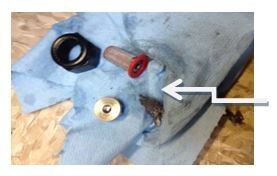
On Spray Jet machines, the screen check valves (153-0220) should be taken out regularly and cleaned. Lint build up on these can wreak havoc on the jet's ability to spray properly and as the check valves get weak, your spray tips can drip. If you notice that your machine is using less cleaner, it may be a good time to take these screens out and clean them. There are also two filters that cleaner passes through before it gets to the screen check valves, one in the tank (154-0212B) and one inline filter before the pump (154-8867A or 154-8887). It is always good to replace these filters every summer.
On Sprayless Cleaning Systems, you need to replace the two filters talked about above, but also your Norprene tubing in your cleaner pump (154-0861B). This style cleaner pump operates by using a set of rollers that press cleaner through this tubing every time the motor turns on. Over time, this tubing can lose its ability to allow cleaner to be pushed through it, and your volumes can be significantly reduced. Many times I have run a cleaner volume check on a lane machine and looked at the touchscreen only to realize that I was the last one to run the test during the yearly service last year!!! You guessed it……the volume was significantly lower than what it should have been.
Once you change the tubing, run a volume check and set it to your desired output and monitor this for a few weeks as the tubing breaks in. It will vary a bit during this time and a readjustment may be required, but it will settle in quickly. This should be checked on a regular basis throughout your season as well.
The cushion roller (153-8838 standard roller and 153-8839 roller with wrap), is another frequently overlooked piece to the cleaning puzzle. The size of the cushion is the key to your cleaning. If we think about how the cushion roller works, when the cloth unwinds, the cushion roller drops onto its stop bolts. When the machine is pushed onto the lane, the cushion actually lifts up off the stop bolts, and the weight of the cushion is what helps clean the lane. Simple right? If your cushion has gotten smaller over time, now it is not making full contact with the lane surface. This means it will not clean well. Mona Lisa and toilet paper soon to follow.
If you look at your cushion roller and see the “alligator skin” look, the ends are flaring out or torn and the cloth is visually pulling into the roller, or if you can wrap your hand completely around it, it is probably time to send it to greener pastures. One trick I show during service stops is releasing the tension on the cushion roller when you finish your lanes.
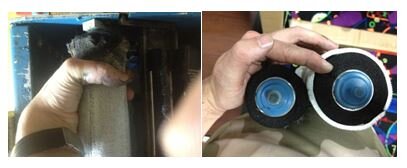
On machines that have the take up roll on the top, you can stand the machine in the transport position when finished and open the duster compartment. Slide the take up roll to the side and turn it 180 degrees and lock it back in place. This will relieve the pressure on the roller and when you turn the machine on to run lanes the next day, the machine will find “home” and wind the cloth back up for you. This can extend the life of your cushion and save you from headaches mid-season.
Squeegee blades (153-8204E Blue or 153-8834 Brown) normally are not overlooked, but why leave them out. Your squeegees should be flipped every six months, and changed once a year. You don’t want to leave any cleaner behind. Always check for your 1/8 to 3/16 adjustment as well, once you change or flip your blades and adjust accordingly.
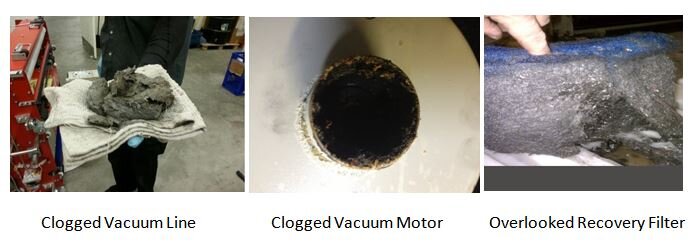
Recovery tank filters are another overlooked item in the cleaning process. Waste tank a little lighter than normal? Check your filter and change it regularly. This is the perfect time to flush out your vacuum hoses and check for small pin holes that may affect suction, along with cleaning your vacuum motor and checking the motor brushes.
Conditioning - “The best canvas deserves a worthy brush.”
A few minor adjustments in your transfer system that have been overlooked can also make you pull your hair out when you’re dialing in your pattern.
Have you checked your crush adjustments on your brush? Most people check the crush from the buffer brush to the lane and set their buffers at 1/8 to 3/16. What most people don’t check is the crush to the transfer brush or roller depending on the machine type. If it can’t pick it up off the transfer brush or roller it can’t get it to the lane!
As the brush wears, it may lose some contact with the transfer brush or roller. When getting ready for the fall season with an existing brush, or when putting in a new brush, always check this adjustment. We like to see 1/8 inch of crush to the roller or transfer brush.
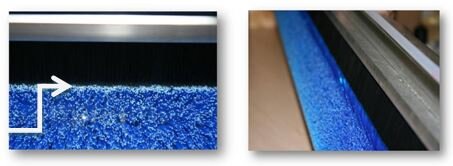
On a transfer brush system, if you turn the buffer on while the brush is in the down position, you should see a thin light colored line where the transfer brush and buffer brush meet. This is from the bristles on the buffer brush being pushed together as they push against the transfer brush. Adjust accordingly.
Your pressure gauge can tell you a lot about your lane machine as well. If your pressure gauge fluctuates as you are applying loads or your pressure seems much higher than normal, you may need to clean your oil control valve. Dirt can accumulate in your valve over time and cause pressure fluctuations while applying loads. If the valve is dirty, take a good look at your filter inside your oil tank as well (154-0212). Replacing it once a year will keep you in top running order.
Your lane machine is one of the most important machines in your center. My final example I tend to give to proprietors and mechanics alike goes something like this…….
If one of your pinsetters happens to go down during a league, you may upset at most the 10 people that are bowling on that pair. But you probably have the parts to be able to fix this later that evening. If your lane machine goes down, and you have a 32 lane center that is full, you’ve now made 160 people upset, and you may NOT have the parts to fix it. You next day air the parts, but your still down the next night, and 160 turns into 320. It is extremely important that you keep your machine clean, do your daily and monthly preventative maintenance, and not take your lane machine for granted. Always keep a few parts on hand. One of every relay, two of every fuse, a fuse holder, a head drive belt, check valves, etc.
This minimal list of low-cost items can be the difference between a full house of happy bowlers, or a lynch mob and a quick backdoor exit of the center. Spend ten minutes a day, 20 minutes once a week, an hour a month and a half day every six months on your machine, and you will be able to keep it clean, and inspect the machine for wear on a regular basis. Always remember we are only a phone call away 24 hours a day 7 days a week from anywhere in the world. We are ALWAYS here to help.
Good luck and good scoring on your new season.

Earl Anthony - Simply the Best

THE difference between the good players, the very good players, and the great players, is the mental game. But what exactly is this mysterious thing called the "mental game”?
Many of the good players and very good players possess similar physical talents to the great players, but they often fall short with their accomplishments.
Simply put, the physical game - in any sport - is how the athlete performs based on their overall talent, ability, potential, skills, and preparation. The mental game however is a totally different animal. This element of the "package" is HOW the athlete thinks.
We have all heard about how the great players are the ones who work the hardest. They are the first ones to practice, and the last ones to leave. But, there is a lot more to it than that. Desire, dedication, determination, self-control, focus, concentration, confidence, self-esteem, positive thinking, goals, visualization, knowledge, and a host of other things, must be mastered.
The following is how the late great Earl Anthony “mastered” the game of bowling.
One time Earl Anthony was being interviewed after one of his early victories by a reporter. It was in the early 1970's, and the reporter wanted to be controversial about the lefty-righty situation that had run rampant in the late 1960's. He said to Earl, "This victory establishes you as one of the best lefties on Tour. Are you happy with that assessment?" Earl looked him right in the eye and said, "I don't know anything about that, my goal is to be the best bowler."
There was another time I remember that showed exactly how the man thought. It was 1974 and he had just been named the Bowler of the Year. A press party was arranged and the award was being presented to him in his office. The wall was cleared and the photographer was going to take a picture of Earl putting up the plaque. Earl was standing toward the corner of the wall with the plaque, and someone in the crowd told him to “put the plaque in the center of the wall.” Earl replied, “No, this one is going here, and the rest of them will go across the wall.”
Earl was right, the other Five Bowler of the Year Awards eventually filled up the entire wall.
Previously, I had written a series of books called the “Final Phase”. They were instructional books to help bowlers learn about the great sport of bowling.
For one of these books I interviewed Earl and posed this question this question to him; "Earl, in my opinion, you were the greatest bowler in the world. You totally dominated the PBA Tour for more than ten years. What do you feel was the formula-for-success that you enjoyed?”
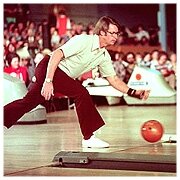
Earl’s answer was, "In my opinion, success is the result of hard work, dedication, intelligence, selfishness, and some luck. How hard you work, and how much you are willing to sacrifice to achieve your goals, will determine to a great degree your level of success.
Natural talent is a wonderful gift, and to be the very best you must have a lot of God-given talent. However, you must work hard to develop that talent.”
Earl continued on to say, “To be a winner also takes a strong mind. You must be able to focus your concentration level to a fine point, and achieve a level of confidence in your ability that is unshakable under the most extreme pressure. Most winners develop an air of arrogance, which is a by-product of the confidence that they have in their ability.
The reason I was successful, was my ability to understand and develop my mental game, as well as the endless hours of practice on my physical game. There was also a certain amount of fear-of-failure that was tempered by a small degree of courage that I used as a motivator to let me continue to fight for my goals, despite many setbacks, and a willingness to put bowling, and my desire to be the very best, above all other things in my life."
Those three interviews alone, tells you volumes about why I thought Earl was the very best. To this day I still get chills and goose bumps when I read them.
The Weather’s Changing…Are Your Lane Conditions?
It’s that time of year again. Leagues began towards the end of summer, the pattern gets tweaked, and everyone starts to get back into the swing of things. Everything is going great and then boom, the weather gets colder and all of a sudden things are different. Then comes the question every manager and mechanic has heard more than they can count - "What happened?"
The products that a bowling center uses to create optimal lane conditions; like lane machines, conditioners, cleaners, and even the lanes themselves, are all physical in nature and therefore temperature dependent. So as temperature changes, the properties and performance of all those products will change as well.
So how do changes in those physical properties show up in the bowling center? They show up in lane machine performance, oil pattern differences, lane topography changes, and of course, what the bowlers feel and see in ball reaction. As the temperature of the conditioner gets colder, the viscosity, surface tension, and density all increase which not only affects ball motion, this also affects different lane machines in different ways.
For this article, we will discuss these changes and offer advice on how to minimize the effects of cold weather on lane conditions. We will focus on the products used to condition the lanes, and in the next issue, we will move on to discuss the topographical changes the lane surface goes through as the climate changes.
Lane Conditioner
In early 1997, we conducted several tests to see how much conditioners changed when the temperature was raised or lowered. What we found was eye-opening. The viscosity of some conditioners changed 2 cps (centipoises) for every 1° F of temperature change. That means if you start with a 20 cps (viscosity) conditioner and the temperature drops from 80° F to 70° F, the viscosity of that conditioner would be 40 cps.
This is not true for all lane conditioners. Some only change 1 cp for every 2° F of temperature change. That is only 25% the change as some of the others, but regardless of how much they change, it's important to know that all of them do.
To minimize this change, look for a conditioner with a higher viscosity index (VI). VI is a way of assigning a value to a conditioner’s resistance in viscosity variation as the temperature changes. The manufacturer of your conditioner should be able to give you this value and guide you accordingly.
Lane Machines
For centers using wick technology lane machines, if the conditioner or lane machine is not kept at normal room temperature, or if stored near a cold wall, the oil will “thicken” and impede the wicking action which reduces conditioner flow onto the lane. As it gets colder, the capillaries in wicks shrink, also restricting flow. Therefore the oil pattern that you started out with at the end of summer might not be the same oil pattern as the weather gets colder.
For centers using Kegel Sanction Technology™, like the IKON, FLEX, and Kustodian line of lane machines, temperature decrease will not affect the output of conditioner like it will in a wick machine. However, if the conditioner gets colder, what you may see is the pressure in your oil pump gauge increase. Fortunately, this does not change the output of conditioner; that’s the beauty of Kegel’s Sanction Technology.
For Sanction Technology lane machine owners, Kegel’s Steve Cross suggests the following when seeing slight pressure fluctuations:
- DON'T PANIC! Expect pressure fluctuations because it is normal with temperature changes.
- Do not change the tubing (pressure regulator). Many people will try to put in a shorter tube to decrease the pressure, but this is not necessary. We have designed a large margin for psi and still have the machine perform as intended. Pressure alone does not affect oil output in Sanction Technology machines.
- Do not adjust the fluid metering pump to adjust pressure. Adjusting the fluid metering pump will increase and decrease the amount of conditioner output (volume).
- Get the machine out early, turn on the oil pump motor, and let it run for about 10 minutes. You should see the psi gauge go back to normal.
Our tech support department receives many calls this time of year with temperature related concerns and we recommend the following no matter what lane machine or lane conditioner you are using:
- Keep the lane conditioner in a temperature controlled environment. The office, front desk, or wherever the temperature is most constant.
- Keep on top of your chemical orders; try to place orders a few weeks in advance to give the chemicals a chance to “acclimatize.”
- Keep the lane machine in a temperature controlled environment so the machine functions properly. If that is not possible, look for other solutions like an electric blanket, packing blanket, or a space heater to help keep the machine warm.
Ball Motion
As we stated before, when conditioner gets colder, the viscosity, surface tension, and density increase. With the increase of these physical properties, more resistance is created on the bowling ball as it rolls through the conditioner. This, in return, usually causes the bowling ball to slow down faster which means it will hook a little more.
Another byproduct of colder weather is the conditioner tends to “stay in place” more which reduces carrydown and therefore, helps the backends stay stronger longer.
Not every bowling center is affected by outside temperature changes but if yours is, our technicians have a couple tips you can employ:
- If when the weather gets colder you notice the bowling balls are hooking more, increase your oil pattern by one foot. This will help bring back the hold area you had when the season began. Once the weather warms back up, decrease the pattern length back to what it was when the season began. Note: Wood lanes with overlays can change in shape which may increase this affect; read about "Changing Lanes".
- If you find temperature changes tend to affect your lane conditions, try to use a lane conditioner that is more resistance to temperature change (higher VI index). Kegel’s Offense HV (for Sanction Technology machines only) is such a product. Offense HV was created when Kegel was entrusted with lane maintenance for the PBA Tour. It was designed to minimize the difference in ball motion from the weekly competition to the TV Show. The TV Show uses many very hot lights that are not present during the rest of the week’s competition. To this day we use Offenses HV when we perform tournaments in venues with less than ideal climate control.
Keep in mind there is no magic lane conditioner or oil pattern that is best for every lane surface or bowling center. Finding a conditioner and oil pattern that is best for your center takes some research and a lot of patience. However, as a Kegel customer you have something going for you; award winning, industry leading tech support by Kegel’s 24/7 Tech Support. Best of all, it’s only a phone call away, and it’s free!
Water Walker
I think that in order to give this story as much credibility as possible, I am going to have to brag a little. I have been involved in doing the lanes with the PBA for over 800 tournaments, which included the National Tour, the Senior Tour and all seven Regions of the Regional Program. I am the only person who has done lanes for every bowler that is in the PBA Hall of Fame. In other words, I have seen them all. And, perhaps, I am really the only person who knows exactly what they bowled "on", as far as lane conditions go.
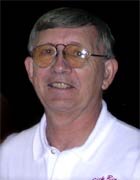
My personal All-Time Top-10, includes; Dick 'Water Walker' Ritger. You talk about TALENT. Dick was unbelievable. He was a world-class bowler, a world class guy, and later became a world-class coach. Without question he was one of the coolest, smartest, shot-makers in the history of our great sport. He could bowl on anything.
I have literally hundreds of stories of some of the tremendous feats that were performed by the greatest bowlers in the world; those that are in the PBA Hall of Fame.
This particular story took place in the early 70's. We (the Tour) were at Cranston Bowl in Cranston, Rhode Island. The weather was absolutely miserable as it had been snowing for about a week before we got there. It was 10-degrees outside when I got off the plane. Not only that, but my job as laneman was going to be a lot tougher this week because we knew in advance that the place was in bad condition because they hadn't resurfaced in a couple of years and all of the league bowlers had been complaining. And it was an old, drafty two-sided house and each side played drastically different from each other - as well as each pair playing differently from each other. I knew that I was going to hear about that.
After the first day of qualifying, Ritger was in the lead, which wasn't unusual for this 20-time champion (at the time). Almost every bowler was upset with the lanes and I had to hear about it.
That night at 2:00am I went in to do the lanes and it was now 19-below zero. There was so much snow in the motel parking lot, that and I couldn't find my car and had to walk about a mile to get to the bowl. About 15-minutes after getting there, part of the roof on the high-side (the real tough side) caved-in from the weight of the snow. It was a disaster. The janitor called the head mechanic who in turn called the Manager. He called everybody he knew to get in there to help clean up the mess. I called Harry Golden (the Tournament Director) to let him know what had happened. I cleaned and oiled the low-side then went over to take a look at what was going on over on the disaster side. There were about 20 people cleaning the water, snow, ceiling tiles and other debris off of the lanes and approaches. You could see the sky through the hole in the ceiling. I remember thinking: "I'm sure that the guys will blame me for this, too."
There were buckets on the lanes that were still catching water from the drippy roof. It was now 6:00am and the Pro's were scheduled to bowl at 9:00am. At that point I thought that there was no way. I started cleaning and oiling the part of that side that wasn't under water. When I got to the part of the house that had caved in, a "Miracle" happened. It had stopped raining and the dripping over the lanes had stopped. I cleaned and oiled the rest of the lanes. There were still some drips coming down over the lanes, but "Miracle number 2" was that the drips were only over the gutter gaps and the buckets that were placed there were catching all of the drops. It was about 8:45am now, and I took the lane machine to the back. The mechanic and all his helpers were back there huddled next to a little heater he had, and they were all trying to dry out.
When I came out of the backend, I saw about 20-bowlers standing in the settee on 31 and 32. I went over there to see what was going on. The only drips that were still coming down were over the approach on that pair and because of the full field, they had to use that pair in the tournament. Harry made the decision to leave the three buckets where they were on the approach. It was either that, or put 5 on a pair, and none of the bowlers wanted that. The buckets were to stay in place for BOTH squads.
I stayed around to watch the 1st squad bowl. After they bowled their 6-games that morning, the high game on the pair was 149. It was impossible for the players to walk around the buckets that were there to execute any type of normal shot.
Now the next squad came in to bowl. Ritger was scheduled to bowl his 2nd game on 31 and 32. It would be interesting to see what he could do there and not lose too much of the lead that he had enjoyed. When he got there for game 2 of this second day, there was a huge crowd in the bleachers, and standing behind the bleachers, as well.
I watched him (with no practice balls) alter his approach by snaking his footwork around the three buckets in a serpentine manner. I couldn't believe my eyes. He shot 279 like it was nothing. It was ridiculous.
One World - One Game
It has been almost ten years since John Davis (Founder of the Kegel Company), called together a group of experienced lane men in an attempt to further research the on-going lane conditioning problems with our Sport. It had become apparent that too many tournaments were deemed unfair by the participants and tournament organizers. Bowling ball technology had rapidly advanced and it was getting next to impossible for the lane man to do the job without some sort of social controversy. After that five day meeting in Sebring, Florida, Davis promised to undertake the huge task of taking care of lanes at every major tournament in the world and then posting those results on The Foundation website for the whole world to see. Davis and The Foundation came up with their initial slogan which was: “One World – One Game.”
The Foundation also coined two other phrases:
1. "You don't need to be a lane man to know that there are problems, you just need to be a lane man to know how bad the problems are."
2. "If not us, who? If not now, when?"
Early on, a series of scratch tournaments were developed, called: The Foundation Games. These events were held in this country (and abroad) with some promising results. They were unique by featuring ‘multiple conditions’ in an attempt to further challenge the participants by having more than one lane condition to compete on. Challenging oil patterns were used (both long and short) that required the athletes to compete on different lengths of oil during competition.
In 2000, Dr. P.S. Nathan, then President of the World Tenpin Bowling Association (WTBA), held a World Bowling Seminar in Malaysia and Davis was invited to attend along with many other bowling leaders from around the world. At that week-long educational meeting, it was unanimously decided that in order to find out who the best players were at any given event, the athletes needed to be challenged with these ‘multiple condition’ type tournaments.
The WTBA then formed a Technical Committee (TC) to continue researching the problems on a world wide basis. Since then, different tournament formats have been tested along with bowling ball restrictions (amount of balls used in the events) which were instituted. It is quite clear today, that some of the underdeveloped countries are at a disadvantage regarding bowling equipment.
For many years now, numerous thoughts, opinions and feelings about lane conditioning have been constantly expressed on most every bowling websites discussion groups. Depending on the average person’s position (agenda), most blame the problems with our game on various aspects of the game, including; pins, oil patterns, balls, kick-backs, flat gutters and an assortment of other things. Most have never done lanes and have no idea what that particular job entails.
Today, even with the use of different formats and multiple conditions, problems still exist in our great sport. The WTBA Technical Committee feels that it is time to try a different approach.
"One World - One Game - One Ball"
In 2003, Davis was named as Chairman of the WTBA TC, and Kegel was still taking care of all the tournaments for the WTBA and developing countless oil patterns. It became obvious that the lane man still could not do his job without some social unrest. Something else was needed.
The WTBA TC decided to research and test a type of bowling ball that would not mutate the oil patterns as much as today’s High Tech balls do. Davis was put in charge of doing the research for this project. Days, weeks and months went into this very technical testing, using CATS data.
A ‘prototype’ bowling ball was developed which showed encouraging results. During the week of April 17-22, a Bowling Writers meeting was scheduled in Orlando, Florida (which is only about 80 miles from Kegel’s Training Center), that was combined with the USBC Annual Meeting.
The WTBA TC also scheduled a meeting at this time and this was a chance to announce this new theory. A small scratch tournament would be held and the results would be shown to the world. Many top players from Florida would participate along with some other top amateurs and former PBA Tour champions. It was an eight game event that was bowled across eight lanes. The amount of oil that was used was 7.140 mL, which is an amount that was used in the early 1970’s.
Those results (total pin fall) were:
1. Bob Learn, Jr. (1880)
2. Vernon Peterson (1770)
3. Matt Gilman (1715)
4. Bob Handley (1675)
5. Mike Purdy (1671)
6. Larry Barwick (1670)
7. Rob Comito (1666)
8. Steve Johnson (1660)
9. Neil Stremmel (1655)
10. Storm DeVincent (1627)
10. (T) Sami Luoto (1627)
12. Chris Chartrand (1612)
13. Dennis Davis (1598)
14. Craig Auerbach (1596)
15. Saul Insignares (1573)
16. Tony Lavance (1572)
17. Ron Dixon (1523)
18. Jose Rodriquez (1514)
19. John Forst (1513)
20. Dennis Psaropoulos (1512)
21.Tony Crews (1477)
22. Bill Blackwell (1454)
23. Pekka Korpi (1383)
24. Josh Moore (1354)
Each player paid a $100.00 entry fee to enter the tournament, and that included a bowling ball. Each player had a choice of 15 or 16 pounds to use. Except for that weight difference, all of the balls were made as similarly as humanly possible. Davis donated an additional $2600.00 for a total Prize Fund of: $5000.00. Learn earned $2000.00 for the win along with a very nice banner that was signed by all of the participants and those on the WTBA TC. In all, 12 players cashed.
When asked if he wanted the banner, Learn said, “Certainly. It will go in my trophy room with all of my other cherished awards.” He added, “This was great. ALL tournaments should be like this one because I really think that it was the fairest tournament that I have ever bowled in.”
After the event, all the players were asked to fill out a detailed questionnaire that had a multitude of pertinent questions regarding the tournament. Those queries are currently being analyzed.
All in all, it was deemed a tremendous success by the Players and Officials. All results of the CATS data (from every shot, from every player) are also being analyzed. When completed, a detailed report will be sent to WTBA President Heikke Sarso for review.
STAY TUNED!
The Beginning
The year was: 1956.
The place was: Hillsdale High School in San Mateo California
My first recollection of Billy Hardwick was that of disbelief. What a sight it was. He was a sophomore, a year behind me in school. He was all of 5’3” and weighed-in at exactly 99-pounds.
He came out and (tried out) for the Varsity football team. The Head Coach, Frank Collins, looked at him and said that he was too small to play, but since we were a new school and needed players, he told Billy that he could hold the blocking-bags during practice. He also told him that because of his size (or lack of it) that he wouldn’t be able to issue him a team uniform.
But, Billy had guts and said that he still wanted to play and practice with the team. It was a cold and rainy day in September. There he was in his ragged, old sweat-shirt, sweat-pants and wearing his tennis shoes. The shoes were those old “high-top” canvas style and the laces were tied around the tops about 4-times. His skinny, little ankles were way too small to fill-up the tops of the shoes and it looked like he was walking around with two small “sacks-of-potatoes” hanging off of the bottoms of his legs.
The practice field was very wet and muddy that day, and the first chance I had to block him and the big blocking-bag that he was trying to hold-up, I put a little bit of an “extra” effort into it. The poor little kid had no chance. He went slipping and sprawling and sliding before eventually ending up on his back in the middle of a huge mud puddle. On his way down, all you could see were arms and legs going in every direction as he tried in vain to maintain his balance. It was an absolute riot. Even all of the Coaches were laughing.
I intentionally humiliated him once again when I reached down to help him up and purposely stepped on his foot with my football cleats. He let out a scream and rolled over (face first) in the mud. Now, he was covered from head-to-toe in the sloppy quagmire. It was hilarious. Everybody there was howling. Everybody that is, except for Billy. Looking back though, I was probably a big “bully” for doing that to him. Even though he never said it, I am sure that he hated me for doing that to him.
Basically that was the end of his football career. He did go on to play on the basketball, baseball and cross-country teams. Despite his slight stature, he was a fierce competitor. As the years went by, he would eventually prove “that” to everybody. His burning desire that he possessed soon became evident when a new bowling center opened in our town and he was finally able to find (and master), his sport.
During that year we became the best of friends, and that friendship has been a close one for 6-decades. I owe him a lot from what he has taught me and the countless doors that he has helped me to open. We have (personally) endured a lot together and I have countless stories about him. I will be telling some of them here……at least the ones that are suitable for print!!!
History tells us that he did go on the Tour, twice becoming Bowler of the Year. He was voted in the top 20-players of all-time and inducted into both the ABC and PBA Halls of Fame.
Today, Billy is alive and well and owns a very successful bowling center in Memphis, Tennessee. I still see him now and then and occasionally talk with him on the phone. If you see him, tell him that I said hello.
By the way, he did pay me back. Yeah, he was the rotten egg that got me into bowling!
Bowling Bedlam - Oil
The playing environment of bowling today may be as complex, unpredictable and chaotic as any time in the history of the game. We're not talking about the weekly league or club game where the participants just want to have fun. We're talking about professionally maintained and controlled tournament environments where bowling sports people compete.
It is in this type of sporting environment, along with the basic premise of playing well both physically and mentally, that the decisions the modem player makes will ultimately determine whether they perform up to their expectations or have to wait until the next event comes around.
This is the second in a series of articles that will try to shed some light on many of the variables in the current game of bowling and why the players of today need to be very open minded and aware of the total environment at all times when competing. The supplied information is all in the quest of understanding and to increase performance, not to create excuses.
Oil (Conditioner)
There are low viscosity oils and high viscosity oils. There are oils with different amounts of additives such as friction modifiers and flow agents for different types of lane machines. There are oils with varying surface tensions which help the oil bond to the lane surface.
Mineral oil is used in most lane conditioners as the base oil but over the years lane conditioner has evolved. Today's conditioners are now mixed with a percentage of specialized additives to increase the performance and durability of the conditioner.
All these different types of conditioners will make your bowling ball react differently on the lane. At the same time, different types of conditioner can make the same pattern play different.
If using a wick machine, some conditioners will flow through the wicks more than others making the same pattern settings apply a different pattern. With wick machines, temperature will affect the flow rate since temperature not only affects viscosity or the thickness of the conditioner, it will affect the size of the capillaries of the wicks as well.
If using spray type machinery, different conditioners will either peel off or hold onto the buffer brush more or less which can change the shape of any specific pattern even though the machine settings remain constant. Different lane surfaces will do the same thing so add that into the equation also.
There is a very good online article by Kegel's Chris Chartrand on lane conditioner (oil), "10 Things That Everyone Should Know about Lane Conditioners" which you can view by clicking on the title. Therefore we won't go into specific details on all conditioner properties but one thing we will touch base on is viscosity since the USBC has just made a new specification on this lane conditioner property.
The new viscosity rule the USBC has implemented "requires that lane conditioners used during USBC competition read between 12 and 81 centipoises at 70 degrees Fahrenheit." Centipoise (cps) is the standard unit of measurement for fluids and many lane oil manufactures will have this designated on their product.
Viscosity is very misunderstood in common bowling discussions. Most bowlers believe the higher the viscosity of oil, the "slicker" the bowling ball reacts to it. Actually the exact opposite happens.
By definition, viscosity is the measurement of internal friction of a fluid. The greater the amount of friction, the more force is required to move the fluid against itself which is called shear. Therefore the higher the viscosity, the more force it takes which increases friction. The lower the viscosity of oil, the less force it takes to shear which decreases friction.
In terms of a bowling ball rolling through these different oils, the higher the viscosity, the more resistance there is which makes the ball slow down more. When we get to the bowling ball portion of the series, we will spend more time on this subject but in short, friction is what makes the ball slow down and therefore enables it to hook.
Temperature is one of the biggest environmental factors in changing viscosity of a conditioner. So as the weather changes, so can the bowling conditions.
So what is the purpose of viscosity in lane oils? In short to provide durability to an oil pattern however, because of the many different additives being used in today's oils, viscosity is not as important as it once was in regard to lane maintenance. But as a bowler, you should be aware of how it relates to ball motion.
Oil Patterns
This subject of oil patterns is a difficult one and probably the most blamed and misunderstood subject in bowling. Lane conditioning rules have changed many times over the years and even today with the USBC 'three unit rule' or the USBC Sport Bowling rule in place, there are an infinite number of pattern combinations and ways to apply an oil pattern to the lane.
Kegel's Founder and CEO John Davis had a saying when he was entrusted in doing lanes over the years which goes something like this;
"Its 4 o'clock in the morning and the tournament starts at 8:00. You know if you do this; this might happen. But if you do something else, that might happen. So what are you going to do? Who do you call? Who can you call? You have to do something but there is no book. It is all up to you."
In these simple questions lies the major dilemma for every laneman at every bowling tournament in the world. Only after the tournament do they ever know if the job was socially acceptable or unacceptable. In simpler words, did the laneman do a good job or a bad job?
Of course the laneman might ask the same question to the bowlers; when trying to figure out the conditions, did the bowlers do a good job or a bad job?
What is "Process Verification" and Why do We do it?
There are four questions on the minds of competitive bowlers at every event in the world:
1. Who chose this condition?
2. What right did he or she have to do this?
3. What was the motivation of the person choosing?
4. Were the lanes conditioned the same from week-to-week, day-to-day, squad-to-squad, or was an adjustment made to change the outcome of the event?
It seems to me, that in order to make a dent in our psychological attitudes, these four questions need to be answered, and the answers need to be accepted.
For question number four we now have a solution. In the past, the lane maintenance person’s word has been questioned because of perceived changes in ball reaction. He/she never wins that one. We have found that there are many reasons why the lanes may be done the same, but ball reaction is different.
With the invention of Kegel’s Sanction Technology™, we can now prove the pattern is exactly the same every time. This is a huge step forward in understanding bowling's technical challenges because it eliminates the applied oil pattern as a variable.
Therefore, if the ball reaction is perceived by the players to have changed from the previous fresh condition, we can then look at variables other than the applied oil pattern.
When Kegel is in charge of conditioning the lanes for tournaments and events, we follow what we call the “Process Verification Procedure.” What this means is the process of cleaning and conditioning the lanes is verified. This ensures to the players that the same procedures are being followed each and every time we perform lane maintenance for an event.
Process Verification Procedure (PVP)
Inspection of the lane cleaning.
Ensure the oil program is correct in the lane machine computer.
Perform the oil calibration check. This is a procedure where the oil that would normally go onto the lane is captured into a graduated cylinder for exact measurement. The amount of oil is calculable and verifiable from the desired oil program.
Walking with the lane machine to ensure the machine operation is the same on each lane. This is done by looking at the valve time, the speed of the machine, and the total run time of each lane.
Look on each lane to make sure the oil pattern distance and the look of the oil pattern is the same on each lane.
Taking lane tapes at specific distances to make sure the lane machine applied the oil pattern as intended.
The tournament technical delegate/representative and lanes person then signs-off that nothing in the procedure has changed and is as intended.
By performing this procedure time after time, we not only protect the integrity of the lanes person, we also protect the integrity of the player, and most importantly as it relates to lane conditioning, the sport of bowling.