
Inside Line Tech Tips - Summer 2011
“The oil pattern didn’t play anything like it did at home!”
by John.Janawicz@kegel.net
Often times I hear this comment and there are many reasons why this can happen. Frequently, the center that you are going to bowl the tournament in (say for example the USBC Open Championships) is using a different brand of cleaner, different oil, and a different lane surface (not even taking account of one of the biggest differences….topography). Those are very obvious factors, but often people think that because they have the same lane machine as at the tournament site that it should cover all of those differences. Ultimately, even if you have the same lane surface, oil, cleaner, and lane machine, differences will still remain.
One of the differences we see often is the physical condition of the lane machine. Even though each Kegel lane machine leaves the factory meeting all of our strict adjustment and performance specifications, what happens to it from there is totally dependent on the maintenance (or lack thereof) that is given to it.
For an example, let’s compare two cars: Two 2011 Chevrolet Corvettes.
One Corvette lands in the hands of a business man who uses it strictly as a commuter car. He washes and waxes it every week, changes the oil right at 3000 miles, and always uses synthetic oil. He manages to put 25,000 miles on the car in a 12-month period.
The second Corvette ends up being a rental car. The car is in numerous drivers’ hands many of which perform routine burnouts and jackrabbit starts. This car also logs 25,000 miles in a 12-month span.
Though both of these cars started their life exactly the same, do you think both cars are going to look the same and perform the same after 12 months? Do you think the interiors are going to be the same? It wouldn’t surprise me if the rental car’s transmission doesn’t shift as crisp and probably a few of the basic items are a little more worn out (brakes, parking brake, tires, etc.) All I know is, I’ll take Corvette number 1 and you can take a chance with the rental car, haha!
Knowing this, do you think all lane machines are treated the same? We’ve seen many lane machines after one year look like they’ve never been cleaned! Oil drips out of the vacuum motor (where it never should), the transfer brush is filled with dirt and hair, the paint is peeling off due to cleaner being spilled on it numerous times, and the frame has been tweaked throwing the factory adjustments out of spec since the machine has been dropped more than a half-dozen times due to negligence.
- Do you think that this machine I described above will put out the pattern the same way the brand new machines we have at the USBC Open Championships will?
- Do you think the pattern will be the same with a machine that doesn’t clean the lane well because the squeegee blades or cushion roller have never been changed?
- Do you think the pattern will be the same even if the cleaner tank filter is clogged and the Norprene cleaner tubing hasn’t been changed in over a year which results in half the amount of cleaner coming out (resulting in poor cleaning) and now you’re oiling on top of a film?
- Do you think the pattern will be the same even if the transfer brush has so much dirt in it that it keeps the oil in the transfer brush an extra 6 feet down the lane?
Many factors will make a pattern play different from center to center but often one of the biggest is the physical condition of the machine itself. Stay up with the maintenance of the parts that commonly wear out (squeegee blades, buffer brush, cushion rollers, etc.), keep the machine clean, and your lane condition will be more consistent from week to week and month to month.
Like our VP of R&D Mark Davis once said: “Machines that look like new….tend to perform like new.”
Preparing your Lane Machine for the Fall Season
by Steve.Cross@kegel.net
As many bowling centers close during the summer months, it is especially important to properly prepare your machine to begin a new fall season. If this is not done, it can lead to restriction to flow in the system, or problems with ball reaction at an inconvenient time after the league season has begun.
In order to stay ahead of Murphy ’s Law, I urge customers to follow the Boy Scout motto and “Be Prepared.” You will thank yourself for performing this preventative maintenance on your machine.
The first thing you will need to do is get the machine out and drain the fluids. You will then want to remove both the oil and cleaner tanks individually and perform a thorough cleaning on them and the filters. Inspect the tanks to make sure there is no sediment or residue from the previous conditioner or cleaner left behind. It is important to flush and clean these tanks whether you plan to use a new batch of the same conditioner or intend to switch to a new conditioner altogether.
Once the cleaning is complete and machine is intact, you should turn the machine on and check that oil is flowing freely through the oil lines. You will be looking for a consistent PSI reading. If the pressure readings are too high or too low, this indicates that there may be a problem in the oil lines.
This is also a time of year where many centers will experiment with new oils or patterns. I always recommend that changes be tested before the season begins. This allows time for you to decide what is right for your center and make pattern changes or adjustments if necessary. If your center will be using a new oil, I suggest keeping the same pattern for testing. Changing only one of these variables will give you a better comparison of the new versus the old oil.
This should help to ensure that you maximize your machine’s performance and decrease the risk of problems sneaking up on you once your season has begun. Take care of your machine, and it will take care of you. And if it doesn’t, give one of us Techs a call US Toll Free at (800) 280 2695, or International +1 (863) 734 0200.
DC Drive Motor Maintenance
by Steve Calhoun
All Kegel lane machines are driven by DCV drive motors that are designed with two carbon style brushes, one on each side of the motor. As the brushes wear down over time, carbon dust particles build-up inside the head of the motor between the stator (field) and the rotor (armature). This build-up can cause a short inside the motor. To prevent a dangerous build-up, it is important to routinely remove the carbon brushes, and blow out the motor with air to remove any carbon build-up.
Note: If you use an air compressor, please insure that the air-lines are free of moisture before evacuating the motor.
If the brushes are several years old, they may need to be replaced. Each brush is manufactured with a tension spring that keeps the brush in constant contact with the rotor of the motor. The shorter the carbon fiber brush becomes the less tension there is on the rotor.
How to Make Your Batteries Last Longer
by John.Thrift@kegel.net
As we all know, batteries are not created equal and they do require maintenance. It is important that batteries are charged properly and to make sure the source that is using this supplied power is not abused so that they reach their maximum potential. After reading this, you should be familiar with two causes of decreased battery life and some charging standards for Odyssey batteries.
One of the biggest problems that can decrease battery life is a machine that has been abused. When a machine is not kept clean or well maintained, it can cause an overall higher amp draw and result in the battery dropping out faster.
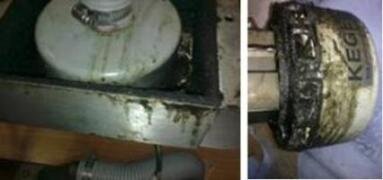
For example, if the vacuum motor has had waste sucked into it, like the images of abused vacuum motors below, this can greatly affect the battery. Damage like this could hinder machine performance and easily cause a NEW set of batteries to do 25 lanes less than it should.
Another battery issue that is often overlooked is whether the charger is giving the batteries a proper charge. This can take into account any portion of the charging mechanism. The Odyssey batteries require different stages of charging which should be as high as 29 volts within the first 30 minutes of being on charge to as low as 27 volts after being on charge for 6-8 hours. If proper charging does not occur, this will also affect the life of your batteries.
Periodic checking of the charging system along with regular maintenance of your lane machine will greatly extend the life of your batteries.
Contact our techs at their e-mail address, or call US Toll Free at (800) 280 2695, or International +1 (863) 734 0200.

Weather, Topography, and Ball Motion
THE INSIDE LINE: 2011/01/18
In the first issue of THE INSIDE LINE, we promised that our next article would discuss how weather affects topography and ball motion. Since lanes are made up of wood, and sub components of wood, we know temperature will affect the shape of them. However, the one part of weather that significantly affects the shape of lanes is the humidity, or lack thereof.
Because wood is porous, and high humidity means there is a lot of moisture in the air, humidity tends to make wood swell up. Low humidity, when there is very little moisture in the air, makes wood compress as the moisture is not as present in pores of the wood. For those that have seen what happens to wood approaches when a spilled drink was left there too long, you know the effects. Bowling lanes do the same thing.
Humidity and Temperature
When bowling lanes and wood based components that make up lanes are exposed to humidity and temperature changes, extra moisture in the air often "enters" the wood material at a point of least resistance. But because there are many differences in construction, and depending on the sub-foundation material and underlayment, as well as the many different wood components utilized in building a bowling lane, the only thing we can be sure of is weather definitely changes lane shape. However how it changes can vary greatly from situation-to-situation.
For instance, often the outer edges of certain materials, like wafer board Parallel Strand Lumber (PSL), are much more susceptible to moisture penetration from the sides rather than from the top. This contamination happens much faster than moisture penetration elsewhere, so in this case the swelling causes a depression.
In other instances, swelling causes the wood, or boards, to compress against each other which can cause a “push up” effect. In this case swelling can cause a crown, or less of a depression.
But how does this affect lane conditions? First, lane conditions in this case are not about the oil pattern, it’s about the condition of the lane. Time has altered the term lane conditions to mean only oil. This was not the case for the majority of time modern bowling has been in existence. So in this case, we’ll discuss lane conditions as it relates to the shape of the lane, and how those shapes affect ball motion.
Depressions and Ball Motion
If weather change makes your lanes become depressed, this shape not only helps guide the ball towards the center of the lane, it also makes the ball lose energy faster. The reason for this increased loss of energy is the rotational effect of the bowling ball against the side hill of the depression.
Here is a graphical example:
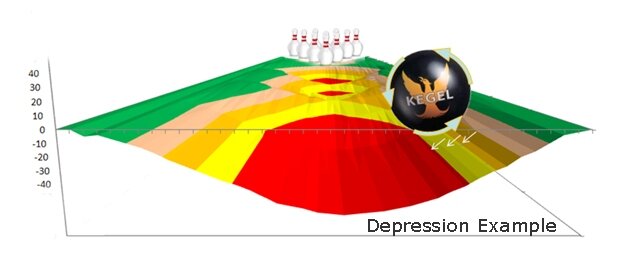
As you can see, for a right-handed player, or left-handed back-up bowler, the rotation of the ball is counter clockwise to the slope, and therefore acts like the ball is trying to rotate uphill. This makes the ball lose energy faster versus a flat lane. When lanes are shaped in this manner, ball motion is more of an “arcing” type motion because of the early loss of energy. This loss of energy is also the root cause of why some houses are referred to as a “10-pin center”.
The majority, if not all, wood lanes are depressed, especially in the head area. The majority of synthetic lanes installed over wood lanes are depressed, especially in the front part of the lane. We have found that new synthetic lane installations are more random; some parts of the lane are depressed, some parts are crowned, some are high left, and some are high right. But they are still affected by humidity and temperature changes, which means the randomness remains, it’s just different.
We have documented examples that show certain type lane structures can depress 70/1000” when weather changes occur. To show how much this affects the bowling ball, we have taken Kegel’s adjustable lanes, shaped them, and performed many tests.
Our testing has shown that a bowling ball released at 18 mph on a lane that is depressed 40/1000” from the edge to the center, can cause the bowler to be over three boards left from that of the flat lane. Slower ball speed players and lighter balls are affected more. Faster ball speed players and heavier balls are affected less. This is in accordance with Newton’s Laws of Motion.
Crowns and Ball Motion
To get an idea how a crown affects the energy of the bowling ball by its rotation, here is the same type graphical example as before:
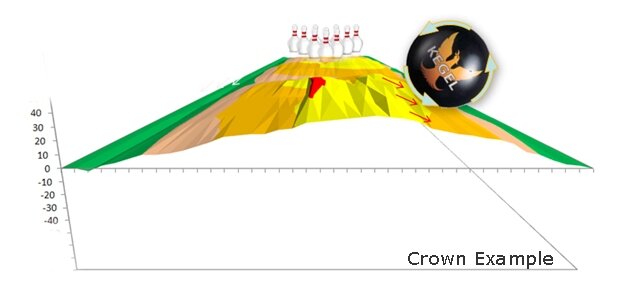
As you can see, now the bowling ball is rotating with the slope of the lane, which causes the bowling ball to lose less energy than it would if it was rotating against the slope of the lane. When a lane is crowned in this manner, high launch angles will be affected more than a bowler that plays “straighter up the boards”. When lanes are shaped in this manner, ball motion is also more “skid snappy” because the bowling ball is retaining more energy.
The Race Track Effect
Because of this rotational effect and gravity, lanes that are depressed in the heads act like there is very little oil in the front part of the lane. Depressed heads are no different than driving your car on a banked curve. The reason for banked curves on the road, or race track, is that they reduce the vehicle’s dependence on friction to navigate the curve.
It’s no different on a bowling lane. Depressed heads keep the ball from “squirting” away from the pocket, or in other words, help the ball make its move towards the pocket, just like a banked race track helps the car turn the corner. That is, until the bowler lays the ball down on the other side of the depression.
Did you ever wonder why players that can get far to the left make the lanes look easy? The next graphic shows why; gravity is now working to their advantage, instead of against them.
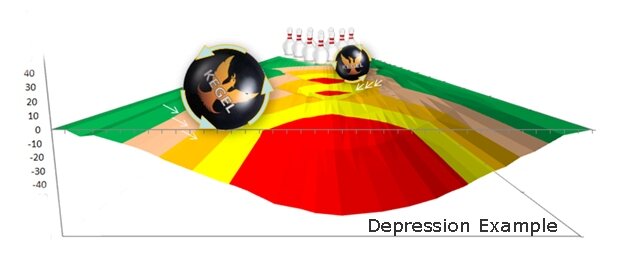
The bowling ball now has a gravity “push to the right” in the front part of the lane, and a gravity “bank shot” once down the lane. Gravity wise, the lane is helping the ball get to the right early with energy retention, and then return to the pocket in the breakpoint area. Players that don’t have the rev rate to get to the extreme left are at a tremendous disadvantage in this type of playing environment.
Notice that during this entire article, we have shown how lane shape affects the direction of the bowling ball, how lane shape affects the shape of the ball’s motion, and how lane shape affects the energy loss of the bowling ball, yet we have not mentioned lane conditioner or the oil pattern once!
The next time you start chasing down a ball motion issue at your center, or even a pin carry issue, and you have performed the Process Verification Procedure on your lane machine and oil pattern, don’t overlook the shape of your lanes. We have a relatively new saying at Kegel; “you can’t fix a gravity problem with oil.”
In conclusion, get to know your lanes; identify how they’re shaped and how weather change affects their shape. Find out why some lanes score high, and why some lanes score low. It will save you a lot of headaches, and help you provide your customers with a high-quality playing experience all year round. And like always, if you have any questions or need help, call Kegel. We are just a free phone call away.
Lane Conditions and Cold Snaps
In last month's article, we touched base on some of the effects weather can have on lane machines, lane conditioner, and ball motion. We wrote about these effects in the sense that the environment has already become more stable. But because of a few recent technical calls, we have decided to release a Special Edition of THE INSIDE LINE, and continue the discussion on how weather can affect lane conditions.
We have found that the biggest problem in a bowling center occurs when there is a drastic and quick temperature change. Kegel's lead chemist and VP of Chemical Product Development, Dennis Sheirs, found this out during the U.S. Open in 1998. For the first two days of the tournament the air conditioner wasn't working in the bowling center, and it was 80 degrees inside the center, and on the lanes.
Sometime in the middle of the afternoon on the second day of the tournament the air conditioning was fixed. Then during that evening someone cranked the air conditioning way down and by the next day both the bowling center, and the lane temperature were 60 degrees.
The bowlers started practice that morning and found the lane pattern played 10 boards tighter. Luckily, since Kegel was doing the lanes and strictly following our Process Verification Procedure, we could prove it wasn't because the laneman or lane machine did something different. But we did learn a valuable lesson; when doing lanes take control of the climate control system!
How does this affect you in daily life?
We find the same thing can happen when you typically get a cold snap up north and it's instant. Normally you will see everything get a little tighter at first. Then as everything goes through equilibrium, and bowling centers kick on the heat, all the other properties change and eventually everything will settle back in. That's when the lanes will start to hook more from the point where they got tighter at.
We said before that when the temperature of lane conditioner gets lower, the viscosity goes up, but that's only one part of the equation. The other part of the equation is the surface tension also increases, which makes the lane conditioner move more until everything settles back down. This can last over a week because during a cold snap the whole system is in flux.
What else can the weather do to my lanes?
During the summer time when the humidity is typically greater, synthetic lanes on top of wood lanes tend to be a bit more crowned towards the gutter outside of the second arrow. We know from our testing, crowned lanes tend to create "hang spots".
But in the winter time, when the heat is turned on in the bowling center or humidity decreases, the wood lane tends to depress, or the crowns decrease, and the panels follow that change in lane shape. This makes it easier for the ball move more towards the center - in other words, hook more. That change however takes a few weeks to fully occur.
If your located in an area that gradually gets colder throughout the year, you won't experience drastic changes because everything is just slowly moving there.
But from our experience, in most scenarios, those quick "cold snaps" (change from warm to cold), tend to make lanes play tighter first. Then, as the inside environment equalizes and the heater settles things down, lanes depress, and that's when we see more hook again.
So as we stated before, typically in the summertime, synthetic lanes installed over wood lanes tend to crown a little bit, and in the winter time, they tend to depress. When measuring lanes using the Kegel LaneMapper, we have documented examples of lanes changing up to .070" from summer to winter and back again - high humidity can create crowns and low humidity releases moisture causing the lane to depress.
In our research, we have found this drastic lane shape change happens only when synthetic panels are on top of existing older wood lanes. Synthetic panels on top of other substrates like MDF/HDF, or LSL do not show much change from summer to winter - only a few thousands of an inch.
Extreme lane shape change by overlays on top of wood lanes is caused by the wood lane underneath becoming "looser and looser" from years of not receiving attention as they did when resurfaced regularly. Basically, the toes screws that hold the boards together, and the screws holding the wood lane to the levelers, start backing out from the constant pounding of the bowling ball, making the wood lane act like an accordion.
Read more about Changing Lanes...
What do we suggest for quick weather changes?
Don't respond to the change too fast - give everything a chance to settle down and get back into equilibrium. Most of the time, our first response is we have to change something when somethings goes haywire - it's human nature.
You are better off to first perform your Process Verification Procedures to ensure your machine is operating correctly, your cleaner is being mixed correctly, and if so, just let everything settle down. Otherwise, you're going to be trying to change something while everything is transitioning.
A non-bowling analogy to the transition is like when you get into a pool for the first time. The water may feel cold, and that could be your first reaction, but if you stay in for a little while, you start to adjust to the temperature. Your core body temperature does not change; you just begin to acclimate to it.
After everything have settled down though, it may be entirely possible you have to adjust your oil pattern in order to keep your bowlers closer to what they are used to. For that just give us a call - the Kegel LaneMapper has provided us with insight and allows us to provide answers much quicker than in the past.
To end, and we can't stress enough, every center is unique and the solutions to any problems are just as unique. Just know that Kegel's Tech Support department is full of dedicated people trying to do the same thing you are; provide our customers with the best possible experience as we can. And don't forget, we are only a free phone call away.
Kegel Road Trip Seminar Videos
During the year 2010, Kegel, along with Storm Bowling, performed a series of seminars throughout the USA. Kegel's portion of the seminar focused on some interesting variables that make up the playing environment.
The You-Tube videos below are of Chris Chartrand presenting Kegel's portion of the seminar. After watching these videos, you will find that there are many things about bowling you probably have never thought of, or even knew about. Enjoy.
Kegel Road Trip Series - Part 1
Kegel Road Trip Series - Part 2
Kegel Road Trip Series - Part 3
Kegel Road Trip Series - Part 4
RELATED ARTICLES
Kegel's Revolutionary Slope Graphs by Ted Thompson
What a Shock - Newton Correct! by Lou Trunk
Weather, Topography, and Ball Motion by Ted Thompson
Topography: What does it all mean? by John Davis
Sir Isaac Newton Knows Bowling by Ted Thompson
The Weather’s Changing…Are Your Lane Conditions?
It’s that time of year again. Leagues began towards the end of summer, the pattern gets tweaked, and everyone starts to get back into the swing of things. Everything is going great and then boom, the weather gets colder and all of a sudden things are different. Then comes the question every manager and mechanic has heard more than they can count - "What happened?"
The products that a bowling center uses to create optimal lane conditions; like lane machines, conditioners, cleaners, and even the lanes themselves, are all physical in nature and therefore temperature dependent. So as temperature changes, the properties and performance of all those products will change as well.
So how do changes in those physical properties show up in the bowling center? They show up in lane machine performance, oil pattern differences, lane topography changes, and of course, what the bowlers feel and see in ball reaction. As the temperature of the conditioner gets colder, the viscosity, surface tension, and density all increase which not only affects ball motion, this also affects different lane machines in different ways.
For this article, we will discuss these changes and offer advice on how to minimize the effects of cold weather on lane conditions. We will focus on the products used to condition the lanes, and in the next issue, we will move on to discuss the topographical changes the lane surface goes through as the climate changes.
Lane Conditioner
In early 1997, we conducted several tests to see how much conditioners changed when the temperature was raised or lowered. What we found was eye-opening. The viscosity of some conditioners changed 2 cps (centipoises) for every 1° F of temperature change. That means if you start with a 20 cps (viscosity) conditioner and the temperature drops from 80° F to 70° F, the viscosity of that conditioner would be 40 cps.
This is not true for all lane conditioners. Some only change 1 cp for every 2° F of temperature change. That is only 25% the change as some of the others, but regardless of how much they change, it's important to know that all of them do.
To minimize this change, look for a conditioner with a higher viscosity index (VI). VI is a way of assigning a value to a conditioner’s resistance in viscosity variation as the temperature changes. The manufacturer of your conditioner should be able to give you this value and guide you accordingly.
Lane Machines
For centers using wick technology lane machines, if the conditioner or lane machine is not kept at normal room temperature, or if stored near a cold wall, the oil will “thicken” and impede the wicking action which reduces conditioner flow onto the lane. As it gets colder, the capillaries in wicks shrink, also restricting flow. Therefore the oil pattern that you started out with at the end of summer might not be the same oil pattern as the weather gets colder.
For centers using Kegel Sanction Technology™, like the IKON, FLEX, and Kustodian line of lane machines, temperature decrease will not affect the output of conditioner like it will in a wick machine. However, if the conditioner gets colder, what you may see is the pressure in your oil pump gauge increase. Fortunately, this does not change the output of conditioner; that’s the beauty of Kegel’s Sanction Technology.
For Sanction Technology lane machine owners, Kegel’s Steve Cross suggests the following when seeing slight pressure fluctuations:
- DON'T PANIC! Expect pressure fluctuations because it is normal with temperature changes.
- Do not change the tubing (pressure regulator). Many people will try to put in a shorter tube to decrease the pressure, but this is not necessary. We have designed a large margin for psi and still have the machine perform as intended. Pressure alone does not affect oil output in Sanction Technology machines.
- Do not adjust the fluid metering pump to adjust pressure. Adjusting the fluid metering pump will increase and decrease the amount of conditioner output (volume).
- Get the machine out early, turn on the oil pump motor, and let it run for about 10 minutes. You should see the psi gauge go back to normal.
Our tech support department receives many calls this time of year with temperature related concerns and we recommend the following no matter what lane machine or lane conditioner you are using:
- Keep the lane conditioner in a temperature controlled environment. The office, front desk, or wherever the temperature is most constant.
- Keep on top of your chemical orders; try to place orders a few weeks in advance to give the chemicals a chance to “acclimatize.”
- Keep the lane machine in a temperature controlled environment so the machine functions properly. If that is not possible, look for other solutions like an electric blanket, packing blanket, or a space heater to help keep the machine warm.
Ball Motion
As we stated before, when conditioner gets colder, the viscosity, surface tension, and density increase. With the increase of these physical properties, more resistance is created on the bowling ball as it rolls through the conditioner. This, in return, usually causes the bowling ball to slow down faster which means it will hook a little more.
Another byproduct of colder weather is the conditioner tends to “stay in place” more which reduces carrydown and therefore, helps the backends stay stronger longer.
Not every bowling center is affected by outside temperature changes but if yours is, our technicians have a couple tips you can employ:
- If when the weather gets colder you notice the bowling balls are hooking more, increase your oil pattern by one foot. This will help bring back the hold area you had when the season began. Once the weather warms back up, decrease the pattern length back to what it was when the season began. Note: Wood lanes with overlays can change in shape which may increase this affect; read about "Changing Lanes".
- If you find temperature changes tend to affect your lane conditions, try to use a lane conditioner that is more resistance to temperature change (higher VI index). Kegel’s Offense HV (for Sanction Technology machines only) is such a product. Offense HV was created when Kegel was entrusted with lane maintenance for the PBA Tour. It was designed to minimize the difference in ball motion from the weekly competition to the TV Show. The TV Show uses many very hot lights that are not present during the rest of the week’s competition. To this day we use Offenses HV when we perform tournaments in venues with less than ideal climate control.
Keep in mind there is no magic lane conditioner or oil pattern that is best for every lane surface or bowling center. Finding a conditioner and oil pattern that is best for your center takes some research and a lot of patience. However, as a Kegel customer you have something going for you; award winning, industry leading tech support by Kegel’s 24/7 Tech Support. Best of all, it’s only a phone call away, and it’s free!
Sir Isaac Newton Knows Bowling
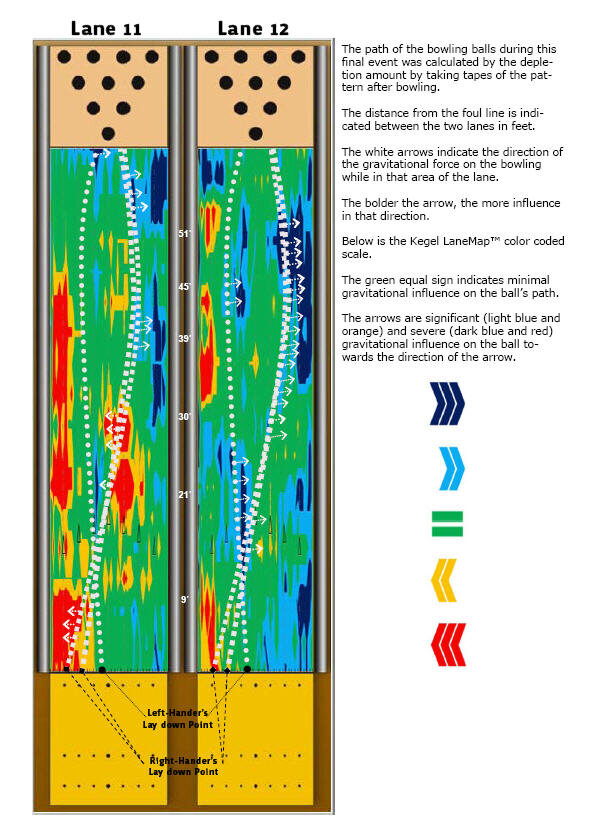
Sometimes pictures, or in this case a picture and a video, explains it best. The video below is the championship match of the Trio’s event at the recently concluded WTBA World Men’s Championship. The picture is the Kegel LaneMap™ of lanes 11-12 at Dream Bowl Palace.
The final match was played on the WTBA Mexico City oil pattern which is fairly flat and 45' in length. Our after bowling tapes showed the optimum breakpoint was around the 10-11-12 boards on that oil pattern at this championship.
The ball tracks of the left-handers and right-handers during the trios championship match are on top of the LaneMap™ Slope Graphs.
Sir Isaac Newton, the father of gravity, was not surprised with the ball motion of the players during this match - Newton has known for a long time that gravity has the same influence on the bowling ball as friction, or lack thereof.
The green areas on the LaneMap™ have very little gravitational influences on the bowling ball. The light blue and orange areas are significant gravitational influences on the bowling towards the direction of the arrows. The red and dark blue areas are severe gravitational influences on the bowling ball towards the direction of the arrows.
Now watch the video below and see if you can see and understand what Sir Isaac Newton already knew. He has been whispering in our ear for many years that it's not always oil or lack of oil (friction), as the reason the bowling ball reacts differently from one lane to the next, or even in certain areas of the same lane.
Pay attention to the right lane and how many light hits the right-handed players have. Then look at the above Slope Graphs in the break point area. Those blue areas signify a significant slope to the right - which is why the ball has a hard time moving to the left. Slopes to the right beyond the oil pattern (for a right-hander) acts like "carrydown". But it's not carrydown causing those light hits - it's gravity,
Water Walker
I think that in order to give this story as much credibility as possible, I am going to have to brag a little. I have been involved in doing the lanes with the PBA for over 800 tournaments, which included the National Tour, the Senior Tour and all seven Regions of the Regional Program. I am the only person who has done lanes for every bowler that is in the PBA Hall of Fame. In other words, I have seen them all. And, perhaps, I am really the only person who knows exactly what they bowled "on", as far as lane conditions go.

My personal All-Time Top-10, includes; Dick 'Water Walker' Ritger. You talk about TALENT. Dick was unbelievable. He was a world-class bowler, a world class guy, and later became a world-class coach. Without question he was one of the coolest, smartest, shot-makers in the history of our great sport. He could bowl on anything.
I have literally hundreds of stories of some of the tremendous feats that were performed by the greatest bowlers in the world; those that are in the PBA Hall of Fame.
This particular story took place in the early 70's. We (the Tour) were at Cranston Bowl in Cranston, Rhode Island. The weather was absolutely miserable as it had been snowing for about a week before we got there. It was 10-degrees outside when I got off the plane. Not only that, but my job as laneman was going to be a lot tougher this week because we knew in advance that the place was in bad condition because they hadn't resurfaced in a couple of years and all of the league bowlers had been complaining. And it was an old, drafty two-sided house and each side played drastically different from each other - as well as each pair playing differently from each other. I knew that I was going to hear about that.
After the first day of qualifying, Ritger was in the lead, which wasn't unusual for this 20-time champion (at the time). Almost every bowler was upset with the lanes and I had to hear about it.
That night at 2:00am I went in to do the lanes and it was now 19-below zero. There was so much snow in the motel parking lot, that and I couldn't find my car and had to walk about a mile to get to the bowl. About 15-minutes after getting there, part of the roof on the high-side (the real tough side) caved-in from the weight of the snow. It was a disaster. The janitor called the head mechanic who in turn called the Manager. He called everybody he knew to get in there to help clean up the mess. I called Harry Golden (the Tournament Director) to let him know what had happened. I cleaned and oiled the low-side then went over to take a look at what was going on over on the disaster side. There were about 20 people cleaning the water, snow, ceiling tiles and other debris off of the lanes and approaches. You could see the sky through the hole in the ceiling. I remember thinking: "I'm sure that the guys will blame me for this, too."
There were buckets on the lanes that were still catching water from the drippy roof. It was now 6:00am and the Pro's were scheduled to bowl at 9:00am. At that point I thought that there was no way. I started cleaning and oiling the part of that side that wasn't under water. When I got to the part of the house that had caved in, a "Miracle" happened. It had stopped raining and the dripping over the lanes had stopped. I cleaned and oiled the rest of the lanes. There were still some drips coming down over the lanes, but "Miracle number 2" was that the drips were only over the gutter gaps and the buckets that were placed there were catching all of the drops. It was about 8:45am now, and I took the lane machine to the back. The mechanic and all his helpers were back there huddled next to a little heater he had, and they were all trying to dry out.
When I came out of the backend, I saw about 20-bowlers standing in the settee on 31 and 32. I went over there to see what was going on. The only drips that were still coming down were over the approach on that pair and because of the full field, they had to use that pair in the tournament. Harry made the decision to leave the three buckets where they were on the approach. It was either that, or put 5 on a pair, and none of the bowlers wanted that. The buckets were to stay in place for BOTH squads.
I stayed around to watch the 1st squad bowl. After they bowled their 6-games that morning, the high game on the pair was 149. It was impossible for the players to walk around the buckets that were there to execute any type of normal shot.
Now the next squad came in to bowl. Ritger was scheduled to bowl his 2nd game on 31 and 32. It would be interesting to see what he could do there and not lose too much of the lead that he had enjoyed. When he got there for game 2 of this second day, there was a huge crowd in the bleachers, and standing behind the bleachers, as well.
I watched him (with no practice balls) alter his approach by snaking his footwork around the three buckets in a serpentine manner. I couldn't believe my eyes. He shot 279 like it was nothing. It was ridiculous.
The Beginning
The year was: 1956.
The place was: Hillsdale High School in San Mateo California
My first recollection of Billy Hardwick was that of disbelief. What a sight it was. He was a sophomore, a year behind me in school. He was all of 5’3” and weighed-in at exactly 99-pounds.
He came out and (tried out) for the Varsity football team. The Head Coach, Frank Collins, looked at him and said that he was too small to play, but since we were a new school and needed players, he told Billy that he could hold the blocking-bags during practice. He also told him that because of his size (or lack of it) that he wouldn’t be able to issue him a team uniform.
But, Billy had guts and said that he still wanted to play and practice with the team. It was a cold and rainy day in September. There he was in his ragged, old sweat-shirt, sweat-pants and wearing his tennis shoes. The shoes were those old “high-top” canvas style and the laces were tied around the tops about 4-times. His skinny, little ankles were way too small to fill-up the tops of the shoes and it looked like he was walking around with two small “sacks-of-potatoes” hanging off of the bottoms of his legs.
The practice field was very wet and muddy that day, and the first chance I had to block him and the big blocking-bag that he was trying to hold-up, I put a little bit of an “extra” effort into it. The poor little kid had no chance. He went slipping and sprawling and sliding before eventually ending up on his back in the middle of a huge mud puddle. On his way down, all you could see were arms and legs going in every direction as he tried in vain to maintain his balance. It was an absolute riot. Even all of the Coaches were laughing.
I intentionally humiliated him once again when I reached down to help him up and purposely stepped on his foot with my football cleats. He let out a scream and rolled over (face first) in the mud. Now, he was covered from head-to-toe in the sloppy quagmire. It was hilarious. Everybody there was howling. Everybody that is, except for Billy. Looking back though, I was probably a big “bully” for doing that to him. Even though he never said it, I am sure that he hated me for doing that to him.
Basically that was the end of his football career. He did go on to play on the basketball, baseball and cross-country teams. Despite his slight stature, he was a fierce competitor. As the years went by, he would eventually prove “that” to everybody. His burning desire that he possessed soon became evident when a new bowling center opened in our town and he was finally able to find (and master), his sport.
During that year we became the best of friends, and that friendship has been a close one for 6-decades. I owe him a lot from what he has taught me and the countless doors that he has helped me to open. We have (personally) endured a lot together and I have countless stories about him. I will be telling some of them here……at least the ones that are suitable for print!!!
History tells us that he did go on the Tour, twice becoming Bowler of the Year. He was voted in the top 20-players of all-time and inducted into both the ABC and PBA Halls of Fame.
Today, Billy is alive and well and owns a very successful bowling center in Memphis, Tennessee. I still see him now and then and occasionally talk with him on the phone. If you see him, tell him that I said hello.
By the way, he did pay me back. Yeah, he was the rotten egg that got me into bowling!