
What is "Waste" and Why You Should Care
What is “Waste?”
When most people hear the word “waste” they automatically think of chemicals or construction materials. And, they almost always think of waste as industrial and hazardous. Yet, the word waste is a very broad term that encompasses many different categories.
From your home to your bowling center, it is important to understand what waste is and how to dispose of it. With changing regulations, businesses that have been unaffected in the past, may soon learn the costs associated with improper disposal.
Residential Waste
First of all, everything that you put in your home trash can or recycle bin is considered a type of waste. Residential wastes can fall into a few different categories. Much of the waste we generate at home is recyclable. Think about the number of newspapers, magazines, cereal boxes (or other food boxes), soda cans, water bottles, and milk jugs that you use. Nearly all of those items can be recycled in some way. Recyclable wastes can be thought of as “good” waste. They cause little environmental impact and they don’t have any negative effects on humans.
But that isn’t the only kind of waste you generate in your home. Have you ever decided to paint a room? What happens to the extra paint when you’re finished with the job? You may keep it for some time but eventually it has to be discarded. Where does it go? Paints, bug sprays (pesticides), cleaning chemicals, and fertilizers are also examples of residential wastes. And, these wastes shouldn’t be thrown in your trash can. Many of these types of wastes must be disposed of more carefully as they can be hazardous to humans and the environment. In fact, many of these items are considered “household hazardous wastes”. Hazardous waste isn’t exclusive to industry; you probably have some of these types of items in your home right now.
These hazardous household wastes must be disposed of periodically and they can’t be just thrown in the trash. To assist residents in disposing of these materials, many local collection agencies arrange certain days of the week or month for residents to either put these types of items by the curb (similar to “everyday” trash) or to bring them to a designated drop off location for appropriate disposal. Items like used cooking oil and even electronics can be hazardous and should always be disposed of in a proper manner. Even light bulbs and batteries have special disposal requirements.
Commercial Waste
Businesses also generate waste. Some of the waste generated by businesses is just like the waste you generate in your home. Paper, soda cans, plastic bottles, and cardboard are all examples of wastes generated by businesses. These wastes, just like yours at home, can often be recycled and they would certainly be considered nonhazardous. But, businesses can also generate more dangerous or hazardous wastes. Hospitals and doctor’s offices have medical waste that must be disposed of properly to keep infectious diseases and germs from spreading. Industrial operations like chemical manufacturers, factories, and even construction sites all generate wastes that can be hazardous.
But, these businesses aren’t the only types that can generate such wastes. Businesses like the local bakery, the shoe store, and even the bowling center also generate waste. While these businesses may not generally create hazardous waste, they still generate waste that can’t always just go in the trash can or recycle bin.
Waste from Bowling Centers
A bowling center with a snack bar/restaurant can generate many different types of waste in each of its various operations. The snack bar/restaurant will generate food wastes, paper products and general trash, as well as wastewater from cleaning and used cooking oil from deep fryers. All of these wastes have different disposal requirements. The food waste and common trash items can generally be disposed of in a dumpster while the wastewater from cleaning; i.e. mop water, dishwashing liquids, etc.; can generally be flushed down the drain. Used cooking oil from deep fryers however, must be collected and disposed of according to specific regulations. In many cases, this material can be collected and recycled. And, in a lot of cases, the waste generator (the bowling center) may actually collect a fee from the recycler (the person who collects the waste for disposal and/or recycling). Many people would see this as a winning situation since they have to discard the cooking oil but they can make a little bit of money from the “waste” rather than having to pay someone to dispose of the oil.
The bowling center itself also has waste. Every time a lane machine moves down the lane to clean the lane and apply new lane conditioner, waste is created. The lane machine picks up a waste that is a blend of diluted lane cleaner, lane oil, and dust. Depending on the lane cleaner and lane conditioner used by the center, this waste is typically a large percentage of water. In fact, depending on the dilution ratio of the cleaner, the waste could be 90% or more water. Of the remaining percentage, a very small percentage; approximately 1%-2%; would be the lane conditioner while the rest would be lane cleaner.
The creation of this recovery tank waste is one of the most common waste questions I receive. When it comes to this waste material, everyone wants to know what to do with it and no one really wants to spend a lot of money to get rid of something that is mostly water. Unfortunately, as environmental regulations and waste disposal laws get tougher and tougher; many bowling centers are finding out the hard way that you can’t just dump this waste down the drain.
But, why can’t I just dump it down the drain? First, grease and oils are not soluble in water and tend to separate from the liquid solution. This means that when the solution travels through the pipes, the oil can settle and cause trouble; i.e. buildup which will ultimately lead to slow flow and clogging; in the piping. Secondly, oils also hamper the effective treatments that are performed at the wastewater treatment plants. In fact, it is because of this that grease traps and other type devices are required at some places.
Improper Waste Disposal
While the waste from the recovery tank of a lane machine would, in most cases, be considered nonhazardous, there are still appropriate disposal considerations that must be followed. And, to make matters even more difficult, the regulations vary by state, county, and city. Just knowing the federal regulations isn’t enough. Your state, county or city may have varying regulations so it is always important to check with the appropriate regulating authorities to determine your safest course of action. Improper waste disposal can carry hefty penalties as well as civil and criminal consequences. In fact, fines for improper disposal can be less expensive than the civil and criminal penalties imposed for the actions. And, the civil and/or criminal penalties could even include jail time!
As I mentioned previously, dumping your waste down the drain can cause problems with the sewage lines and at the wastewater treatment facility. But, it can also be traced back to the establishment as well. When sewage lines get plugged or have slow flow, maintenance workers have to clean the lines or even replace them. When this happens, the managing authorities can determine what caused the blockage. They can then pull samples from surrounding establishments to determine if the blockage was caused by one of them. By pulling samples from lines coming directly off of each of the surrounding establishments, typically, the managing authority can get at least trace amounts of the blocking materials allowing them to determine the offending establishment. They can then charge the establishment with a violation of the federal Clean Water Act. If this happens, the establishment may be required to pay for sewer line maintenance costs as well as additional water treatment costs.
Improper waste disposal can vary depending on the category of waste and the severity of the action. Improper disposal of hazardous waste would certainly be more severe and carry a harsher penalty than improper disposal of nonhazardous waste. That said imposed fines can be more than $30,000 per day! And that doesn’t even include civil or criminal penalties that could be imposed by a court. It also doesn’t include any additional treatment costs that may be imposed by the treatment facility or maintenance costs that may be required to replace or maintain sewage lines.
As I mentioned, the recovery tank waste will generally be considered nonhazardous. This is favorable as it is much less expensive to get rid of nonhazardous wastes than it is to dispose of hazardous wastes. Additionally, there are generally more options available for getting rid of nonhazardous wastes. This means you can shop around and find more cost effective alternatives which will save you some money on the bottom line. Generally speaking, depending on the number of lanes you have and the number of times you clean and condition your lanes per day, and depending on the regulations in your area, you could dispose of this waste for a few thousand dollars (or less) a year. When you start adding up the numbers for fines/penalties, it’s easy to see that the cost of appropriate disposal in one year would be far less than even one day of fines and penalties.
How to Properly Dispose of Waste
So now you’re probably wondering what you should be doing or even who to call that could help you get rid of this waste. As I mentioned before, regulations vary greatly by location so it’s extremely important that you find out what is appropriate for your area. You can always start with a call to your local waste management authority. They should be able to direct you to businesses in your area that can help you with your waste needs. You can also do an internet search for industrial waste or nonhazardous waste handlers. There are many companies around the world that can pick up and transport the waste to an appropriate facility for treatment or disposal. You can also call your local water treatment facility. They may be able to direct you to a company that can work with you. Lastly, if you use a service for a parts washer or even for oil disposal for your restaurant/snack bar, speak with your rep from those companies. They may be able to help you with this kind of waste or direct you to another company that can help you.
Waste disposal is becoming a part of operating a business and it is important, for humans and for the environment, that we dispose of all waste in the proper way. Businesses like bowling centers have generally flown under the radar. But, as regulations are becoming increasingly strict, there are increasing demands of wastewater treatment facilities, and the costs associated with treating wastewater and maintaining equipment increases, law makers and regulating authorities are taking a hard look at problems and where they are occurring. This means it is only a matter of time until your actions could come around to cost you. Taking the extra steps now to insure that you’re properly disposing of your waste may cost you a little bit of money now but it’s far less expensive than the fines and penalties you could be forced to pay, or the jail time you could serve, for improper disposal.

Who do you follow? We're not talking about Twitter...
In previous Inside Line articles, we showed how oil pattern breakdown happens with today's high flaring bowling balls and how different styles of play can affect an oil pattern in different ways. In this article, we will show how different groups of players with similar styles can greatly affect an oil pattern by strategically "managing the oil pattern" during practice time and the first game, and the resulting scoring pace for all those that follow these skillful "pattern managers."
The scene was the Men's Team event second block on the WTBA Seoul oil pattern during the 2013 WTBA World Championships in Las Vegas. The WTBA rule for practice time for 5 person team event is 15 minutes, then all teams bowl 3 games moving lanes every game. This gives us about 4-5 games per lane by the time each team finishes the 3rd frame of game one.
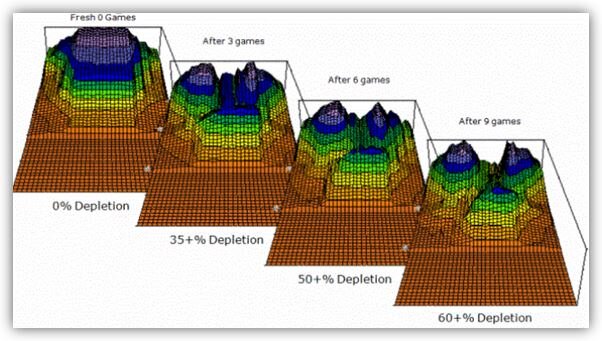
Our testing and after tapes at many modern day events show that when players play a similar line each and every shot during this time on a fresh oil pattern, over 50 percent of the lane conditioner can be removed from that area throughout the ENTIRE length of the applied oil pattern. This is significant and something all competitive players and coaches must be aware of in today's game.
Here was a test showing how much conditioner was removed in the area of play after each 3 games:
The significance and rapid pattern change is so prevalent in today's game that some Federations even employ multiple coaches during championships- one coach on the lanes helping the players during competition, and another coach "scouting out" the pair of lanes they will be moving to. Just knowing how and where the teams are playing on the lanes in front them can give them valuable information and help them get lined up quicker. In championship events, this can be the difference between winning, losing, or not even getting a chance to win. This played out exactly this way during the 2013 World Championships this year in the men's division.
Here is a graphic of the Seoul oil pattern just before the men's second squad of team event took the lanes - the graphic is with the perspective of looking at the oil pattern from the pins, so the 10 pin side is the left side of the graphic. Also shown below are the Sport Bowling ratios at multiple tape distances before the players took to the lanes:
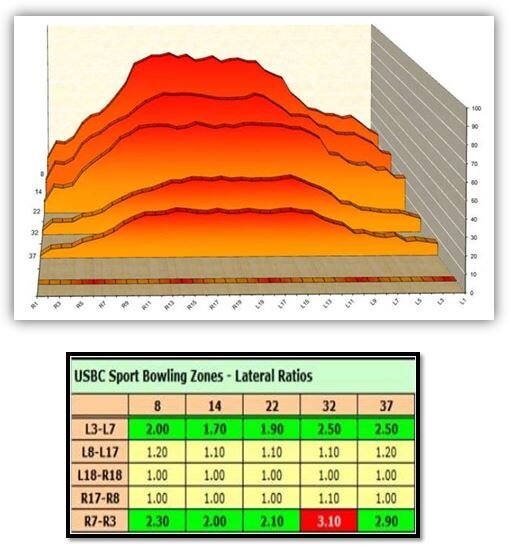
As a side note, the WTBA Seoul oil pattern is asymmetrical with more oil outside on the left side than the right side, hence the lower ratios on the left side. You may also notice that at 32' this pattern does not fall within the 3 to 1 ratio parameters, but Sport Bowling ratios only use 22' and 2' before the end of the pattern to calculate whether it meets USBC Sport Bowling requirements, and the WTBA does not have any ratio requirements.
During this second block of team play, with these pairs of lanes being right in front of the tournament office, I was able to watch and see how each of the teams on these pairs were breaking down the lanes during the 15 minutes of practice. While watching Puerto Rico and Brazil on 57-58 play more outside, and the teams on 55-56 play more inside, I was wondering how much an effect that might have on the teams coming to these pair of lanes in games 2 and 3, so I planned on taking after tapes as soon as the block was over. Little did I know at the time, the way the teams on 57-58 broke down that pair would help Team Finland make history.
After 15 minutes of practice and three 5-man team games (15 plus games per lane), here is what the Seoul pattern morphed into on lanes 55-56:
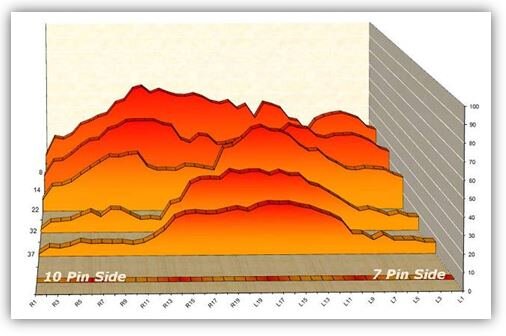
From looking at these after tapes, it is clear how deep inside the bowlers on this pair ended up playing the lanes, which all came from how the initial teams decided to play the lanes in practice and game 1.
Here are the after ratios of lanes 55-56, calculated the same way as before:
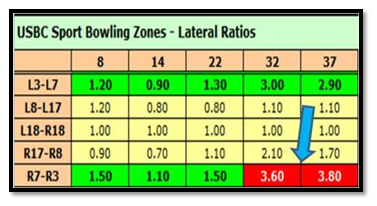
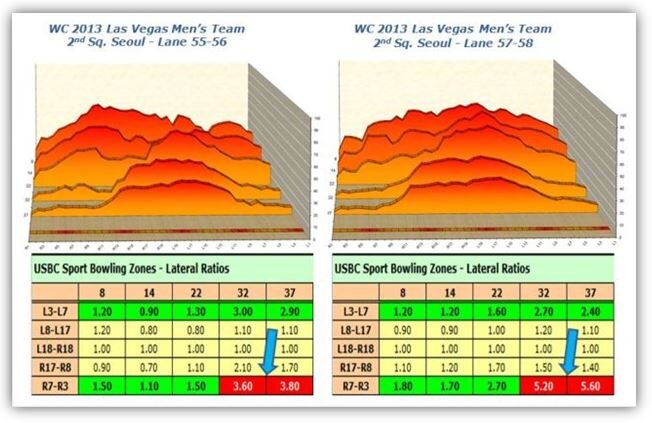
The ratios normally get lower up front as the oil pattern gets depleted from the middle of the lane. What makes scoring pace rise as players break down the oil pattern is when all balls come together towards the end part of the oil pattern, which raises the ratios from outside to the middle. In this example the ratios from the fresh oil pattern went from about 3:1 to 3.6:1 at 32 feet and from 2.9:1 to 3.8:1 at 37 feet. This is enough for world class players to increase the scoring pace, and this block was no exception.
Here is the resulting scoring pace of each team for each game of this particular block of games on lanes 55-56::
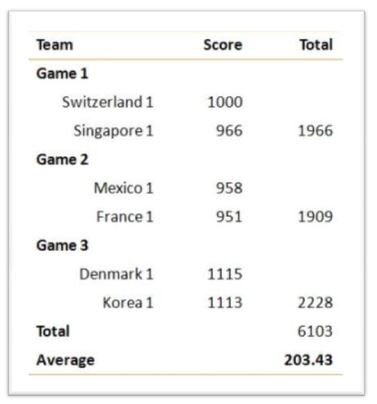
As you can see by game 3 that pair became more playable because of oil pattern development with both Team Denmark and Team Korea breaking the 1100 barrier. It took longer because of how deep the previous teams played that pair. The reason it took longer is because when teams start in the deeper amount of oil, it takes longer for the ball to reach the "spark point", or in other words, break down the oil pattern enough for the ball to poke through the oil film and get to the lane surface. Once the ball sees the lane surface, it also sees friction. The earlier the ball sees friction within the oil pattern, the easier that pattern becomes because left of that is the created oil line.
And now the pair of lanes where the Seoul pattern was changed into something else, which helped Team Finland make history. The mutated Seoul oil pattern on lanes 57-58:
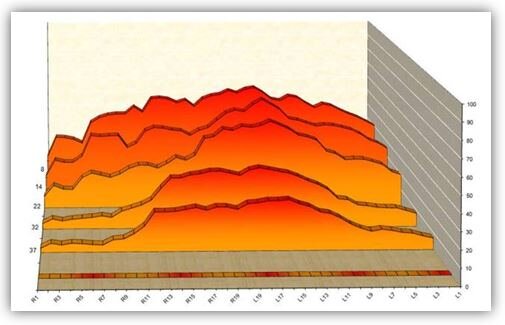
From looking at these after tapes, it is clear how much more outside the bowlers on this pair ended up playing the lanes, which also was decided because of how the initial teams decided to play the lanes in practice and game 1.
Here are the after ratios of this pair, calculated the same way as before:
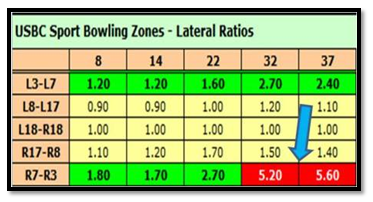
While lanes 55-56 went to 3.6 and 3.8 to 1 towards the end of the oil pattern, the players on lanes 57-58 took the ratios to 5.2 and 5.6 to 1! This is borderline what many house shots are in today's game, but like I said before, most of the change happens within practice and the beginning of game one.
Here is the resulting scoring pace on lanes 57-58 of each team for each game during this block of games:
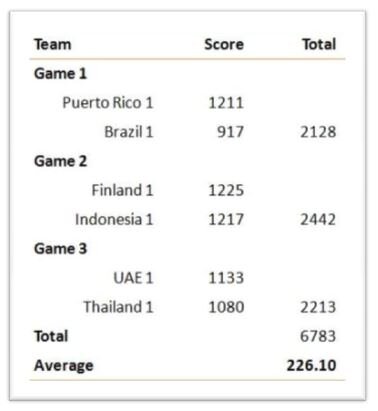
As you can see by the team game total scores, the teams that were fortunate enough to follow Puerto Rico and Brazil benefited greatly, but none more than Team Finland. This second team game with a score of 1225, along with the momentum that gave them and another 1200 plus score in game 3, catapulted them into the Team finals. After winning their semi-final match they defeated Team USA in the finals for the first team Gold medal for Finland in 30 years.
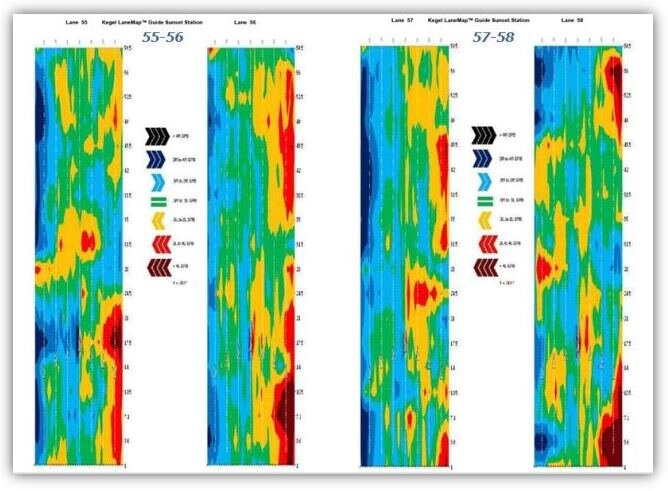
Fortunately, during this championship we also had available Kegel's LaneMap Guide of Sunset Station which shows the gravity influence on the ball based upon topography so we were able to see if one pair was significantly different causing that to be the reason for higher scores this block on 57-58, but that proved to be not the case, as the below graphic will clearly show. Both pairs have very similar characteristics.
Finally, one more look an after bowling graphic of both patterns and the resulting ratios side by side:
A well renowned Kegel laneman and now National Team Coach for Indonesia, John Forst, had a saying; "the applied oil pattern is only the pattern until the bowlers start bowling on it. After that, they are the ones that decide what happens, not the laneman."
In today's vernacular, the Seoul oil pattern, or any other named oil pattern for that matter, is only the intended pattern until players start rolling balls over it, and then that named pattern becomes something else. Some players can turn it into Easy Street, and some can turn it into the Highway to Hell. Keep your fingers crossed you follow players that can turn things into Easy Street.
Understanding 3 Point Targeting with Quiet Eye in 7 Easy Steps

By Rick Wiltse, Coach at the Kegel Training Center
In the history of bowling there have been many methods to allow bowlers to accurately roll a bowling ball from one point to another on a bowling lane. Probably the most common and easily recognizable target system has been the seven “arrows” that are placed between 12 and 15 feet past the foul line on most every lane in bowling. More specifically, the 2nd arrow on either side of the lane has become the most famous target for bowlers. In addition, bowlers have used pin bowling, spot bowling, area bowling, visualizing the ball path and breakpoint targeting.
All these targeting methods have been used with some measure of success, but none of these systems compare to the immediate improvement in accuracy and consistency that has been documented by using 3 Point Targeting and Quiet Eye.
At the Kegel Training Center, the coaching staff has been teaching this very effective targeting system called 3 Point Targeting with Quiet Eye. Although our research has proven that this system produces dramatic improvement almost immediately, it also has raised more questions by bowlers than any other area of bowling in my experience as a Kegel coach. In this article we will explore 7 Easy Steps to Understanding 3 Point Targeting with Quiet Eye and we will then answer some of the most common questions asked by our students at the Kegel Training Center. This process will hopefully give you a much better understanding of 3 Point Targeting with Quiet Eye which, in my opinion, is close to being a “magic bullet” in bowling.
Step 1 – How Long is the Oil Pattern - Find out the length of the oil pattern on the lanes where you will be bowling. This can be done by reading a program sheet or lane graph. You can also consult your local laneman or the center staff who may be able to tell you pattern length. If none of these methods work, you can roll a few slow speed practice shots and make an educated guess as to where the oil ends and the dry lane begins based on the hooking action of your ball.
Step 2 – The Formula PL Minus 31 - Take pattern length (PL) number and subtract 31. The result of this subtraction will give you the desired location of your bowling ball at the end of the oil on the pattern. For example, if the pattern length (PL) is 43, subtract 31 from 43 and the result will be 12. Board 12 (at 43 feet) is where your bowling ball should be to gain the most margin of error for this lane pattern.
Step 3 – The Focal Point - Look at board 12 at 43 feet down lane and draw a straight line to the pins. Pick out a part of the pin that most closely matches up with the line from board 12. Each pin will have 5 locations that may match the line.
1. Inside edge
2. Center
3. Outside edge
4. Inside base
5. Outside base
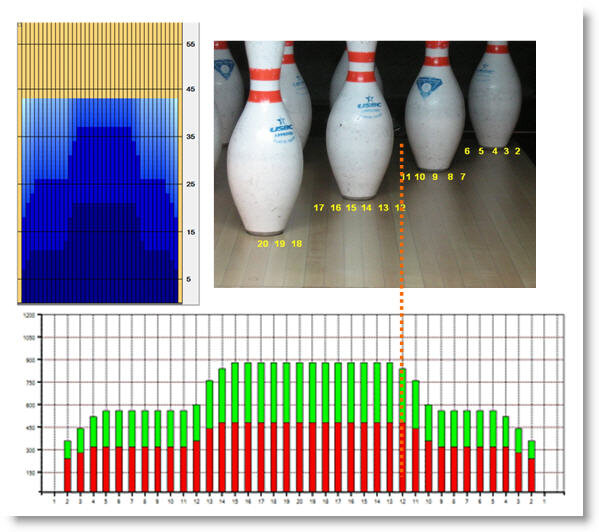
The pin location you selected for the 43 foot pattern should be the outside edge of the 3 pin (board 12) and this will be called your “Focal Point”.
Step 4 – The Visual Target - Now trace back from the outside edge of the 3 pin location along the line to board 12 and extend this line back to a visual target of your choice such as the arrows or dots. This location will be called your “Visual Target”.
Step 5 – Locate Your Starting Point on the Approach - Step up on the approach and align your body with the Focal Point and Visual Target by placing the inside edge of your slide foot 6 boards from the 12 board. In this example, that would place the inside of your slide foot on board 18. Now your body is properly positioned to swing the ball and roll it down board 12 toward the outside edge of the 3 pin. Achieving this trajectory will give you the most margin for error and the greatest chance to strike even if you miss your target on one side or the other.
Step 6 – Quiet Eye - Combine this targeting system with what we call “quiet eye”. To implement “quiet eye” simply focus on the “Focal Point” which in this case is the outside edge of the 3 pin for two full seconds – count in your mind 1001 – 1002. Then move your eyes smoothly from the focal point pin to the Visual Target at the arrows or dots. Again, focus on the Visual Target for two full seconds – a count of 1001 – 1002. Then take a breath, exhale and execute your delivery keeping your eyes on the Visual Target throughout your approach.
Step 7 – Drift and Shift - Note the position of your slide foot at the foul line and determine if you have any “Drift”. If so, adjust your starting position (based on the amount of drift) so that you will be sliding on the appropriate board at the foul line. In our example, you want to slide on board 18. If your drift causes you to slide 2 boards to the left (board 20), you will need to adjust your starting position on the approach 2 boards to the right (board 16) to compensate for your drift and slide on board 18. Finally, if you roll the ball down the intended target line and you don’t hit the pocket, you will need to make an adjustment or “Shift” such as a 2 and 1 move (2 boards with your feet and 1 board with your eyes) to hit the pocket. Continue to adjust as oil depletion occurs on the lane and your ball motion changes.
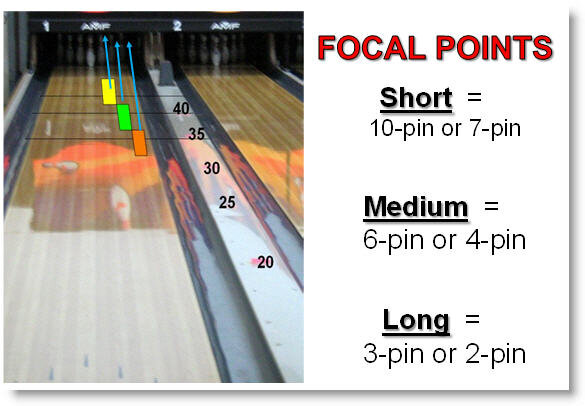
The Example below shows three focal points for short, medium, or long lane patterns, for both right and left-hand bowlers. Right-hand bowlers would focus on some part of the 10-pin for short patterns, a part of the 6-pin for medium patterns, or a part of the 3-pin for longer patterns. Left-hand bowlers would use the 7-pin, 4-pin, or 2-pin respectively.
Answering Questions About 3 Point Targeting with Quiet Eye
Question: Most students, who come to the Kegel Training Center, enter with a strong desire to get better and a willingness to try almost anything to improve their game. The exception to this willingness to try new techniques seems to appear most often when we ask a student to try a new targeting system. The comment is often heard, “But I’ve always used the 2nd arrow as my primary target”. The implied question is “Why should I change?”
Answer: The response to this question is simple. If you use a single point as a target such as the 2nd arrow, it is possible to roll a bowling ball across that target at an infinite number of angles – each time hitting the 2nd arrow, but each time the angle of the ball path will be different. In order to obtain consistency, two points are needed to create a straight line and a ball path with a single angle of travel. Thus, the use of at least two points for targeting increases accuracy and consistency to a degree well beyond the scattered outcomes of using a single point target.
Question: The 3 Point Targeting System begins with a simple mathematical calculation that we have termed pattern length minus 31 (PL – 31). For some bowlers who are feel players or who just don’t feel comfortable with math, this beginning calculation can be a roadblock to going further. The question for these bowlers becomes, “Why do I have to solve a math problem to bowl?”
Answer: The incentive to find out the lane pattern length by asking your local laneman or center staff or by consulting a program sheet is that by doing this simple subtraction problem you will gain the most margin for error. This means that every time you use this simple formula you will be able to miss your target left or right by the largest margin possible and still have a chance to hit the pocket and strike – not a bad incentive to go back to math class!
Question: The next question that we often hear is “How does PL-31 give me the most margin for error?”
Answer: If you examine the lane graph shown above you can see that outside board 12 there is a lower volume of oil on the lane. This means that if you miss your target to the outside, the ball will encounter less oil (more friction) and it will hook back toward the pocket.
The lane graph also shows that inside board 12 there is a larger volume of oil, thus if you miss your target to the inside, the ball will encounter more oil (less friction) and it will tend to “hold” its position and stay close to the pocket. In this way, the PL-31 formula insures that you have the most margin to miss your target and still hit the pocket and strike.
Question: So now let’s say that you’ve made it past PL-31. For example, you found out from the front desk staff that the house pattern is 40 feet long. You take the number 40 (which represents PL) and you correctly subtract 31. The result is 9. The next question is, “Now what do I do with this number 9?”
Answer: The number 9 represents the board on the lane that the ball should be on at the end of the 40 foot oil pattern in order to gain the most margin of error. Look down the lane to board 9 at approximately 40 feet keeping in mind that the lane is 60 feet long from the foul line to the head pin. From this point on board 9, draw an imaginary line to the pins and pick out part of a pin that corresponds to the imaginary line. In this case it will be the center of the 6 pin.
Then move your eyes smoothly back from the center of the 6 pin and a corresponding visual target of your choice (i.e. at the arrows; at the dots or at the foul line). This will allow you to select a starting position on the approach and to have two points of reference to guide your swing along the correct ball path to get the most margin of error.
In summary, 3 Point Targeting with Quiet Eye offers an effective method to increase your accuracy and consistency. Using the seven steps above, you should be able to obtain a clear understanding of how to practice this technique which will help take your game to the next level. For more information or to schedule a lesson, please contact the Kegel Training Center at: US Toll Free (800) 280-2695 or International +1 (863) 734 0200.
Silicone is Not a Four Letter Word
We’ll say it right up front - silicone in lane conditioners is a good thing. That’s right, it’s a good thing. In modern chemistry there are no other additives that perform, and are as safe, as silicone.
The idea of using silicon in place of carbon did not come to be until the early 1900’s, and the first patent ever issued for a silicon containing chemical was not issued until the 1940’s. This is when the term 'silane' was developed, later to be known as silicone.
In the early years of development, silicone products were developed and used everywhere with great success. But then some problems arose with silicone, and it came from wood polishes. It was noticed that these new products repelled water, and when people started to re-coat the furniture and floors that were polished with this new stuff, they could not get the finish to wet - the finish would fish-eye everywhere. Eventually they figured out the silicone was not cleaned off the outer layer of coating and when they sanded the furniture, they literally sanded the silicone into the wood.
A similar problem occurred in the bowling industry in the late 1970’s with a lane conditioner called 42/40. That lane conditioner was silicone oil and it created a bunch of problems with re-coating a wood lane, and this is when silicone was "deemed bad" by the bowling industry.
However, it was found that you could actually re-coat wood lanes in bowling centers that used 42/40 with success and without problems, it just required more work. A fish-eye remover was required to get the finish to wet the lane surface again, and ironically, almost all fish-eye removers contain a type of silicone.
So to say something has silicone in it, and therefore it is bad, is a very generic statement. But that’s what has happened in the bowling industry.
Currently there are thousands of chemicals that contain the Si (silicon), and they can be found in everything from cleaners to adhesives. In cleaners, there are silicone based surfactants and silicon based builders, with some of these even being used in the bowling industry today.
The reason for using silicone chemistry in products is simple; performance. Most silicone additives are used in very small amounts, typically less than 0.5%. With carbon based additives on the other hand, it takes 1-3% of those less safe amounts to achieve a similar performance effect.
Kegel uses 0.1% or less of silicone chemistry in its lane conditioners to increase performance, while keeping a focus on safety. The advantage with using this technology is achieving the desired properties with maximum safety for everything the conditioner comes in contact with, and those products are tested extensively to ensure just that.
Nevertheless there are still some that like to promote their products as silicone free, as if it’s a good thing. But, the alternative chemistry available for use today is much less safe in terms of health.
Don't fall for a sales or marketing pitch on a fear of something that happened a long time ago in a much lower tech era - chemistry has come a long way over the years. If you read the material list on the back of a product in your house you will find silicone in most of them. Silicone performance and safety make it great choice for use in everyday products, and also in lane conditioner. Bottom line, silicone is a good thing.
Read more about Silicone from Dow Corning
Read more about Silicone from the American Chemistry Council
Oil Pattern Graphs: KOSI Composite Graphs
How many times have you gone to a bowling tournament, or even a bowling league, and seen a lane pattern graph and not known what in the world you were looking at? I was at a collegiate bowling tournament where lane graphs were given to the teams at check-in and I heard many a team trying to decipher what the lane graphs meant. Over and over, I heard teams trying to decide where to play based on the lane graph. It actually surprised me how many people didn’t know what to look for.
If you are like me, and I know there are many of you out there, when you look at a lane pattern graph, you don’t really know how to extract information from it. Basically, you’re just looking at a picture of a lane or worse, some lane tapes that might as well be written in an ancient language. To help you, I have consulted some of the top minds in pattern theory for a little lesson in how to read and understand the various types of lane graphs.
To begin, we must first understand that there are different types of lane graphs. Some are related to the lane machine program sheet and some are related to the actual oil pattern on the lane.
Calculated from the lane machine settings (the program that is entered into the lane machine), we have the overhead graph and the composite graph. From lane tape readings (taken directly off the lane from the oil itself), we might see the 3D graph or the 2D graph. Each of these graphs look different and provide different ‘views’ of the oil pattern, but ultimately they all give you the same basic information – the shape of the oil pattern.
Some of the information you should look for, regardless of the graph type, is pattern distance, pattern volume, inside/outside ratios (don’t get confused, we’ll discuss) and pattern shape. All of these things will provide clues about what to expect from the oil pattern.
Pattern distance tells you how long (or short) the lane pattern is; in other words, how far down the lane from the foul line the oil is applied. A short pattern will play much different than a long pattern simply because there is longer part of the dry lane to deal with.
Pattern volume tells you how much total oil is applied to the lane. It does not tell you where that volume is; only how much oil is there. The total volume of oil is measured in milliliters and per board values are measured in microliters.
When you see a graph with units as the value, it is a calculated measurement based upon the ultra violet additive (UV) that is mandated to be in each batch of lane oil. The UV additive allows the optical lane reader to “see” the oil. Units of oil should not be confused with volume of oil.
Ratios tell you the difference in the amount of oil from left to center and right to center. Pattern shape is the shape of the oil on the lane. Some examples of shape are top hat, block, Christmas tree, or flat.
The first type of graph we’ll study, the composite graph, is one that most people will see most often. The composite graph is also called a volume per board chart. The composite graph, shown below, gives us the total amount of forward and reverse oil that is applied to the lane. The total amount of applied oil is calculated based on the program that is entered into the lane machine.
In actuality, the composite graph shows us the amount of oil on each board. The best way to understand the composite graph is to imagine taking all of the oil that was applied to the lane, then drag it back to the foul line and stack it up. This would look like the composite graph.
Take a look at the composite graph example below.
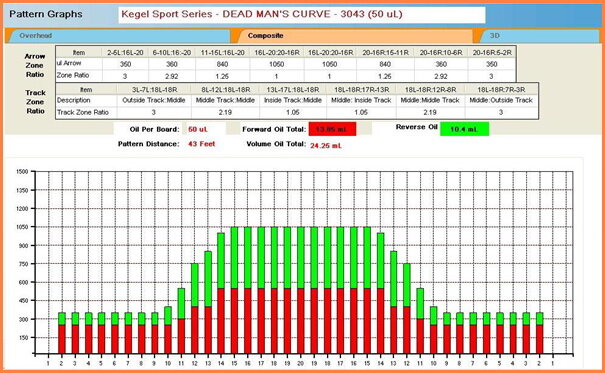
Along the bottom, or the ‘x’ axis for you math people, you can see the lane boards labeled; board one on the left to 20 in the center to the one board on the right.
Along the side, or the ‘y’ axis, the amount of oil is measured in micro liters.
This particular example is the composite graph for Dead Man’s Curve, a Sport pattern in the Kegel Navigation Series. Sport Bowling uses ratios to describe (or define) the level of difficulty of a pattern; a lower ratio is more difficult than a higher ratio. The Sport Bowling ratio is defined as the average amount of oil (in units) between boards Left 18 to Right 18 divided by the average amount of oil (in units) between boards R3-R7 & L3-L7, respectively.
While this graph does NOT give us units, nor does it tell us exactly where the ratios are within the oil pattern, it is still a good reference. In this graph, we can see that there is about three times as much conditioner in the middle of program as there is on the left and right side of the program; a 3 to 1 ratio.
The chart area above the graph, which you may or may not see on a composite graph as it depends on how the graph was generated (which computer software program generated the graph), also gives information on ratios in different parts of the pattern program. It may be somewhat difficult to read in this example due to the size of the picture; however, some information about ratios around the track area is given.
The track area is generally defined around the 10-board on either side of the lane (typically a bowler will play the track on a house shot). In this example, ratios are given for outside the track (boards 3-7 on either side of the lane), middle track (boards 8-12 on either side) and inside track (boards 13-17 on either side). In general, the lower the ratio of the oil, the more difficult the pattern will be to play.
In this example, the inside track (boards 13-17) would be very difficult as it is basically flat with a 1:1 ratio whereas the outside track (boards 3-7) would be somewhat easier at a 3:1 ratio. To put the ratios into perspective, a house pattern might be 6:1 or even higher. A high ratio program, like many house patterns are, will give the bowler a defined “ridge” to play against within the oil pattern.
This difference can help you determine how best to play the lane. Don’t misconstrue that; the composite graph can give you an idea of how to play the lane, but a common misconception is that it can tell you where to play the lane. This isn’t always true since the topography of the lane surface can often be more dominant than the oil pattern.
The composite graph is more of an idea of how difficult, or how easy, the oil pattern may play. Again, generally the lower the ratio of conditioner from the inside to the outside, or the flatter the oil pattern, the more challenging the oil pattern will be.
The last things to note in this graph, and they may be difficult to read because of the graph size, are the pattern distance and pattern volume. In this particular example, the pattern distance is 43 feet and the total volume is 24.25 mL.
Since a lane is 60 feet from foul line to head pin, there is 17 feet of ‘dry lane’ after our 43 foot Dead Man’s Curve pattern. That basically means there is 17 feet of friction that the ball must move through before it hits the pins.
We hope this information has helped you understand how to read a Composite Graph. It is important to remember that the information is only as useful as your interpretation. The graph isn’t telling you where to play; it is only providing you with some information to help you make an informed decision regarding lane play.
Next time, we’ll see another type of graph, learn about how to read it, and extract useful information from it. Until then, Happy Bowling!
JJ’s Blog - 2012 PABCON Championships
Friday August 17th - Travel Day
The adventure to Las Vegas started with the alarm going off at 2am. I have a 6:40 am flight and it’s a one hour drive to Orlando International Airport, hence the early trip to the airport. I’ve got a short 45 minute connection in Memphis, so hopefully we won’t be late leaving Orlando. I got to the airport with no issues but the flight was a few minutes late and they said we were taking a route near Chattanooga because of storms to the south of Memphis which was going to add a few more minutes to the trip.
We were about 20 minutes late in Memphis but fortunately I made it. The flight to Vegas was good but since I had a tight connection I was worried my luggage wouldn’t make it. Fortunately it did make it. I was going to rent a car for the day since we didn’t have any team functions set and pick up some chocolate and cupcakes for the team. Also it worked out good since the room wasn’t ready to check into yet. My good friend Diandra Asbaty came with me and we started out with lunch at Spago at Caesars’ Palace. We then took a walk to the Palazzo to check out a cupcake place that is home of the World’s Most Expensive Cupcake at $750. Needless to say we didn’t get any, but we settled on a couple of their regular ones, haha.
After that we went back to Caesars to shop a little bit where Diandra bought a purse and I picked up more chocolate at Max Brenner’s. We then went to Crystals at City Center where I did a little shopping and bought a shirt and then we headed to Mad Hatter Cupcakes to pick up some cupcakes for the Team. This is a unique place in that the cupcake is already made and they put the filling and frosting as you order it. Basically they customize it however you like. I got a dozen for the Team the next day.
I dropped Diandra off back at Sunset Station and then went back to drop off the car and then hitched a ride with the shuttle driver who was taking Shannon Pluhowsky back to the hotel. After getting back to the hotel I went to the room where my roommate for the week Steve Smith was already there. Steve and I went to In-N-Out and had a burger and then went back to the room. I was out not too long after getting back to the room since my day started out pretty early.
Saturday August 18th - Unofficial Practice Day
I woke up at 6:30am (which is seriously sleeping in compared to waking up at 5am in Eastern Time Zone) and went with Steve to go to the breakfast buffet but the buffet didn’t open until 8am. Went back to the room and watched some TV until 8am rolled around and then did breakfast and then went to the bowl for practice with the Team at 10am.
Practice went pretty well. I had to spend some time opening up my thumbholes since my hand always seems to blow up when I come to Vegas. I threw it pretty well and felt pretty good. After practice Steve, Marshall Kent and I walked over for a burger at Carl’s Jr. After killing a little time there I went back to the room and ended out taking an unplanned nap, haha! At 6pm, a bunch of us went to Mimi’s Café to have a little bite to eat. Afterward I then went to another dinner celebrating Leanne Hulsenberg’s birthday at a Japanese steakhouse. After meeting more than my allotted 500 calories for dinner I headed back to the room and crashed. A pretty low key day, but after getting up a little early I was feeling pretty pooped. Need to make sure I head to the gym tomorrow morning to get back on the fitness trail.
Sunday August 19th - Official Practice Day
I woke up on my own at about 5:30am but didn’t get out of bed until about 6:00am. I decided to go to the gym since it’s been since Thursday since I last went. I normally go to the gym about 5 days a week when I’m home, so it’s about time to get back on it. I never like to do anything heavy when I have to bowl so it just consisted of about 15 minutes of cardio, some pull-ups, a lot of abdominal work and stretching. After about an hour in the gym I went back to the room, showered and got with Steve and went and had some breakfast. We have official practice at 10am so I wanted to make sure I go there early to get ready because I feel my hand blowing up again so I need to allow some extra time to open up some thumbholes.
Practice session went very well. The patterns that will be used will be the 34’ WTBA Stockholm and the 44’ WTBA London. Though they’ve changed these patterns slightly at the beginning of the year, they still maintain a lot of the same characteristics that they’ve had in the past. In my opinion they are both on the easier side of the WTBA patterns, though not the easiest.
On the short I had a good look with both of the urethane balls I brought, so I decided to check them both in. The Storm Natural flares a couple of inches while the 1992 Ebonite Nitro doesn’t flare at all. I feel the pattern is short enough and there is enough friction in the surface to where I think my long pattern balls will work if I need them. Since the volumes are higher on all of the WTBA patterns this year, I feel you can get away with stronger covers, especially when the oil moves down the lane from all of the urethane balls.
The long pattern played a little shorter than I had expected. I had a good look there as well. It was a little tougher for me to play closer to the track as the ball wanted to pick up a roll a little earlier than I had anticipated but I did have nice ball reaction around 22 swinging out to the 12-13-14 zone down the lane. Over the course of the hour and a half of practice the lanes held up pretty well in my opinion. I got into a good rhythm physically so I have no complaints. I decided to check in my Ebonite Maxim for spares along with the Storm IQ Tour, Ebonite Innovate and Columbia Omen. In WTBA Zone Championship competition you are only allowed to check in six bowling balls, so you have to be pretty good at making some guesses as to what you think you’re going to see.
I had lunch at Panda Express with Steve and my good friend Vernon Peterson who came out for the weekend and then went in to watch the girls practice. At 3:25pm we had the opening ceremonies which lasted about 45 minutes and then we went back to the room. At 6:00pm Steve and I met Stefanie Nation, Josie Earnest, Liz Johnson and USBC’s Matt Lawson to walk to dinner at Tony Roma’s. After that we came back to the hotel and relaxed. The girls bowl at 8am tomorrow so I want to make sure that I get plenty of rest as we start bowling for medals tomorrow at 1pm.
Monday August 20th - Singles Event
We bowled in the afternoon, so I was able to sleep in even though I was still up at 5:30am. I went to the gym to do a workout with Steve and then we went to the breakfast buffet at 7:30am. We watched the girls bowl for a couple of games, went back to shower and then had Subway before we bowled.
We were bowling on the short pattern for the Singles which was the 34’ WTBA Stockholm pattern. I figured scores would be pretty high and that I’d need to have at least 1370 to be even close for a medal. Practice session went ok, didn’t hit the pocket too much because I think that Natural I was using flared too much. I knew it was wrong when my first two frames went Greek Church/Miss the headpin. I switched to my other urethane ball the Nitroand moved a little more right and moved my eyes left to where I was a little more on top of it and then I reeled off a 7-bagger to pull a 247 out of it.
I shot 248 the next game and then 227 in game three so I was at +122 for 3. That was putting me about 4th place. I moved to the next pair and keep inching right and taking some hand out of it because the oil was getting pretty thick down the lane with all of the urethane balls plowing it down. The non-flaring Nitro was able to keep me on top of the dry without the ball over-hooking if I got it a little right quick. I shot 235 in game to put me +157.
In game 5 I started to lose ball reaction. The ball went a little long in the first frame for a 2-4-5 and I slid by wrapping the 2 around the 4. The next 4 frames went strike, stone-8, ring-10, 4-9. I now had 75 in the 5th and was in trouble. I felt like I needed to get the ball to go through the pins better to I decided to move 2 left and use more grip pressure. I reeled off a 5-bagger but in the 11th frame I came in light and left a paralyzer 5-pin. Needless to say I was a little naked after bowling a really good game with the exception of the first frame for only 214 - that put me at +171 and in about 7th place going into the last game.
I knew I needed at least 260 the last game to have any kind of chance at a medal because the scores were too high, even though I hadn’t looked at the scoreboard until the middle of game 5. I debated whether to throw resin the last game, but it didn’t look real good on my fill shot shooting the 5-pin. I decided I needed to stay with the stronger hand, but on that 5-pin it obviously didn’t go through the pins real well so I needed to do something to help it slow down - I decided I’d move another board left and soften the speed.
I started the game with a double and I knew right there by watching how the ball went through the pins that it was the right look. It was just a matter of me just getting it off of my hand after that. The next thing I knew I had the front 9! I had been inching a ½ a board about every 3 frames and I knew that I need to keep the hand pretty strong so I inched another ½ a board in the tenth and I threw it where I needed to but I missed it a pinch at the bottom and left fortunately only a 2-pin. I covered the spare and then tried to catch it a little more on the fill ball and left a 6-pin. I didn’t know where I was at because I finished about 3 frames ahead of a few of the people in front of me but I later found out that I won!
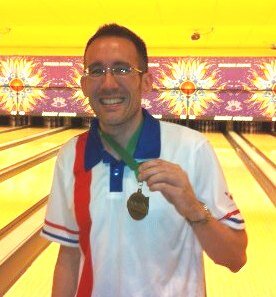
I was behind the leader Marcelo Suartz by 71 pins going into the last game but he only shot 181 the last game. I had a great feeling of relief and joy considering I wasn’t even near a medal 20 minutes ago. You always have to believe in yourself and never give up.
I was quite elated to say the least, but I was starving so I went with my roommate Steve Smith and Patrick Allen to Romano’s Macaroni Grill for an enjoyable dinner and then called it a night because I had to bowl early tomorrow in the Doubles with Steve at 8am.
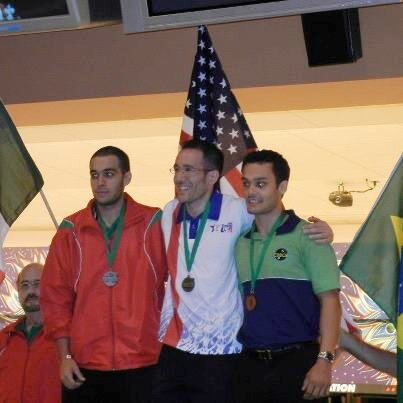
Tuesday August 21st - Doubles Event
The alarm went off at 5:30am but actually I was up about an hour earlier. I had a hard time sleeping for some reason. I don’t know if it was the excitement of the Gold Medal yesterday or what but I was awake at 4:30am even though I didn’t get out of bed until the alarm went off. Showered and had breakfast with Steve at 6:30am as we had to bowl at 8am.
The Doubles was going to be on the Long pattern and I had a good look on it in the practice session but it wasn’t quite as good for the Doubles. I struggled shooting 167 the first game where I felt I was too far right. Then I switched balls and went farther in and shot 232. Then we went to the next pair and it was different enough where I lost my look and shot 179 with a late double. Tommy Jones came up to me and said that he thought I was too far left and needed to go straight through the fronts a little more and get more up the back of it and/or use more ball speed to keep it on-line. I think in retrospect that was the problem. I think I was a little too slow ball speed-wise and I moved left and used a weaker ball because of it. Steve was a little right of me but his ball speed was higher and he was bowling great. It’s frustrating when you don’t see the picture and you’re scoring terrible because of it while everyone else is striking. I’m still mad at myself as I type this for not seeing the picture soon enough.
Fortunately I saw it quickly enough to where I shot 716 the last three. The last game we made a run and I had the front 7 but I cut one off a pinch for a 3-6-10 and then I chopped it. Steve punched out from the 4th frame for 245 and I went flat-10 in the tenth for 245 as well. The good news was we snuck into a Silver medal but we lost the Gold by only 28 pins. I was feeling that 270+ game just like yesterday but I couldn’t milk two more frames of it. It was ok though because our teammates Bill O’Neill and Tommy Jones won the Gold and there is no shame finishing behind them. Steve bowled great as he was +283 alone for 6.
We went and grabbed some dinner with Josie and Stef at Buffalo Wild Wings across the street and called it a night. We had to bowl Trios at 9am so I wanted to get some sleep.
Wednesday August 22nd - Trios Event
I had trouble sleeping so I decided to head to the gym for a workout at 5:30am. After an hour workout and a shower, Steve and I went to breakfast at 7 and then headed down for the Trios. It was going to be me, Steve and Patrick Allen. I was really looking forward to it.
The day started off great as we were leading after 2 games with +203 but then we went to 5-6 and the left lane hooked a lot more and after a few splits we only shot 612. Thank goodness PA shot 258 that game. We bounced back with 686 in game 4 but then in game five, transition was starting to affect Patrick. The righties were getting pretty deep and we were starting to torch his lay-down area. He was bowling unbelievable up to that point as he was +180 after 4 games himself and the fourth game he went strike, stone 9, strike, stone 8, strike, ringing 7 and then off the sheet for 240. PA started to struggle and neither Steve nor I were able to help him much either as we were struggling with the transition as well. We shot 636 and 614 the last two to miss a medal by 40 pins. Not the best of days as we finished 5th and our other Trios team of Tommy, Bill and Marshall Kent finished 2nd.
Afterward it was me, Stef, Steve, Josie, PA, Liz, Diandra and Matt Lawson for dinner at the Italian restaurant at Sunset Station. Salmon and sautéed spinach it was for me. It was a well needed change after some of the chocolate I had that afternoon, haha! It was kind of a long day so I went back to the room, checked a little e-mail and then was out by 10pm. We had to bowl at 8am and breakfast was at 6:30am so I wanted to make sure I got some sleep.
Thursday August 23rd - The Big Daddy, Team Event
I woke up a little before the alarm went off at 5:30am and then after shower and breakfast headed down to the bowl. It was now the first day of Team event, the granddaddy of them all.
We were bowling on the short pattern today which was my best pattern by far. I had the trusty Blue Nitro ready to go. We were bowling well as a team and I had a really good look the first game. I actually started the game with the front 9 but going into the tenth frame I did something that I’ve never done in my life. I was trying to play around 5-6 at the arrows and get it to like 4-5 down the lane and I threw it in the gutter on the front 9! Doh! What made it worse was I left a 4 pin on the fill ball so I shot 258 the first game. It wasn’t as much the embarrassment that bothered me but the fact that I cost the team a potential 42 more pins that first game. We ended out shooting 1119 the first game which put us in 3rd.
We went to the next pair and the pair seemed the same as I started with the front 3 but then I got it a little right and it went 2-4-8-10. After getting 2 I threw a double and then went 4-6-7-9. I didn’t think I threw it that bad even though that lane was hooking a little more. I then went back on the right lane and went 2-4-8-10 again. At this point I didn’t know if I needed to throw resin and hook it but at the same time no one on the team was really crushing them with resin either so that made it even tougher to decide.
I decided to stay with the Nitro in the ninth and then left a 4-pin and converted. I tried my Omen in the tenth but threw a bad shot and left the 1-2-8 and I went to hook at the spare and managed to leave the 8 after making the 1-2 on the left. Stay hot! A three-bagger and a double for 169…..nice job. Needless to say I was a little livid at that point. We shot 1014 despite my sub-par performance but we lost ground to the field.
We went to the next pair and I talked with Tommy and Bill on what I felt like I needed to do. I watched Rolando Sebelen from the Dominican Republic shoot 260 on that pair hitting up on a Black Hammer and thought I might be able to do the same while getting slower. I tried that in the first frame and went 3-6-10 so that wasn’t a good idea. I made the spare and then I switched to and IQ Tour and threw it terrible for a Brooklyn 5-pin but made that spare. Steve had suggested trying that Innovate again since that’s what I used near the end of the Trios and lineage-wise they were getting to about the same point. I did that and managed to string a three-bagger and then came in light for a 4-pin on a shot that I missed a little at the bottom.
We were all starting to string strikes so we were feeling the momentum start to swing. We ended out shooting a huge 1184 the last game and I managed to punch out for 258. That put us in first by 45 pins going into the long pattern on Friday. It was nice to shoot a big game to help the Team the last game but at the same time I also felt a little bad because I left so many pins on the table those 14 frames in the middle. I have to say I don’t remember having that many strikes for 685 ever, haha! I’ll be bowling with the pacer team tomorrow on the long which frankly I think is the right call. The other guys definitely had a much better look on the long than I had this week and I’m sure they’ll do great as this is definitely their “money” pattern.
We went back to the room and changed clothes and went to Pizza Hut with Steve and his wife Christine who just flew in last night. After consuming way more than my 500 calorie allotment for lunch, I went back to the room to check some e-mail and then went to watch the girls finish out their team event. They shot 1185 and 1132 to finish out but they’re only leading Mexico by 14 pins. Mexico is bowling quite well. Liz shot 785 on the short to help power the team which was 100 pins better than the highest guy on our team. Great bowling Liz!
We then carpooled after bowling to eat at Claim Jumper with the Team and some of their spouses and friends. It was a really good way to end the night with about 20 of us enjoying a good meal. After that, it was off to bed. The girls bowl in the morning followed by the guys in the afternoon.
Friday August 24th - Team Event Day 2
We bowled in the afternoon, so I had some time to relax and watch the girls in the afternoon. We were bowling on the long pattern today and I was going to be the one bowling with the pacer team. My look on the long wasn’t quite as good as the other guys so I understood the decision, though I was excited to bowl because I bowled much better on it in the Trios.
Lucas Wiseman came up to me and said that since I was bowling on the pacer team that I was destined to shoot 750. Little did he know he was going to be correct. I started out great with a 258 game with a smash 7-pin in the middle. I managed to back it up with a 248 in game 2 and a 246 in game 3 for a 752 series. It was actually a well-bowled set which consisted of no open frames. I was quite a few pins short of the all-events medals but I knew that if I popped out a big set that all things were possible. I ended out missing the bronze medal in all-events by 3 pins. Oh well, I gave it a good run by punching out from the 7th frame of the last game.
As far as the Team event, we were pretty close after one but we shot a huge 1243 game in game 2. That gave us the lead by about 170 going into the last game which we managed to win. Yay, 2ndgold medal for me this tournament to go along with the silver medal I got in Doubles with Steve Smith. It was a good day. We ended out celebrating at the Sonoma Cellar Steakhouse at Sunset Station as a group where I had a nice meal of Sea Bass and Truffle Mac and Cheese. Nice way to end the night. Off to bed as the Masters starts at 8am tomorrow.
Saturday August 25th - The Masters
After the 6:30am breakfast it was off to the bowl for the Masters portion of the tournament. The top 24 bowled 6 more games and then cut to the top 8 for 7 games of match play with 20 bonus pins for a win. All pin fall carried over so I was in a good position to make it being in 4th.
The lanes were pretty much the same as they had been but they were a little tighter down the lane which isn’t unusual for a multiple re-oil tournament in its 6th day. Somehow I was making them a lot tougher than they really were shooting 185 and 178 the first two games opening in bowl 10thframes. It was a real comedy of errors. I was too slow on the left lane the first game and split twice and then I went to the next game and had the left lane figured out and then lost the right lane where I split twice and slipped and hit my ankle and threw it in the gutter in the 2nd frame. It was just an all-around disaster. After spotting the field 100 pins the first two games I finally got back on track and finished the block about +86, which was good considering I was -37 after two. That left me in fifth going into the round robin.
The round robin was kind of an up and down experience. I won my first two games shooting 245 and 225 but then I lost my next 3. Had a 279 game shot at my 246, nice draw ha-ha. I won against George Lambert IV in game 6 so my last game was against my teammate Tommy Jones. I had a good look starting out three-bagger, spare, spare, double but Tommy started with the front 6. I spared in the 8th frame but I was starting to lose my look as I thought I threw it really well in that frame for a 2-5. Tommy opened in the 8th and 9th so I had a chance to lock him out if I punched out. Mind you I didn’t know what I needed to get to the top 4, but I knew I needed to keep striking. I threw a horrible shot in the 9th for a 2-4-10, but made the split. I got up in the tenth and after coming in light I decided to stay in the same spot and just make a better shot but dead-yanked it left for a 3-6-10 spare. I still didn’t know what I needed but I knew I had to get all I could, but I chopped the spare to finish with 209. Tommy marked in the tenth to finish in the 220’s. I found out later I needed to beat Tommy for the bonus pins and/or strike on the first ball in the tenth and fill twenty. I ended out missing the medal round by 14 pins finishing in 5th place.
That was a hard one to take since I had my fate in my own hands and threw it terrible two frames in a row and missed a spare that I normally make quite regularly. It was a bitter pill to swallow, but like with all things in life I’ll learn from it even though it still bothers me as I type this. Me not finishing the tenth frame allowed George Lambert IV finish 4th in which he beat Tommy (who was the #1 seed) in a one game match and then went on to beat Puerto Rico’s Frankie Colon by shooting 300 in the final. It was fun to watch and I was very happy for George who I’ve known for many years. Overall, it was a very good tournament for me even though it had a very bitter ending. There’s always room for improvement and it was another good learning experience for me.
We had the banquet at Club Madrid inside the casino and it was a good time with teammates and friends. The lasagna was really good and I helped myself to a double portion of carrot cake ha-ha. I headed back to the room about 12:30am and had to take the 4am shuttle and I still had to pack so it was going to be a late one to say the least.
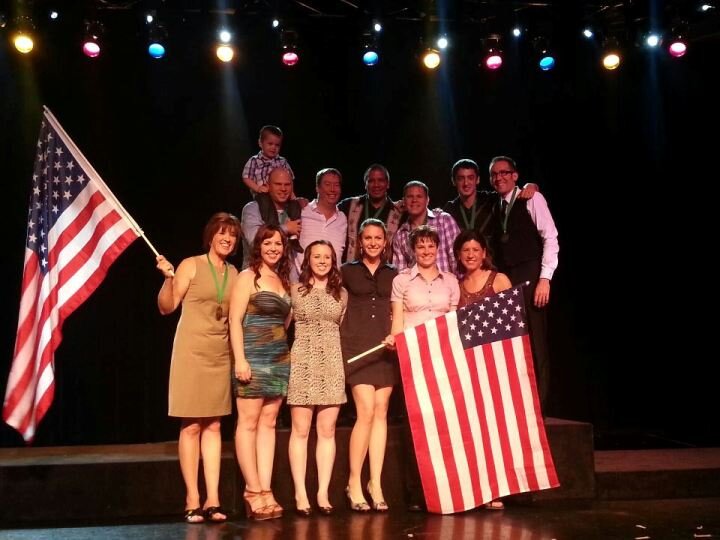
I made my flight and got home safely but it was a quick turnaround since I had to fly to Hong Kong the next morning as I now have to put my Kegel hat back on to oil lanes for the ABF Asian Championships. I want to thank Team USA and Kegel for supporting me and giving me the opportunity to be able to participate in the PABCON Championships and hopefully I’ll get to represent the USA in a tournament next year.
JJ
Breakdown and Carrydown - By The Numbers
In our last Inside Line feature article, Breakdown and Carrydown – Then and Now, we discussed the reasons why breakdown and carrydown are different today. For this edition’s feature article, we will add some data and visuals to support the previous article. The data was taken from the recently concluded European Bowling Tour Masters in Munich, Germany and it shows the same thing we often see in bowling tournaments today.
The event consisted of the top 16 men and women from the 2011 European Bowling Tour point list. On the men’s side there was a mix of styles; high rev players, medium rev players, and low rev players, with fourteen right-handed players and two left-handed players. On the women’s side there was also a good mix of styles, even though most fall into the medium to low rev rate category, with 15 right-handed players and one left-handed player.
The players on the men’s side were: Martin Larsen (RH), Mika Koivuniemi (RH), Karl Wahlgren (RH), Sean Rash (RH), Gery Verbruggen (LH), Dominic Barrett (RH), Perttu Jussila (RH), Syafiq Ridhwan (RH), Osku Palermaa (RH), Mik Stampe (RH), Paul Moor (LH), Dennis Eklund (RH), Jesper Agerbo (RH), Robert Andersson (RH), Thomas Larsen (RH), and Stuart Williams (RH).
The players on the women’s side were: Rebecka Larsen (RH), Clara Guerrero (RH), Mai Ginge Jensen (RH), Krista Pöllänen (RH), Nina Flack (RH), Patricia Luoto (RH), Wendy Kok (RH), Bianca Wiekeraad (LH), Britt Brøndsted (RH), Joline Persson-Planefors (RH), Jacqueline Sijore (RH), Zandra Aziela (RH), Lisanne Breeschoten (RH), Nicole Sanders (LH), Heidi Thorstensen (RH), Sascha Wedel (RH).
The Data and Graphics - Breakdown
The oil pattern used for the event was Kegel’s Navigation Sport Series pattern The Turnpike. This pattern is almost flat from the midlane to the end of the pattern because the forward application consists of only 2L-2R loads. The shape from the mid portion of the oil pattern to the foul line is built on the return pass.
Here is a graphic of the fresh oil pattern with tapes taken at 8’, 22’, 32’ and 39’ (left side of the graphic is the right side of lane, right side of graphic is left side of lane – you are looking at these graphs from the pins perspective):
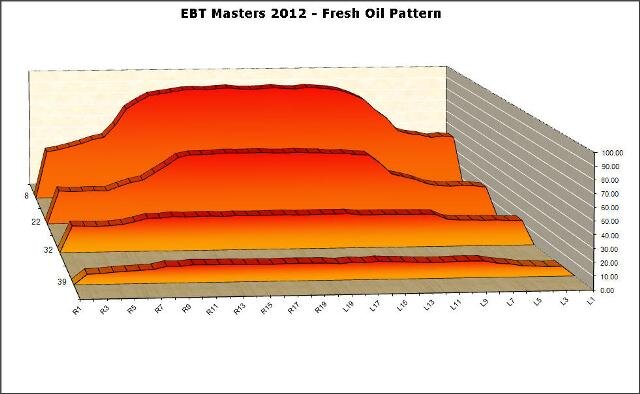
As we have known for many years, apart from the type of equipment being used, how the oil pattern breaks down is dependent on where the players play on the lane. When styles or rev rates are more similar, players tend to play in a more similar area of the lane, causing a much different type of pattern breakdown than when styles and rev rates are more diverse.
During the EBT Masters, all blocks consisted of 6 games with four players per pair, which equals 12 games per lane, plus ten minutes of practice. In comparison, a five person league would be 15 games per lane, plus 10 minutes of practice.
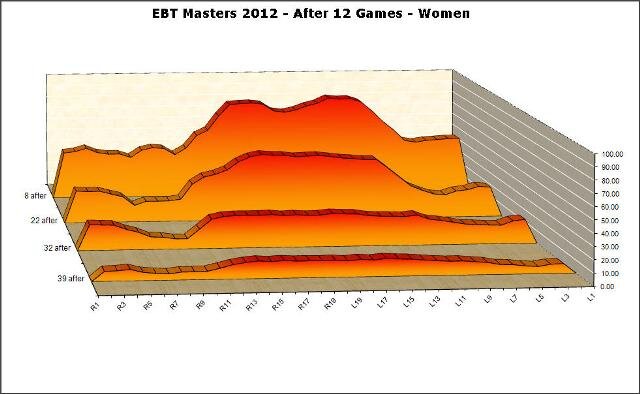
Here is the graphic of the EBT Masters pattern after one block of play by the women:
Here is the same graphic of the men’s pattern breakdown after one block of play:
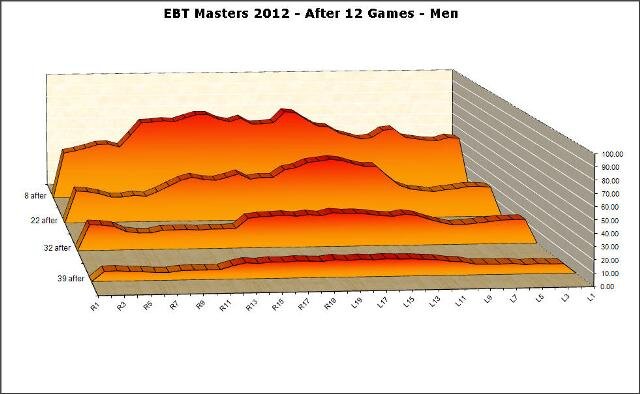
You can plainly see (I hope!) that the pattern breaks down significantly different when styles/rev rates are more similar versus when styles/rev rates are more diverse.
Here is a graphic of the before to after bowling between the men players and the women players at each tape distance, 8’, 22’, 32’ and 39’ (fresh oil is behind the after bowling tape):
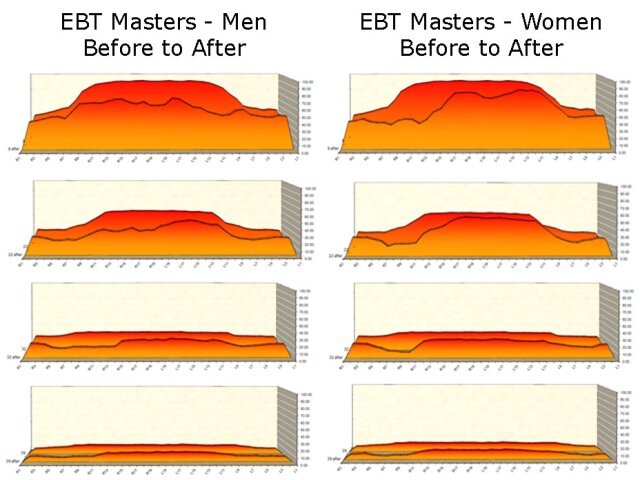
This graphic clearly shows how the lower rev rate women players “cliff” the oil pattern much more than the men players simply because the women play in a more similar area.
But now comes the interesting part of this breakdown pictorial and data article – the numbers.
What we often track is the oil depletion in percentages from that of the fresh oil pattern. As you will see, the percentages match up to the above graphics. What might surprise you is how much each group depleted. Common thought is high rev players deplete much more conditioner than lower rev players, but is it really so?
Here is the depletion by percentage on the men’s side of the event, with the square boxed area being a guide to show where the greatest depletion took place:
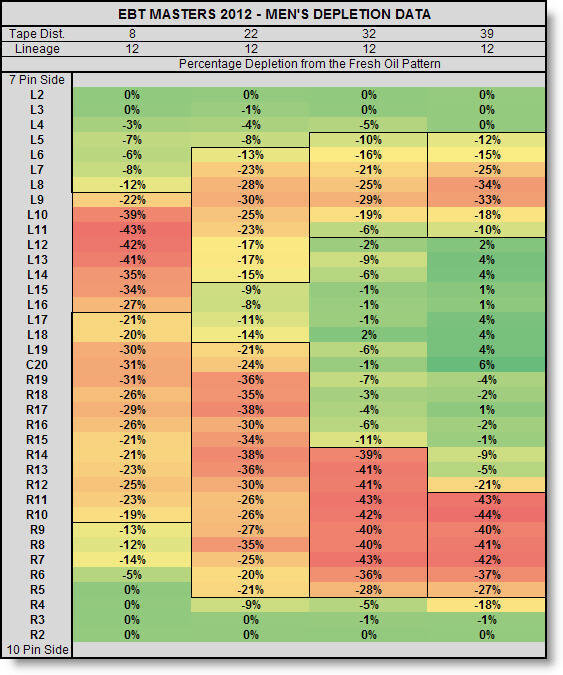
As you can see, the men took off about 40 plus percent at each distance throughout the oil pattern. After about 4 games of play, the right-handed players and the left-handed players came together in the fronts (8 feet) from boards L10 to L15, causing the greater depletion numbers in that area.
Before that move left, the right-handed men players continually moved towards the inside portion of the lane in their lay down area, yet they were still playing to near the same exit part of this 41’ oil pattern, between boards R5 and R11.
So how many units were left in the oil pattern after play? And what area of the depletion caused them to move left?
Here is a graphic of the before, on the left side of the graphic, and after tape data, on the right side of the graphic:
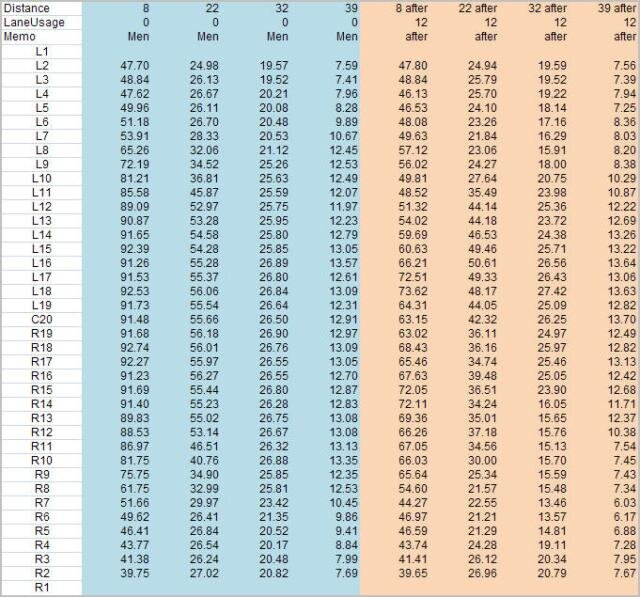
As you can plainly see, at the 8 foot distance of the pattern, after 12 games plus practice there was still over 60 units of oil on the lane. Only when the left-handers and right-handers lay down point became similar did we see the 50 unit barrier get broken, and that was only on a couple boards.
As we pointed out in the last feature article, the depletion towards the end of the oil pattern is what causes players to move left in today’s game, not “the fronts”.
Now the depletion tape data in percentages from the women’s side of the event, and as before, the square boxed area is a guide to show where the greatest depletion took place:
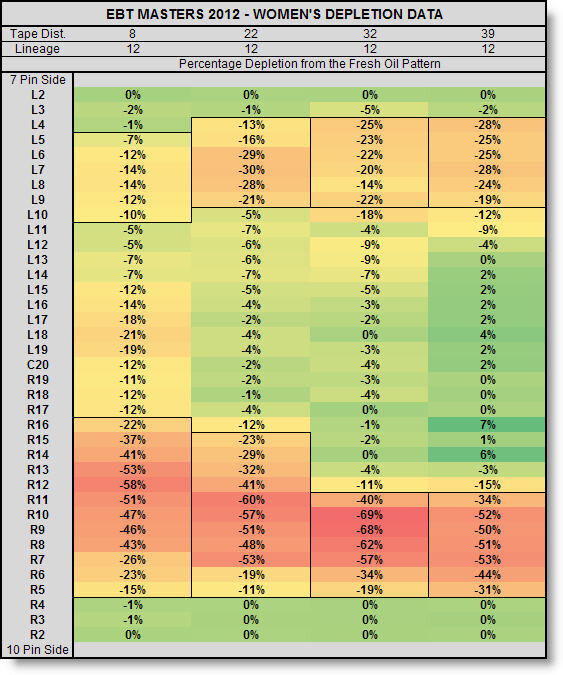
As you can see, because the women’s styles are more similar, as well as their rev rates, this group tends to play in a tighter area of the lane. This causes more depletion than when everyone is spread out all over the lane.
If you notice, the greatest percentage of depletion is at the 32 foot mark. The reason is, for the women players, all shots are starting to come together at this distance and there is more oil in that area than the end of the pattern - more oil equals more change.
Now let’s look at the same graph of the tape data in units of a women’s block after 12 games:
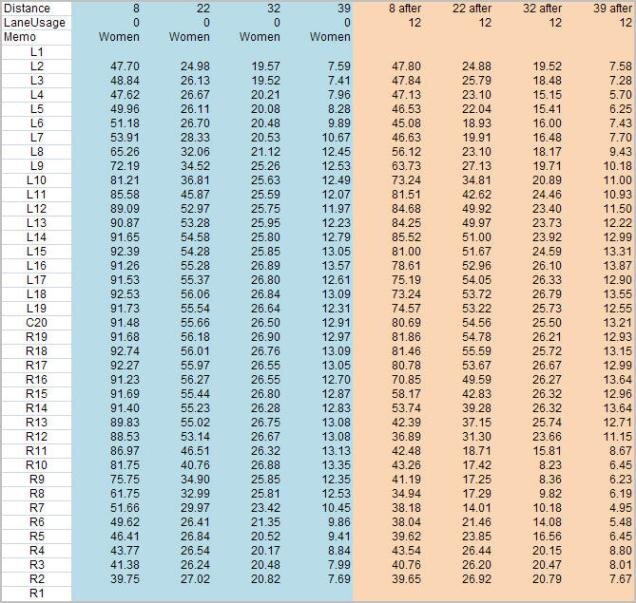
As you can see by this data, the women actually erased more oil off the lane in their lay down area (8’ tape) than the men did, yet still not enough to make the ball hook early, or make them move left because “the fronts have gone away”. The end of the pattern however is once again, another story.
The women have “ganged up” on the exit point of the pattern causing the 10-12 units of fresh oil at 39 feet become 5-6 units by the end of play. At 32 feet, the fresh 25-26 units of oil became 8 units after bowling.
This back-to-front oil pattern breakdown is the cause of the players moving left, not the old school front-to-back oil pattern breakdown we used to have before bowling ball track flare became a dominant force.
Also, to give you an idea how much oil is left on the lane by each group at each tape distance after bowling, here is what the tape data showed as an average amount of units at each tape distance:
- The men players at 8’ had an average of 54.35 units left on the lane, at 22’ an average of 31.73 units, at 32’ an average of 19.93 units, and at 39’ an average of 9.84 units.
- The women players at 8’ had an average of 58.79 units left on the lane, at 22’ an average of 30.79 units, at 32’ an average of 18.60 units, and at 39’ and average of 9.40 units.
Carrydown Data
This next graph and data might surprise some people, although it will make perfect sense once explained. I have been watching this in action over the last few years and it is something as lanemen we have no control over.
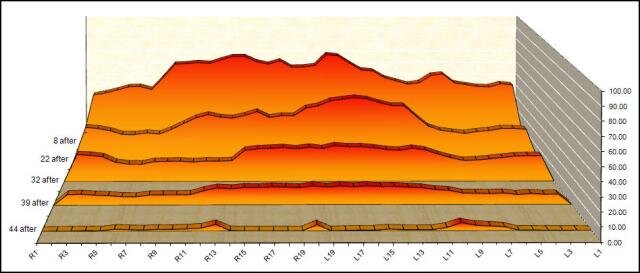
During this event we took carrydown tapes of the men and we will show the same percentage graphic as before with an additional twist, the carrydown tape in units. We do this so you can plainly see the exit points within the oil pattern of both the right-handed and the left-handed players.
Here is the graphic with carrydown tape visual (left side is right side of lane, right side of graphic is left side of lane – you are still looking at these graphs from the pins perspective!):
Here is the data, depletion percentages plus carrydown in units of oil:
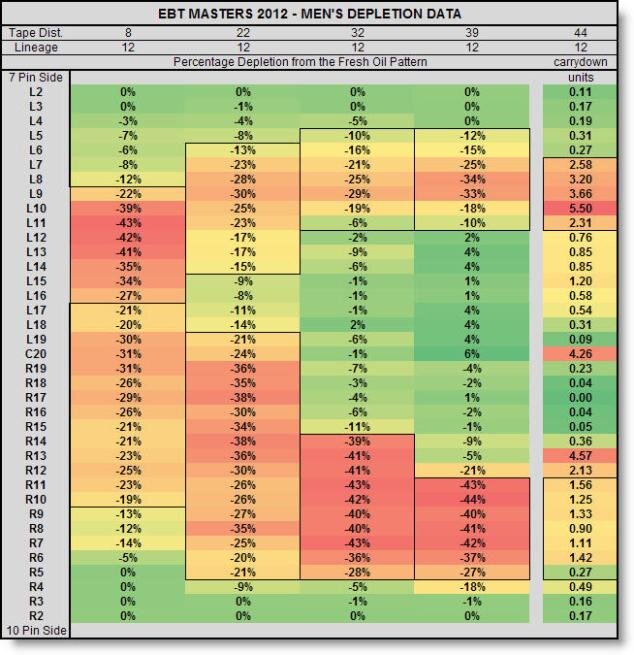
If we look at the blocks which show where both the left-handed and right-handed players played, you can plainly see how much carrydown is on the left side of the lane at the left-handers exit point of the pattern, yet not so much on the right-handers exit point. Why might you ask?
It is actually very simple once we think about it. We know that most spare balls in use today do not flare much, nor do they soak up oil like high flaring reactive resin strike balls that are in use today. So as right-handed players continually shoot spares on the left side of the lane, these non-flaring non-absorbent spare balls leave those long carrydown strips when they exit the oil pattern.
These ball types also do this when players are shooting spares on the right side of the lane, yet the carrydown tapes clearly do not show as much carry down at the end of the pattern.
The answer lies in the amount of high flaring balls going down the lane on the right side of the lane versus the left side of the lane.
Basically, the right-handers strike balls continually erase the carrydown left by the spare balls, but on the left side of the lane there is simply not enough high flaring absorbent balls going down the lane in that area to erase left side spare ball carrydown.
This lane condition change can be beneficial or detrimental to the left-hander. If these left side carrydown strips become dominate inside of target, like on patterns or conditions that allow the outside of the lane to play, it can give the left-hander hold area.
Yet if these spare ball carrydown strips become dominate left of target, or at their exit point, like many medium long or long patterns, it can result in a hang spot or reduced pin carry.
One more thing to be aware of with spare balls on today high volume oil patterns is how they can actually increase the amount of oil at the end of the oil pattern where high flaring balls are not traveling. We saw this happen often in the late 1980’s even where the traffic was when more aggressive coverstocks and larger core urethane balls were mostly in play. The end of the pattern after a couple blocks often had more oil on it than when fresh. It also shows up often in our after tapes in today’s game outside the track area (where most balls are being rolled), which can clearly be seen on the aforementioned data.
The reason for this today and back then is simple, by the mid to late 1980’s the amount of oil on the lane had to significantly increase in order to give the wood lane protection.
The by-product was more carrydown because more oil was being picked up by the ball in the fronts and re-deposited towards the end of the pattern and the dry back end.
This combination led to a great advantage after a few games by high rev big hook ball players as they could simply go around the carry down for return outside of target, and then the carrydown became hold area inside of target for this type player.
We see the same dominant style trend happening again today but for different reasons – this time it’s rapid depletion of the oil pattern from back to front and who can chase the oil inside of target on the lane the fastest.
Normally today, just like in the late 1980’s, it is often the high rev players who can create the largest margin of error and best angle for the best pin carry once the oil conditions are altered simply by bowling.
After reading all this you might be asking yourself what then is the best combination of ball versus lane versus oil that would minimize all this rapid lane condition change? That my friend is another article for another time…
JJ's Blog - 2012 US Open
Saturday February 18th:
It was another crack of dawn flight to New Jersey. The alarm went off at 2:00am. I got in the shower and when I got back I see my phone rang three times. Once I got some clothes on, it rang again. It was after-hours tech support, which is part of my job. The phone calls can come at any hour. It was a little challenging trying to focus on fixing his problem and also trying to go over my checklists to make sure that I had everything, but fortunately I had some time and he had some patience.
I spoke with him off and on throughout my one hour drive to the airport, and unfortunately I couldn’t get him fixed, but he had to get back home anyway and I had to check in luggage and then go through security so there wouldn’t be much I could do for the next 30 minutes anyhow. He said he would call back in the morning if he needed more help.
I got to New Jersey with no problems and actually got in a little early at about 11:00am. I got my rental car and I decided to go straight from there to the Woodbury Common Premium Outlets in Central Valley, NY. It was about an hour and 10 minute drive. I got there and did the valet parking because after “vulturing” around the parking lot for a few minutes I got tired of wasting time and fuel trying to find a parking space. I spent about 3 ½ hours shopping and the only thing I bought was a pretzel dog and bottled water. I found a polo shirt I loved, but they didn’t have my size. Saw a really nice tuxedo but the same thing, didn’t have my size.
I then went and drove back to New Jersey and checked into the hotel room. I was there for a while and then I met my good friend Corissa for dinner at a restaurant called Old Man Rafferty’s in New Brunswick. We had a great dinner and it was good to catch up with her since she moved up to New Jersey four years ago.
By the time I got back to the room it was about 9:00pm so I was getting a little tired and decided to just call it a night.
Sunday February 19th:
I woke up in the morning and called my good friend Ron Dixon who drove up last night from Boynton Beach. We talked about going into New York City a few weeks ago and he wanted to go this morning as well as I. I met him at his hotel around 10:30am and then we drove over getting there a little before noon. We spent the day shopping on Fifth Avenue and also went to Rockefeller Center and went to the “Top of the Rock”. The roof is at the 67th floor and we got some awesome views of the Empire State Building, Central Park and the rest of the New York skyline.
We had some dessert at La Maison du Chocolat downstairs where I picked up some truffles and chocolates to bring home. It was a great day just walking around and enjoying the city even though it was in the 40’s with the wind blowing at about 15 mph, even though that was pretty mild for how it normally is this time of year.
We had a nice steak at Smith and Wollensky and then headed back around 7pm since most all of the stores had shut down by then. Also I needed to get back because I was supposed to pick up my roommates for the week, Marcelo Suartz and Gary Faulkner who both bowl for Webber International University who were supposed to be getting in around 11pm. They were coming from Indianapolis where they were bowling the Hoosier Classic, but they called me shortly after 7pm and said they missed their flight because the tournament was running late. Since Webber International finished 2nd they were bowling to the very end.
I dropped Ron off and then got back to the room about 8:30pm. Since it was a long day of walking around, I decided to retire early. They were both going to be flying in about 11am, so I needed to go pick them up.
Monday February 20th:
I woke up about 7am and then walked over to Panera Bread. It was about a 10 minute walk and the 37 degree weather was pretty brisk, but I needed the exercise anyway and the colder weather definitely helped to wake me up, haha. I headed to Newark and picked up Marcelo and Gary. Their flight was good except for three of Gary’s bowling balls didn’t make the flight. We got back to the hotel room and changed and the headed to the bowl for practice session. Our practice session (since we had all C squad) was at 2pm.
The practice session went well overall for me but the fresh was really hard. I brought a lot of old bowling balls with me since I’ve heard that the B squad (no re-oil after A squad) tends to hook quite a bit. Friends had told me that a lot of the old bowling balls come into play because of the amount of hook so I brought some old ones, like a Red Pulse, Black Ice, (2) Original Ones, 505C, a Game Changer and the old trusty Maxim for spares. I figured if they hooked less, I could drill something there, but if they hooked a ton there wouldn’t be any old balls on the truck.
I had a pretty good look with my Original One that was drilled 4” pin down once they opened up a little bit. I had a pretty good look going from like 20-13 but at least for me I couldn’t get anything to recover outside of 13. With the pattern being 42’, I could fall it back at a few different spots around 25. The lanes were pretty tight overall. There was much less overall hook than I was expecting. I think I could survive the transition with what I had, but I might need to drill a ball or two during the week, especially if the lanes tightened up which I pretty much know they will. I might need a stronger ball for the burn than the stuff I brought since they’re pretty tight down the lane.
After practice Ron, Gary and I went back to the City. Gary had never been to the City before. Marcelo hadn’t either, but he had some schoolwork he had to get done. We got to the City about 6:00pm. The Knicks were playing the Nets at Madison Square Garden but the tickets were all sold out, especially since this was the peak of “Linsanity”. We decided to not do the “scalper” route so we just started walking around. We went to Times Square and took some pictures and then we went to Grand Central Station to check out the Apple Store they recently opened there and had some great cupcakes from the Magnolia Bakery downstairs in the Food Court. We then went back walking down Fifth Avenue and then we took a cab to Mulberry Street to Little Italy. Ron was trying to find this restaurant he ate at before but he couldn’t find it. There were a bunch of restaurants there so we ate at Lunella Ristorante Italiano and it was unbelievable. Olive Garden and Carrabba’s will never be the same, haha!
After that meal we headed back to the car and then went back to New Jersey. It was getting close to about 10:30pm by the time we got home. We didn’t bowl until 6pm tomorrow, but I wanted to get some sleep so I wanted to get up early and watch a little bit of A squad so I could get another look on the fresh, since my look in practice was pretty stinky.
Tuesday February 21st:
The Big Show begins today. I went in to watch a little bit of A squad just to see what was going on and give me a second look on what I might need to do. After that Ron Dixon and I went to the Mall at Short Hills in Short Hills, NJ to look around and get some lunch. It was about a 45 minute drive to Short Hills and we looked around for an hour or so and then got lunch at Joe’s American Grill, but I still didn’t buy any clothes. Just bought some macaroons and some more chocolate from La Maison Du Chocolat, didn’t find anything I liked clothing-wise other than this tuxedo at Neiman Marcus. Maybe if I bowl for the title I’ll come back for the tuxedo, haha!
We got back about 2pm and I went to watch a little bit of the burn since that’s what I’ll be bowling tomorrow. They were starting to get kind of keep around game 6 but nothing really alarming. Some guys were getting in front of the ball return but not near as bad as what I was expecting from the stories from previous years.
I went back to the room for a little rest and then went with Gary and Marcelo to get a little bite to eat before the squad. We stopped at Chipotle for a quick meal and then went to the bowl.
The day went pretty well. I went +81 for the six games and bowled really well except for the last game where I shot 177 on 77-78. That pair was tight and I made the mistake of trying to move right where I should’ve moved about an arrow left. I did that but it was a little too late at that point. At least I got a double near the end to avoid a potentially disastrous 150 game. My best ball reaction was with that 4” pin down Original One and used that for pretty much the whole squad. I started going about 18 at the arrows to about 13-14 down the lane and then just kind of chased it in after that. I could see that I could maybe use another ball for the burn squad, one with a stronger coverstock than some of the relics that I brought with me.
I spoke with Mike Calderon with Ebonite and he suggested drilling an Elevate with like a 5 ½” pin with no hole. This way I would be able to get some length with the drilling but with a stronger cover to be able to slow down in the back ends. I went out to the truck and laid it out, filled out the specs and then headed back to the room. It was late so Marcelo, Gary, Ron and Amleto Monacelli and his girlfriend and I went to the Omega Diner down the road for a light meal since we needed something in our stomachs after bowling for 4 hours. After that we got back to the hotel about midnight and it was time for bed.
Wednesday February 22nd:
At 2pm we’ll be bowling on the B squad known as the “burn” squad since they won’t re-oil after A. I woke up about 7:30am and then went to Panera Bread again for my usual Asiago Cheese Bagel, Yogurt Granola Parfait and Orange Juice. After that I went to chill back in the room for a little while and then went with Gary and Marcelo to the bowl because I wanted to get there early not only to work out the Elevate that I just drilled but also to watch some of the end of A squad just to get an idea about how much they’ll be “burning”. I got my ball but realized something was wrong, the finger holes were HUGE! I didn’t understand why….until I looked at the spec sheet. My finger hole sizes are 49/64 and my thumbhole is 59/64. For some reason I put down 59/64 for my finger hole sizes. Since it was about an hour before I had to bowl, there was no way to be able to plug it and there were too many people in line to be able to drill another one.
Good job Double J! Alzheimer’s is closer than you think!
Knowing that I needed to do SOMETHING and that I would probably need that ball, I just started using a lot of white tape and starting cutting it in small pieces to be able to close the gaps around the tops and sides of the finger holes to hopefully try to get it to fit. Fortunately, I actually got it to fit pretty well. Ironically, I used that ball for a good portion of the block! I didn’t hit them as good as some of the guys from the squad yesterday did, but I went another +79 which got me to +160 total for the two days. I was actually kind of happy since high on our squad was only +130.
Looks like A squad started deeper than the day before (not a real surprise, haha) so it forced us deeper than the guys were yesterday. We probably didn’t get the best deal, but that’s the way it goes sometimes. Either way I’m still doing fine, since the cut after two days was around -33.
Since I was in a good position and I was going back to the fresh, I kind of wanted another look on the fresh….something with a little stronger cover so just in case they get tighter I’ve got something that I can just let go, instead of trying to get too soft in order to get to slow down in the back of the lane. I went back to Mike Calderon from Ebonite and he suggested drilling an Omen. Apparently this is a much smoother ball with a very strong cover and he suggested a drilling like my One. I laid it out on the truck, filled out another spec sheet and then headed out.
Marcelo wanted to stay back in the room and study for an upcoming exam so Gary Faulkner and I went to the Menlo Park Mall which is only about 15 minutes up the road from the bowl. We walked around for a little while, but I still didn’t find any clothes that I liked. Not much clothing success so far, but at least I’m saving money that way, haha! The only thing I got was some chocolate covered strawberries from Godiva. Ron Dixon met us up there and we had some Chipotle and then headed back to the room. We were going to bowl A squad tomorrow so I wanted to be in bed by 9:30pm since we bowl the next day at 8am. We got back to the room around 9pm and I was out shortly afterward. Back on the fresh tomorrow…..
Thursday February 23rd:
The alarm went off at 5am…..time for the fresh. But first it was time for a fresh breakfast at Panera. I’m a creature of habit…..mostly bad habit, but a creature of habit nonetheless.
I went with Marcelo to open the place at 6am but getting there at 6:05 we noticed they weren’t open, though the sign on the door “says” they’re supposed to be open at 6am. Since Panera was denied, we went over to Starbucks instead. I had to settle for a yogurt parfait there, which was not nearly as good as Panera’s, but was all of the cost.
After that we went back to pick up Gary and then headed for the bowl. I needed to go back and work out that Omen that was drilled last night and then went to do some surfaces on the stuff I thought I was going to need.
The fresh went pretty well overall. The Omen worked ok but I only got about 5-6 frames out of it before I could see it was starting to die a slow death. It started to become too early so I bailed out of it and then went into the Original One for a little while. It wasn’t really much better but I was able to stay near par for the first 5 games or so. At least I wasn’t killing myself.
I then switched to the Elevate in game 4 as I noticed that it looked like that fall-back shot around fifth and sixth arrow was starting to develop. Game 4 I shot a decent game, but I shot back to back 255 games in 5 and 6 to leap to +293 which ended out leading our C squad. I just found a little groove and I actually made some really good shots and that ball hit REALLY well to say the least. With the scoring pace that low, 510 for 2 will move you up the ladder in a hurry.
I knew I was a lock for the casher’s cut but I really felt like I needed something after that Omen started to die. Something with a little stronger coverstock and core than the Original One to give me something else to go to until the lane developed into the slot where I could fade it with the Elevate. I went back to talk to Mike and see if he had any advice. He thought to drill a regular Pursuit with the same kind of 4” pin like I had with my Original One. I went ahead and laid that out and then headed for lunch. I felt a lot better now that I had another option because even though I was in really good position to make the top 24, I wanted to stay near the top.
I went with lunch with Marcelo, Gary, Ron Dixon, Amleto Monacelli and his girlfriend to On The Border right down the road. I had the Shrimp Tacos, one of my favorites there. We had originally planned to go to New York City afterward since it was only about 2:30pm at this point, but since I was going to be bowling the casher’s cut tomorrow and the fact that I was right near the top (I ended out qualifying 7th for the day after it was all said and done) I felt like I needed to stay closer to home and focus on tomorrow.
I just kind of chilled in the room for a little while and then went with Gary over to the Mall at Short Hills. I got some more macaroons from La Maison Du Chocolat and we ate at an Italian restaurant there called Paparazzi. It was good, but after eating at Little Italy in New York City it’s hard to compare anything to that. I dropped Gary off at the airport where he was going to get a rental car and then I got back to the room around 9pm. After that it was time for bed, ready for the second stage of the US Open: Casher’s Round.
Friday February 24th:
I got up at 5am again and was ready to go. I got cleaned up and went to Panera where they were actually open at 6:05am. I asked what happened yesterday and he said…..”We’re open at 6am, but it’s a long story.”
That was enough of an explanation for me.
I got my usual Asiago cheese bagel, yogurt parfait and orange juice and then I was off to the bowl. I wanted to work out that Pursuit and also get there early enough to refresh the surfaces on the 4 balls I thought I might be able to use.
I used the Omen at the start but since it was the casher’s round the guys on my starting pair pretty much burned up the middle of the lane after practice which put me in the Pursuit right away. The ball rolled great and I used it for most of the block. They were pretty burned up by the end of the block mostly because we were all playing the lane pretty much in the same part of the lane (inside of 20, haha) and the rev rate on the squad was overall much higher.
I could see with the way the lane was developing that using a little more spin with higher tilt was better. I can do it ok, but that’s not my A or B release so I didn’t score as high as a few guys that whacked them but it was still enough for me to stay near the top. I’m kind of glad it ended when it did because I shot 193 and 191 my last two games. My ball reaction was kind of fading and the Elevate didn’t work quite as well as it did when I got into that zone previously.
Overall it was a good squad for me. I went +65 for the block which got me to +358 for the tournament which qualified me for 6th going into the top 24. I felt pretty good with my arsenal but I wanted to see if Mike Calderon thought there might be something else to give me another look playing inside in case the Elevate didn’t work out too well. He suggested a Jet Black Taboo with a 5 ½” pin like the way my Elevate was laid out. This ball wasn’t really going to come into play later tonight for match play since we were back bowling on the fresh and we were only going to be bowling 8 games with 2 per pair, but maybe for the next day for the burn.
However, it could be useful playing in the track as well. Match play is a whole other tournament and now it’s pretty imperative that you’re going to be playing the pair where the other guys are playing them. The ball could be useful in other zones.
Gary, Marcelo, Dixon, Monacelli, his girlfriend and I then went to Chipotle to get a meal and then I went back to the room to just kind of chill out for a while. Match play was going to start in about 3 ½ hours so I just wanted to catch up on some e-mail and just kind of rest. I got back to the bowl about 4:30 to work out that Taboo and re-do some surfaces.
Match play went ok. I went 4-4 but only went -10 for the block. I was fortunate to win a couple of matches shooting 170 (those pairs were brutal, haha) but even though I didn’t score really well I only dropped to 7th. It kind of evened out because I also was the victim of Chris Barnes’ 298 even though I bowled a pretty good 223 game though I say so myself. He’s tough on his Team USA teammates, haha!
I was overall pretty happy but I need to bowl better tomorrow. I think I’ve got the right strategy on the fresh but I need to just execute better. I think my swing is still bouncing out a pinch when I’m trying to go up the lane and on this condition if you bounce one a little right off the hand on the fresh you’re missing the headpin.
Went back to On The Border with Marcelo and then back to the hotel. More Shrimp Tacos, mmmmmmmm. Match play wasn’t going to start until 11am so I didn’t have to be up at O-Dark-Thirty for a change.
Saturday February 25th:
I still got up early anyway, so I headed off to Panera at about 7:15am. Had the usual, some things never change, haha!
I went back to shower and then headed to the bowl at about 9:30am to re-do the surfaces. In all tournaments, there are a few games that you wish you had back. Well in this tournament, I’d like to have the first 3 games of match play back. I went 175, 177 and 165 and didn’t win any of the matches. Next thing you know I went from 7th to 14th in 3 games. Granted two of the matches the guys shot 220 and 230 at me, but still. You can’t go 517 your first 3 games and expect to gain any ground of the best 24 bowlers in the US Open no matter how hard the conditions were.
I think I played too far right on the first pair and just didn’t execute very well. The second match I had to move in and missed a spare early in the game. I needed the first strike in the tenth to win the game and threw it great and left a stone 8-pin. The third match was just as bad as the first. I had to move back to the track and left a washout in the tenth and wrapped the headpin around the 10 to finish with 165.
I really don’t have any excuses, just didn’t throw it real good and I paid the full penalty for that hour. I moved in and bowled well for most of the rest of the block and got my match play record back to even and actually went +2 for the block, but the damage was done. I was in 13th place and now about 240+ out of the show. Need to have a really good block in the evening to make up for that.
I was invited to lunch by Jason Belmonte and Diandra Asbaty to the Skylark Diner right up the road. Apparently this place was featured in Guy Fiori’s Diners, Drive-Thru’s and Dives program on the Food Network and features a little higher class diner food. It was us and about 7 others including Mike Fagan and his parents, Osku Palermaa, Martin Larsen, Alex Cavagnaro and Mikael Ahlqvist. I had the Lobster Mac and Cheese and the Shrimp Quesadillas. It was excellent! It was a good way to help change my spirits since I was a little down after dropping that far in the standings.
I went and dropped Alex and Jason back at the bowl and then went with Diandra to Cold Stone to get a pre-squad ice cream. After Cookies and Cream in a waffle cone I was ready to head back to the bowl.
Match play went better as I went +59 for the block, but I couldn’t win any matches or at least not enough to make up any ground. I ended out in 12th place with a 12-12 match play record and averaged 208.18 for the 50 games. Overall I was pretty pleased even though I’d like to have those three games in the morning back and I missed too many clusters. I missed (4) 3-6-10’s, (1) bucket, (4) washouts, (1) 1-2-4, chopped (1) 4 off the 7, chopped (2) 2-5’s off the 4 (sweet), chopped (1) 4 off the 7 (sweeter) and chopped (1) 6-10. Not horrible, but still I can do better than missing 14 multi-pin combination spares. If there was any one bright spot I didn’t miss any single-pin spares for 50 games. I was proud of that because when you’re averaging only 208 for 50 games, there were a lot of single pins, haha!
Afterward, I spent some time talking with my good friend David Eisenberg and another good friend Eric Frost who came from Massachusetts to watch me bowl match play. Eric used to work for Kegel years ago and he came to see me the night before as well. It was great to see him again. Unfortunately I had to cut the visit a little short since I looked at my phone afterward and see that I had some missed calls and texts from Amleto and Marcelo.
They both went to the City in the late morning and they were trying to call me so I could pick up Marcelo at the New Brunswick Train Station at 10:55pm. Considering it was 10:30pm, I had to go! Amleto said Marcelo’s phone was dead so I had to make sure I was there to meet him or otherwise I’d have a hard time locating him. I got there about 10 minutes before he arrived and fortunately he had enough battery life left to get texts. After that we stopped by TGIFriday’s by the hotel to get a quick bite to eat and then we went back to the room. I was flying out at 6:30am so I went back to the room and packed and got some sleep.
Sunday February 26th:
The 3am alarm went off early since it was about 1:30am by the time I got all packed and went to bed. Gary was going to take Marcelo to the airport so I left the hotel at 3:30am and got to the check-in counter at 4:15am.
I went to try to check in 4 bags and I knew that I was going to have to pay extra. I knew I could get 3 bags for free since I was Diamond Medallion with Delta but when they told me it was going to be $125 for the 4th bag I said no thanks. I wanted the bowling balls, but a few of them were old so they really weren’t worth it for me to pay that much to bring them home. I told them I was just going to leave 3 balls with them.
I had to do some reorganizing since I had to figure out which 3 balls to leave. During that time the lady at the ticket counter was asking me if there were other ways I could bring the balls back or if there was someone here locally that could take the balls for me. I told her there was, but she left for Los Angeles 4 days ago and wouldn’t be back for another 4 days. I explained to her I couldn’t put them in the other bags because then those bags would be overweight. This issue stemmed because of the fact I drilled 4 balls this week.
After about 15 minutes of talking with the lady at the ticket counter and the skycaps on trying to find ways to bring these home, a guy in a white shirt came up to me and said that they would go ahead and check the 4th bag for me for free since I was a Diamond Medallion Frequent Flyer and loyal Delta customer for all these years.
Sweet! Problem solved. I had a great tournament AND I was able to get everything home without costing me a dime in extra baggage fees. This……was a good day!
I got back to Orlando at about noon and then headed to AMF Semoran Lanes to watch a little bit of Erik Ramos’ 10-game sweeper that I just missed. After spending an hour or so visiting with some friends I headed to the Mall at Millenia to get some chocolate at the Godiva store and had a nice meal at Fleming’s Steakhouse off Sand Lake Road and then went home.
It was a great week of bowling, great time with friends and had more money on the 26th than I had on the 18th (which is always a sign of a good tournament) but it’s good to be home….and to 70 degree weather.
The gloves can go back in the closet until next winter.
JJ