
Breakdown and Carrydown – Then and Now
We hear it all the time; “the heads are hooking”, “carrydown is happening quickly today”, “time to move again”, “my ball’s burning up – grab the fire extinguisher!”...ok maybe not the last one. But with the amount of oil needed in today’s environment in order to protect the lane surface and keep the modern ball from hooking into the gutter at the arrows, rapid and chaotic change is often the result. Even the best of players can get confused in today's game over the course of a few games.
In this month’s piece we'll try and give some sense of order to that chaos, but the first thing many will have to do is let go of what you’ve learned and experienced in the past – today’s pattern mutation, carrydown, and resulting bowling environment is different, very different.
Oil Pattern Change
The first thing we need to understand about oil pattern change is how bowling balls with different amounts of track flare change the oil pattern.
Prior to the 1980’s, when bowling balls did not significantly flare, the ball essentially picked up all the oil it could within the first couple revolutions - the first 8’ to 16’ of the oil pattern. It was in the head area where the oil pattern dried out the most, and after that, the oil pattern basically remained unchanged. Only once we got to a point of about 24 games per lane or more, did the rest of the pattern began to “dry out”.
As lower flaring more aggressive coverstock balls were introduced in the mid to late 1980’s, the amount of oil on the lanes had to increase, and oil pattern mutation changed because of that. John Davis' research showed the latter half of the oil pattern actually increased in volume during this era.
Back then the bowling ball picked up so much oil in the front part of the lane, it re-deposited some of that oil towards the end of the pattern, and then a lot more of that oil on the dry back-end. This is the time when carrydown quickly became a big problem.
When ball manufactures figured out that track flare increased the friction between the ball surface and the lane surface, bowling balls became unbalanced again - only this time it was by way of significant Radius of gyration (Rg) differential, It was then, oil pattern mutation, and the resulting ball motion, changed dramatically.
However, bowler "lingo" hasn't seemed to change as much as pattern mutation has, which can cause a lot of confusion and misinformation in our world of bowling.
Bowling balls with track flare (pictured below far right) pick up and erase oil off the lane with every revolution, causing a much different type of oil pattern breakdown. It’s not just the heads that breakdown down anymore, it’s the entire length of the oil pattern that breaks down, and it begins with the first ball thrown on the oil pattern.
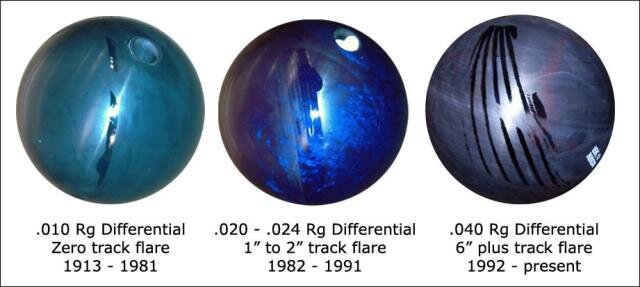
In our research, when starting with 80 units in the front part of the lane, our after tapes show that about half the oil has been depleted during a normal league session, which is 15 games per lane. We see the same trend in high level events bowling 12 games per lane.
That means there are still about 40 units left in the heads, but many in our industry still talk about the “heads hooking”. Anyone want to bowl on a pattern with 40 units on the outsides? Of course you don’t - your ball will never hook! So what causes the players to move left in today’s bowling environment? It’s more about the removal of oil from the mid-lane towards the end of the pattern.
Because of oil pattern taper, the mid and end part of the oil pattern has much less oil than the front part of the oil pattern. As the ball erases the oil off the lane, the modern “mountain range” like coverstock can easily poke through that thin film of oil towards the back part of the pattern. This causes the ball to read the friction much sooner there than in the front part of the pattern, and that is what makes players move left, not the oil pattern breaking down in the heads.
What this flaring ball pattern breakdown does to ball motion is simple – the ball simply slows down sooner and therefore hooks more. For high rev and high ball speed players, this pattern mutation falls right into their wheel house as finesse has been removed from the equation for them - its flat out every shot without having to worry about “throwing it through the break point”.
For rev challenged and slower ball speed players, this pattern mutation becomes more difficult to overcome – their bowling balls slow too early and begin to lose axis rotation too soon causing less room for error and decreased pin carry.
Of course this type player could switch to a less aggressive ball to combat the increased friction towards the end of the pattern, but then that type ball is more susceptible to carrydown. It’s a delicate balance for these styles of players.
Can the heads (the first 16 feet) still give the ball the perception it is hooking early? Sure they can, but in today’s bowling environment, more often than not it’s not because of the lack of oil.
With synthetic lanes it’s normally a side hill slope issue where the ball is thrown into a hill and trying to rotate up that hill. This topography issue will make the ball “check up” or move in the direction of the slope, which is more of a gravity issue, with a bit of friction thrown in for the banked curve affect.
For wood lanes or really old synthetics, it could be a severely roughed up lane surface, which therefore is a friction issue. However no reasonable amount of oil will significantly help in either of these situations simply because the depth of the scratches in the lane surface are deeper than the oil film – resurfacing or re-leveling the lane surface is the only solution to combat that kind of "early hook".
In short, bowling balls that do not flare tend to break an oil pattern down from front-to-back, and today's high flaring balls tend to break down oil patterns from back-to-front.
With high flare balls the oil pattern is literally getting shorter in the ball traffic area with every shot thrown, and by moving left we are increasing our launch angles to that area in order to give the ball more time to hook. Of course when missing inside of target, we are now in a "longer pattern" again so the ball holds pocket. This is why sport and challenge patterns get "easier" and scores often increase after a few games.
Carrydown
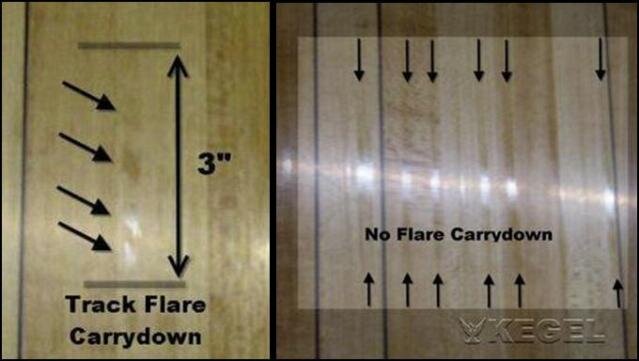
Carrydown is also much different by balls that don’t flare versus balls that do flare. Bowling balls that do not flare leave long three to four foot streaks of carrydown beyond the end of the pattern. Because the footprint of the bowling ball is so small, a shot hitting these long streaks of carrydown can all of a sudden make a pattern feel like it is much longer, mainly because to the bowling ball, on that single shot, the oil pattern has become longer!
With the amount in the middle of today's oil patterns, it is not uncommon for those streaks of oil to be in the 5-8 unit range.
As noted before, significant carrydown was not a problem in bowling until the 1980’s - especially towards the middle to end part of the decade. With the advent of ever stronger urethane balls, as well as increased dynamic weight blocks, an increased amount of oil was necessary as more and more customers bought these new balls.
And as players began sanding the covers and using drilling techniques to create more dynamic imbalance, more oil was needed to help protect the lane surface and keep these new higher friction balls on the lane, and of course, keep the customers who bought these new balls happy.
It was only then that we saw carrydown become such a significant part of the playing environment in so few games. Prior to that, when fairly dynamically balanced rubber and polyester balls were mainly in use, there was simply not enough oil needed nor used on the lanes to cause significant carrydown issues.
Sure there was carrydown after a few days of play, when lanes were not cleaned but once a week, but nothing like what happened in the 1980’s to tournament organizations like the PBA Tour, who cleaned the lanes every day.
Carrydown that is created with balls that flare however is much different, as well as how these much more aggressive and diverse internal dynamic balls allow players to play the lanes.
Meaning, because the amount of dynamic imbalance is much greater, this increases the range of available hook and allows players to play the lanes in a much wider area than in the past. When balls were more balanced and didn’t hook as much, everyone played the lanes near the same area, causing a much narrower spread of carrydown.
This dynamic imbalance causes track flare, and track flare creates what are called “bow ties” (where the flare rings come together) at only two points on the balls surface. Those two points are the only parts of the ball with oil on it that touches the lane every revolution.
The higher the differential Rg, the wider the track flare is, and the smaller those touching points are. This in turn creates random 2” to 3” strips of carrydown. For instance, using a 40’ pattern as an example, one track flare carrydown strip may be at 41’ to 41’ 3”, another small strip at 41’ 6” to 41’ 9”, and another one at 42’ to 42’ 3”, etc.
Therefore, when a fresh part of the modern flare balls surface comes in contact with these small strips of carrydown, ball motion is hardly affected at all. As these strips build up however, along with the longer three to four plus foot random strips of carrydown created by the many low flaring spare balls going down the lane, the back-ends will “tighten up” somewhat, but not as soon, or as much, as lanes did in the late 1980’s.
There was a very good article written by the PBA that represents what happened in the late 1980’s. It stated how after a few games of bowling the “fronts go away” and significant carrydown happens beyond the pattern at the balls exit point.
When this occurs, the player who greatly hooks the ball can move left and effectively “go around” the carrydown, creating an increased margin of area from that of a fresher oil pattern, and clean dry back ends. Low flare carrydown gives this style of player hold area inside of target.
On the PBA Tour in the mid to late 1980’s it was not uncommon for big hook ball players to average 20-30 pins a game more in the evening blocks versus the morning blocks.
Today however, even though high rev and high ball speed players can often struggle right out of the gate because their ball motion is too “skid-snappy” on the fresh, with today’s expeditious pattern breakdown, and high friction balls, high rev players can hit their stride much sooner. Today it doesn’t take more than a couple games to “smooth out” their ball motion from front to back.
In addition, as we stated before, carrydown at the end of the pattern with high flaring balls is not as defined as it was in the 1980’s, or when lower flaring urethane balls were in use. Therefore today there is simply not enough defined carrydown to go around and use as hold area.
High rev players tend to get their advantage today more from rapid pattern breakdown towards the mid and end part of the pattern, not carrydown. As most know, low to non-flaring balls today are most often regulated to shooting spares and therefore, those long strips of carrydown are more random across the lane surface - sometime you’ll hit a strip, and sometimes you won’t.
Remember, today you must think different. No longer are we using non-flaring balls on less than 5 milliliters of solvent based lane conditioner like we did in the 1970’s. No longer are we using low flaring balls on 12 milliliters of oil with massive carrydown like we did in the mid to late 1980’s. No longer are we bowling on lanes that are resurfaced every year like was mandated until deletion of the rule. No longer is levelness being maintained regularly like we did prior to advent of synthetic lanes.
The bowling environment today is much more varied, much more complex, and does not always make sense, or play “how it’s supposed to play”.
The best piece of advice we can give you is what the late great PBA National Tour tournament director Harry “Goose” Golden use to say to the players after every roll call; “bowlers, let your ball be your guide”.

10 Things That Everyone Should Know About Lane Conditioners
There has been a lot of scuttlebutt written about the bowling ball evolution. The dramatic changes in cover-stocks, weight blocks, drilling techniques, ball reaction, you name it. What about lane conditioners? Bowlers are quick to take credit for when they bowl well and in some cases rightfully so, but we all know that when they have an off night it's seldom the bowlers fault…..it's the LANE CONDITIONS! Believe me, I'm a long-time bowler myself and I am just as guilty as the next guy. So why isn't there more information explaining the TRUTH about lane conditioners?
Today's products have numerous additives, varying viscosities, different levels of surface tension, and many other components to give oil companies reasons to proclaim that their product "Holds Up Longer", and "Doesn't Carry Down." This is all fine and dandy, but what does it all mean. The following is a list of ten very important things that everyone should know about lane conditioners. We will talk about what everything really is and why it is important when choosing or applying a particular lane conditioner. Hopefully this will help clear up some of the confusion that surrounds this mysterious invisible substance.
1. Solvent Based / 100% Solids / High Performance
Solvent Based conditioners were developed in the 40's and used primarily during the rubber and plastic bowling ball era. Some are still being manufactured and used in bowling centers today. The basic idea was that solvents would be added to the mineral oil base which would help break down dirt and aid in the cleaning process. This was very important at that time because most centers were only cleaning anywhere from once a week, once a month, or never, but who can blame them really when they were doing it by hand.
100% Solid conditioners were simply a progression to having no solvents in the formula. This was brought upon by the urethane bowling ball era and technically can be used to define most lane conditioners in production today. From the mid 80's to the mid 90's, products contained anywhere from 4-8 components with mineral oil being the main one usually accounting for about 98% of most formulas.
High Performance conditioners are becoming more popular and necessary in centers now to help combat the aggressive bowling balls. The ultimate goal of these products is to minimize change in ball reaction and maximize application consistency. The percentage of mineral oil can be as low as 75% in some formulas with the total number of components reaching the 14-16 range. These new components or additives (which we will explain later) are items such as friction modifiers and lubricity agents.
One important thing to note here is that conditioners have evolved as well. Most of our bowlers are not throwing the same bowling balls they did when older conditioners were made so it is imperative that we "Maintain Par" and move towards using products that are designed specifically for today's environment.
2. Viscosity
Definition - The measure of the internal friction of a fluid. This friction becomes apparent when a layer of a fluid is made to move in relation to another. The greater the friction, the greater amount of force required to cause this movement, which is called "shear." Highly viscous fluids therefore, require more force to move than less viscous materials. Also, the unit of measurement for viscosity is the centipoise (cps).
Importance – There are some very important things to know about viscosity. With older conditioner technology, higher viscosity generally equated to a “hookier” conditioner while lower viscosity generally equated to a “slicker” conditioner. Fancy lubricity additives and friction modifiers (which we’ll discuss later) have made this old generality untrue. Viscosity isn’t nearly as important as it once was. It still has value though; higher viscosity conditioners won’t work well; if at all; in a wick machine. And, higher viscosity conditioners may require some adjustments to pressure regulating tubing in some lane machines.
Viscosity & Lane conditioners
Second Most Important component of a lane conditioner
Lower viscosity conditioners flow better and more consistently through wicks
New additives lower the importance of viscosity
3. Surface Tension
Definition - Surface tension is a study of how well a liquid wets a solid. This is a pretty technical section so I'll do my best to keep it simple.
Most manufacturers check surface tension in relation to air. That is the number that is given on the certificate of analysis.
It can also be measured by internal liquid/solid interaction. What that means to you and me is how well a conditioner recovers, or "Self Healing", when a ball rolls through it. The goal being that the conditioner will flow back together once the ball travels through the conditioner.
Surface Tension is also directly related to surface energy. All lane surfaces have a surface energy that can be different from surface to surface and by the conditioners and cleaners applied to it. Let me give you an example:
If you apply wax to the surface of your car the water will bead up and not "wet" your hood. The energy of the hood was changed and you will protect the paint because the water will not penetrate.
Our goal with lane conditioner is the exact opposite. We don't want the conditioner to bead up, we want it to lye down and form a bond to the surface. This helps create durability and also helps enhance the self-healing characteristics.
Importance - Studies are being done now on this topic that will help us gain some valuable ground on today's bowling balls. There are also complimentary studies testing the relationship with conditioners and bowling ball cover-stocks. The perfect lane conditioner is one that likes the lane and not the ball giving us ultimate durability. I hear the Trojan horse is on its way.
4. Temperature
Effects on Lane Conditioner - I can't say enough of how important temperature is to lane conditioners. Many people have their theories about how lane conditions change when the weather changes so we decided to get some hard facts.
In early 1997, we conducted several tests to see how much conditioners changed when the temperature was raised or lowered. What we found was eye-opening. The viscosity of some conditioners changed 2 cps (centipoises) for every 1ºF of temperature change. That means if you start with a 20cps (viscosity) conditioner and the temperature drops from 80 ºF to 70ºF, the viscosity of that conditioner would be 40cps. This is not true for all lane conditioners. Some only change 1cp for every 2º F of temperature change. That is only 25% the change as some of the others, BUT regardless of how much they change it's important to know that all of them do.
Temperature affects the molecules of lane conditioners by causing them to slow down when cold or speed up when hot. Think of water turning to ice and water boiling.
Temperature will affect the viscosity, which in turn also changes the flow rate through wicks.
When the viscosity of the conditioner is changed the ball reaction will also be different as a result.
The capillaries in most wicks will shrink up when it gets colder restricting flow.
Tips:
Keep the lane conditioner in a temperature controlled environment. (Office, Front Desk, or wherever the temperature is constant)
Keep the lane machine in a temperature controlled environment so the machine functions properly as well. We understand that this may not be possible in all situations so you can look for other solutions like an electric blanket or a space heater to keep the machine warm.
5. Order of Addition
Definition - The order of which ingredients are combined in a formula to create a desired result.
This is just a little inside information to share about the sensitivity of lane conditioners. If I was given the ingredients to one of today's conditioners, not only what was in the formula, but also how much of each, I still would have no shot at making the product.
The order and timing in which the components are added together is equally as important as the components themselves. When mixing a cocktail the order is always: ice, liquor, and then mixer. If we poured the liquor in a drink last what would happen? The liquor would float on the mixer. This is simply because the density of the mixer is usually greater than the liquor.
The main thing to understand is that there is more actual "chemistry", not just "mixing" taking place with today's products.
Tip: Leave the mixing to the chemists. Some centers are mixing different conditioners with some success, BUT we do not advise doing so based on the technical make-up of conditioners today.
6. Additives
Definition - The components added to a lane conditioner formula to enhance performance and to create desirable changes to the physical properties.
There are many things that we expect from our chosen lane conditioner. We expect it to be slick, but not too slick because of ball calls. We expect durability, but some breakdown for the lanes to open up. We also expect the infamous, "NO CARRY DOWN." Trust me, if you see a company's ad saying their oil does not carry down, don't believe it. If it's liquid, it moves. ALL OILS CARRY DOWN.
However, different additives are used to minimize the carry down and create an illusion so the ball doesn't see what the eyes do. That means some conditioners use a tacky mineral oil so ball reaction doesn't change when oil is carried down.
Some of the additives used are:
Friction Modifiers - Designed to reduce friction
Viscosity Modifiers - Designed to change the viscosity
Flow Agents - Used to enhance the flow properties of a conditioner through wicks.
Lubricity Agents - A spin-off of the friction modifier to enhance the lubricity of a conditioner
Surfactants - Short for "Surface Active Agents." These additives change how a conditioner "wets" or spreads out on the lane. They also control how well a lane conditioner flows back together when a ball rolls through.
7. Quality Assurance
Definition - Quality procedures that aim to PREVENT non-conformities.
I think every mechanic will raise their hand when asked the question, "Have you ever had a bad jug of Oil?" Unfortunately, this job continues to get more difficult by the day.
All lane conditioners are made with raw materials and various additives. Mineral Oil is a true Raw Material whereas most additives are made by chemical manufacturers by other raw materials.
Here's the process when lane conditioner is different:
The bowler complains to the mechanic or manager.
The mechanic or manager complains to the distributor.
The distributor complains to the manufacturer.
The manufacturer complains to the raw material manufacturer.
The raw material manufacturer complains to the ground.
Who's to Blame? Manufacturers today are forced to test all raw materials before they are used in production. Adjustments are commonly made to the overall formula to compensate for any changes in the materials.
Think about manufacturing lane conditioner like making your favorite recipe. Let's say that favorite dish is Lasagna. One of the main ingredients in lasagna is meat. If the meat you purchased last time had more salt in it than the meat you purchased for this batch of Lasagna you would be forced to add more salt so the dish tastes the same.
I know this example may seem like a stretch, and making lane conditioner is much harder than making lasagna, but in many ways they are the same. Chemists and Cooks are constantly trying different ingredients in search for the magic recipe. In relation to Quality Assurance, they both have to test and make sure that all the ingredients are the same before using and make adjustments to compensate for inconsistencies.
8. Quality Control
Definition - Quality procedures that aim to "DETECT" non-conformities.
Quality Control is an equally important procedure as Quality Assurance. Its role is to detect any non-conformities or changes in the product after it has been manufactured. These include a series of tests to check the viscosity, weight, surface tension, UV additive, and flow rate.
Some manufactures also use a variety of on-lane tests that ensure ball reaction and breakdown is the same as well. This is basically a big giant "DOUBLE CHECKING" of the finished product before it is shipped.
Continuing on the food theme this can be viewed as the taste test before a meal is served. Together QA and QC perform a specific and very important role. They guarantee that a finished product is exactly what it's supposed to be.
Tip: Find out what procedures your manufacturer uses for QA and QC. Make sure that you feel confident that your chosen brand is doing everything it takes to ensure product consistency.
9. Shelf Life
Definition - The amount of time determined by a manufacturer that their product must be used by in order to guarantee satisfaction and consistency.
We've already explained that mineral oil is the main component in lane conditioners. Mineral oil alone has a very long shelf life. Because the newer conditioners use less mineral oil to make room for other components the shelf life is not as long, ranging from 12 to 18 months.
Think about the shelf life of common food items such as milk and bread. When the ingredients are exposed to air they will deteriorate and lose their originality at a faster rate.
When raw materials are used for lane conditioners, they too are taken out of their natural state and exposed to air. This simple fact has forced the manufactures to advertise a shelf life in order to guarantee product consistency.
Tip: Find out what the published shelf life is on whatever conditioner you are using and follow that recommendation. Usually you can find the manufactured date somewhere on the container or packaging. If you're unable to locate it, or can't understand the numbers contact the manufacturer for assistance.
10. Environment
Definition - The set of circumstances that exist in your bowling center(s).
Finally we get to the big question; how do you know what conditioner is right for you or how do you properly apply the one you are currently using? The answer is…..Understand the circumstances that make up the ENVIRONMENT in your center. Here is a checklist of the items that determine conditioner selection and application:
Lane Machine Type
Lane Conditioner Type (Existing)
Lane Cleaner Type (Existing)
Dilution Ratio
Pattern and Cleaner Settings
Type of Surface
Condition of Surface (Be Honest!)
Topography (If Known)
What type of bowlers do you have in your center?
Where are your bowlers used to playing?
What are you looking to achieve by changing conditioner or your pattern?
These criteria will help guide you towards the solution. I wish I could tell you that there is a magic lane conditioner, but there isn't. I wish I could tell you that there is a magic lane pattern, but there isn't.
The best advice I can give would be to call the experts for help. Most manufacturers have one or more trained technicians on staff to help with this problem. For years, bowling centers have struggled with lane conditions independently trying to figure out this complicated problem with limited information.
Now there are places that are collecting data about many different situations to help bowling centers not make the same mistakes that another center has already made.
In conclusion, I don't think that the natural tendency of bowlers to look elsewhere for poor performance will ever change. But by gaining more knowledge on your part you can feel more comfortable when you say;
"I DID EM' THE SAME!"
JJ's Blog - 2012 USBC Masters
Sunday January 22nd
The alarm went off at 2:45am to head to the airport for a 6:45am flight to bowl the USBC Masters. It was a particularly rough wake-up call because I went to bowl a 5-game sweeper in Jupiter (the city near West Palm Beach, not the planet) the night before and I only got home 2 hours ago. It was ok because I knew I could sleep on the plane.
I got to the airport at 4:20am. By the time I got to the ticket counter, checked in and cleared security it was 5:00am. I got to the Delta Sky Club and then just hung out there until 6:10am. We got boarded with no problem and I was off to Memphis and then straight to Vegas from there.
I arrived in Vegas at 11:30am and got my rental car. Rental cars are pretty cheap in general in Vegas but the airport really hits you on the taxes. I rented a mid-size car for $59 for the week….but the taxes brought it up to $130. It was still really cheap so I really can’t complain that much.
I spent most of the day shopping since there was really nothing going on since I didn’t get in early enough to bowl the unofficial practice session or the sweeper. I went straight from the airport to the Outlet Mall at Primm and found nothing so I went to the hotel and then checked in. After checking in and visiting with a few friends, I headed back to the Strip to shop some more and grab a bite to eat.
I was just here like two weeks ago for the Team USA Trials so I’d already scoped out most of the stores previously, but with a lot of the Spring/Summer clothing starting to come in I thought maybe I might find something new. I found a nice workout shirt at the Nike Store at the Forum Shops at Caesars, but that was about it.
I then walked to the Bellagio and then took the tram to City Center and shopped a little bit there but found nothing that I really liked. I then went to the Fashion Show Mall for a little while and then walked over to the Esplanade at the Wynn and then to the Palazzo. Found a few things I liked at the Wynn but nothing that I particularly wanted to pay full price for.
It was about 8:30pm and I went to the airport to pick up Diandra Asbaty and then we went back to the Forum Shops and had a nice sushi dinner with her and Jason Belmonte who met us there. Afterwards, I then went back to the hotel to call it a night.
Monday January 23rd
I was bowling A squad so I had the 10am practice session. Practice went pretty well. I had a pretty good look between 6-10 throwing it pretty straight through the front part of the lane and with a couple of different balls. It was a good practice session overall. I felt physically good, no issues with the approaches and the bowling balls felt pretty good on my hand. I grabbed some lunch with Jason Couch and Dave Wodka after the practice session and then went back to the room to chill out for a little while.
At about 3:45pm I went back to the Strip with Cody Reichenberger (one of the students at Webber International University) and we hung out there for a few hours. He hadn’t been to the south part of the Strip before so we spent a few hours walking around bouncing from casino to casino. I like to walk a lot in the afternoon during the down time because it’s pretty decent exercise (as opposed to just sitting in the hotel room) and also it helps get me worn out so by the time I get back to the room around 8-9pm I’m pretty tired so it’s easier to sleep.
At home I go to bed pretty early, around 9-9:30pm because I go to the gym at about 5:15am during the weekdays. Being 3 hours behind I don’t want to be going to bed at like 6pm and getting up at 2am, so this walking around on the Strip is pretty helpful to keep me awake in getting used to the time change. Cody and I got back about 8:45pm and then it was about time to retire. I’m going to hit the gym about 5:45am to get the body warmed up before my 9am squad tomorrow.
Tuesday January 24th
The alarm went off at 5am and after hitting the snooze button a few times. I got up and headed to Gold’s Gym which was only about 8 minutes away. I never do anything heavy on tournament days, mostly just some light cardio, pull ups and abdominal work. After doing that I headed to Panera Bread for some breakfast and then back to the room for a shower and to get ready for the squad.
The practice bell went off a little after 8:45am. I had a great look in practice playing pretty straight around 5-8 at the arrows. I struck a lot in that zone so I was trying a few different zones to see how the lane looked in other areas. Once the game started I was seeing transition but it was different on both lanes. The left lane was getting tighter down the lane and the right lane was starting to hook earlier. They started out about the same in practice but now the right lane was hooking about 3 boards more. I was using a combination of the Red Mission on the right lane and the Encounter on the left lane but I switched to the Encounter on both lanes when the fronts on the right lane started hooking too early and needed something I could get around the corner better.
After starting with a double I threw a couple of bad shots on the left lane where I missed the headpin for 1-2-4’s and I missed one of them for a 193 start. I moved to the next pair and the Encounter that I was throwing was definitely starting to burn up too early. I switched to a Mission X and then threw a Double but then I threw a couple right and they hung out there for a 2-4 and then a 2-8-10. Throw in a blower 7-10 and then next thing I knew I shot 189.
I could see the outside was starting to get a little flaky and I saw a couple of guys striking playing between 15-20 going out to like 8-10. I tried to do that on the next pair and it worked on one lane but not as well on the other. A couple more bad shots and some bad carry on the left lane resulted in a Dutch 200. I didn’t bother to fill out the application for the USBC patch.
I tried to stay inside but made a couple of bad shots early in the game for splits and then never threw a double for 168. I switched balls and then couldn’t strike…..ugh! This was turning into a really bad block. Since nothing else I was doing was working, I decided to go around 17-12 in game 5 with the Mission X and threw it straighter and harder. I decided to go this route since playing out was pretty well cooked and I couldn’t get my ball to the pocket consistently or get it to go through the pins the right way from playing inside so I’d try and split the difference.
I threw a double but had a couple of bad shots that kept me from stringing any more strikes and then sent the headpin in front of the tenpin on a washout attempt. Combine that with another open and I finished with 182 and -68 for the block.
That was one of the worst performances I’ve had in a long time. Bad execution and bad decision-making aren’t going to get you anywhere in this tournament. Throwing (3) doubles for 5 games didn’t help my cause either. I think I threw more strikes in 15 minutes of practice than I did for the whole block, haha!
It’s been a long time where I bowled the last 2 games and really didn’t have any idea on the best way to play the lanes. Nothing I did worked, and I went through all of my bowling balls. There were people playing all over the place at the beginning: hooking it, throwing it straight, playing out, playing in the track, playing 17, all with somewhat decent results. Too bad I couldn’t make any of those options look good.
I was pretty frustrated so I went back to the room to change and headed to the Forum Shops at Caesars to get some lunch. It was time to get out and clear the brain of the train-wreck squad I just bowled.
Lunch was the best part of the day so far. After drowning my sorrows in a burger and a cookie from Max Brenners, I went back and watched a little bit of B squad to see where I went wrong and maybe give me a few clues to see how tomorrow may play, even though that’ll be pending if A squad plays them the same as we did. That probably won’t be exactly the same, haha!
Mike J. Laneside invited me in the booth for Xtra Frame for a few minutes and gave them my spin on how the block went amongst other conversation. It’s always good to be up there with Mike and Jason Thomas, thanks for the invite guys!
After that I went to see Mike Calderon from Ebonite to see if he had any advice for tomorrow. He suggested drilling a Jet Black Taboo for the burn squad. I went to the truck and laid it out and I’ll work it out in the morning. We’ll see if it’ll strike because I’ve got a LOT of ground to make up tomorrow.
Tomorrow will be a new day…..
Wednesday January 25th
I woke up about 5:30am and headed to Gold’s Gym to do a light workout. It’s nice to be at Sunset Station because Gold’s is less than 10 minutes away and it’s a very clean one. After the workout I went to Panera Bread to get my daily Asiago Cheese Bagel, Yogurt Parfait and Orange Juice and then went back to the hotel to shower and relax a little.
After that I went to go workout the Jet Black Taboo that was drilled on the truck last night. I just took the high gloss off of it and hopefully it would roll well for the burn. I watched a little bit of A squad and it looked like they started a little deeper than we did. You could play between 6-9 pretty straight on the fresh and a few guys could make the 18-9 angle look pretty good. I think out was better personally but after about 2 games I think you needed to hit the abort button and move inside with the masses.
I started out pretty well and didn’t miss the pocket for 216, playing a little straighter in the 22 to 14 zone. I was using the Eruption but it wasn’t quite going through the pins right. The new Taboo seemed a little too long at the time, at least on the first pair. I then switched to the Taboo in game 2 and it got a little better for 221. Not a bad start but I knew that the target score for me was get to at least +100, so I knew that I needed to start striking. The lanes were then breaking down a little more and I figured it was time to move in a little bit more and see if I could open up the lane.
I moved in closer to 27 at the arrows out to about 12-13 down the lane and lo and behold……254-244 the next two games! Now we’re cooking with gas!
The lanes were starting to curve and I knew the next pair was going to be hooking more. I was concerned that the next zone I was going to have to jump might be a little too far in for this Taboo.
The next pair I moved 3 left and the first shot went 4-6-7. Sweet……way to get a good read!
Fortunately though………I made it! Bounced it out of the pit and took out the 6 pin like a Jet Li bicycle kick, haha! (more on the significance of that conversion later).
I went to the other lane and moved another 2 and went ringing-10. The ball kind of burned up. I made the spare and moved another 3 and got it in a touch and I hit the nose and left a 3-pin. Made that spare.
At this point I knew I needed at least 230 to even have a chance and with this ball reaction the best I was going to muster would be a 205-215 game so I knew I needed to do something drastic. I went to something that I remembered that worked at the Team Trials a couple of weeks ago……loft.
I knew my ball roll wouldn’t be any good if I tried to go farther left and there was a little hold right in the 13-14-15 area down the lane so if I could just get it down there clean I’d be in good shape. I also switched balls to a Mission X since that ball was a little cleaner and wouldn’t over-react off the dry…….and there was plenty of dry in the mid-lane at this stage of the day, haha!
I squared up with the loft and a little extra speed going like 23-13 and reeled off a 5-bagger. Whew! I got up in the 9th frame and just got it in the oil for a flat-10 and I made the spare. I wasn’t watching the board but I had a gut feeling I needed to double in the tenth. I moved a board left on the left lane in the 8th frame and came in light so I figured I wasn’t going to move. The only problem was I threw it a little right and firm and I left the bucket…….just the spare I want to shoot in the tenth frame…….NOT!
Fortunately I made the bucket and made a good shot on the fill ball but flat-10’d again. I think I milked the loft for all it was worth which gave me 232 the last game. That put me at +99 and the cut to 77 was at +98 with one to go. I thought for sure that I was going to miss by about 4-5 pins.
I think Criss Angel came from the Luxor to Sunset Station to work his magic because the cut ended out being……+99. I tied with my good friend Rhino Page for the 76th and 77th spot.
Putter in the air……..three pumps with the fist” (from the Tiger Woods Nike commercial a few years back).
I went +167 for the block to get the last spot. Considering +97 was 78th place, how big was that 4-6-7 conversion in the last game? Oh……..the drama! Might be the first time I jumped 162 spots in 5 games in a tournament, haha!
Needless to say, I was quite ecstatic. That was grounds for celebrating at Caesars’ Palace with my favorite Smoked Salmon Pizza from Spago and a Max Brenner cookie…..but I didn’t feel like driving and sitting down to eat, so I just went to my favorite fast-food joint in Vegas (In-N-Out) to get a burger.
I also went back to Mike Calderon from Ebonite for some advice for the cashers round and he suggested drilling another ball to give me another look since I obviously had some trouble the last time on the fresh to say the least, lol!
I went to drill an Ebonite Pursuit-S (Symmetrical) with a 4” pin down for the next day and see if that would give me a little better look than what I had when I had to move in but would pick up a roll a little earlier when the Taboo would be a little too clean.
Afterward I was invited to my friend Wendy MacPherson’s home where she was hosting a dinner for my friend Robert Lee and about 8 more people from Japan who Robert brought over to bowl the tournament. Wendy had a friend from New York fly down who cooked some amazing food. It was a great way to end the night spending time with them. Thanks for the invite Wendy, I had a great time!
Thursday January 26th
I woke up again about 5:30am and did the same G.P.S. routine (Gym, Panera, Shower). I got to the bowl about 8:30am to do surfaces and work out the Pursuit-S I drilled the night before. Always good to get there early and beat the crowd.
I was crossing with Rick Steelsmith, Chris Barnes and Rhino Page for the cashers round. There were 77 players and we were bowling 5 more games and then cutting to the top 63, so we were eliminating 14. I started out pretty good with a 232 game playing pretty straight around 7-8.
We then went to the next pair and I couldn’t hit the left lane to save my life. Struck on the right lane every time but the left lane was tighter which resulted in missing the headpin, 2-pin, 2-8, (switch balls), light 10-pin and then 4-pin.
No, I didn’t want to throw double…….not at all.
I threw the first one in the tenth and fortunately got the second in the tenth as well and struck on the fill ball for 210. I’m so glad I got the second one in the tenth because the last thing I wanted was my SECOND Dutch 200 of the tournament. I still didn’t fill out an application for a patch with USBC.
We moved to the next pair and I felt it was time to move in, since there were more guys starting to strike from in there. I went to the Mission X and it looked close but I had a few bad shots during the game but fortunately I didn’t pay any penalties for it. I didn’t have a double but had a strike working in the 9th and was going for 216 if I could double in the 10th and threw a good shot but came in light for a 7-10.
Thanks……really appreciate it. 184……..and not particularly amused.
That put me at +125 and even though I wasn’t scoreboard watching, I knew I needed a couple of good games to make it to match play. I knew I needed to switch balls so I thought why not try that Pursuit-S? I know I’m only going to shoot another 185 game if I stay with what I got.
I moved in a couple more boards where I was now going about 24 at the arrows to about 12 and guess what? 254-231 the last two games to get me to +210 jumping me up to 38th place for match play.
I hate it when you use the wrong ball for too long. Very bad for your score’s health.
Well, I now made it to match play and I had to bowl Keith Odette from Hawaii for my first match. The format from here is 3-games total pins double elimination. I wish I could say I bowled great but I didn’t, though I didn’t bowl particularly poorly. I missed (2) 1-2-4 combinations in the first two games.
I tried to hook at them but choppedthe 1-2 off the 4 both times. Keith bowled very well shooting 695 at me. I think I stayed out between the 7 and 10 zone a little too long which when I leaked it a little bit was where I missed the headpin.
I shot 631 in the losing effort.
I then bowled Kyle Barnes the next match in the losers’ bracket. I shot a good 228 the first game to Kyle’s 195 but then transition took place and it got kind of ugly. Kyle shot 208 the next game to my 181. I then tried switching balls, moving left, lofted a couple of shots, it didn’t matter.
I tried switching balls and moving out between 7 and 10 in the 6th frame and struck on the first shot but then 2-8-10’d in the 7th frame. The right lane got cliff wet-dry in the mid-lane from inside and the left lane had a bunch of hang down the lane.
Kyle was only leading by less than ten when I went up in the 8th and 9th frames and pretty much took the gas pipe. Still not sure where to play I went back between 6-10 and left a 3-6-10 and on the spare slid by missing the 3-pin. I then went up on the left lane in the 9th frame and left a 2-8 and then took out only the 8-pin.
Now Kyle only needed a mark in the last two frames to win, which he did just that. I lost 594-568. The worst part was I took the ball I tried playing outside with and I thought I’d try in the tenth frame playing inside where I was earlier and I proceeded to dead flush all three in the tenth for 159. Now I was really nauseous after seeing that on top of missing two pretty routine spares in the 8th and 9th frames to give the match away.
Congrats to Kyle…….I can’t expect to nor deserve to win matches against the best 63 players in the tournament shooting 568 no matter how hard the pair was. It’s funny, my tournament ended pretty much the way I started it. Really bad, haha!
With that being said, I was pretty bummed about how it ended so I decided I was going to try and change my flight and get out tomorrow. I was supposed to stay until Saturday night but after spending a week in Vegas at the beginning of the month for the Team USA Trials and now another week here for the Masters, I just wanted to go home. I went and grabbed a quick bite to eat and then I went back to room afterward as I was a little tired.
Friday January 27th
I changed my flight to get out on the 12:20pm flight out. I wanted to get some chocolate from Max Brenner’s before I left and I saw on their website that they opened at 9am on Friday. This would be perfect as I would leave the hotel at 8:30am get to Caesars’ about 9am, then buy the chocolate and head out to the airport.
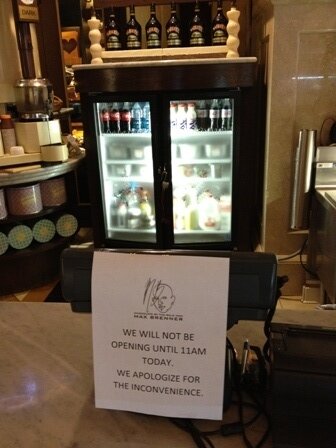
All was going well and I parked the car in valet and got to Max Brenner’s and this is what I saw (see picture).
Yep, this trip is ending just like it started. Three weeks ago it was the cupcake drama in Los Angeles…….now this! I knew I should’ve bought all of my edibles a couple of days ago!
Well, being in Vegas I was not to be denied. One of my other favorite dessert-places is the Jean Philippe Patisserie at Aria. They also have one at the Bellagio. I headed over there as I knew they would be open. I got some chocolates for a couple of friends (and myself of course) and then headed to the airport to catch my flight.
I had no problems getting home with plenty of time to change planes in Memphis getting back to Orlando at 10:20pm and getting back to my condo at about 12:15am. It was a late one, but it sure is nice to sleep in your own bed!
Overall it was a good trip. Made some money, did a little shopping, saw some old friends and ate some good food. I had more money leaving Vegas than I had going in……definitely a good trip!
JJ's Blog - 2012 Team USA Trials
Saturday December 31st
The alarm went off at 2:45 am. It was an early one but it was easy to get up because I was heading to Los Angeles and then Las Vegas to bowl the Team USA Trials. I’m an early-airport-guy so I like to be at the gate like 90-120 minutes before my flight. Since my flight was at 7:30am, that would get me to the airport to about 5:00am. I got up a little extra early just so I could go through my checklists to make sure I had everything.
I got to the airport at 5am and had a quick and painless check-in and run through security. I sat in the Delta Sky Club for about an hour and a half and then went to the gate. We boarded on time and everything was going as planned. I was supposed to get to Los Angeles at 10am and was going to spend the day shopping and also going to this cupcake place in North Hollywood that makes the best cupcakes. I wanted to share some of these with a few of my friends that were going to be bowling the tournament next week.
For those of you that don’t know me real well I have a real passion for two things: Clothes and chocolates/cookies/pastries/any kind of sweets.
We sat at the gate until about 8am when the pilot got on and said that they were having trouble with the fuel pump and they were having the mechanics come out and look at the plane so at this time we didn’t know how long it was going to take. Mind you, this plane just arrived from LA about 6:30am, so all they were doing was basically topping off the tank and cleaning it up and it was heading straight back to LA.
About 8:20am they were letting people de-plane but told them to check in to the gate every 10 minutes to make sure all was ok because when the plane was ready, we were leaving ASAP. About 8:35am the pilot said we were ready to go and at 8:45am we were all boarded. Well, 5 minutes went by, then 10 minutes, and then at 9am the pilot got back on the PA and said that the fuel pump was still not working and we were going to be re-routed because he had no idea how long this was going to take.
Next thing I knew that I was getting rerouted to Atlanta and my itinerary said I was going to get to LA about 6:40pm!
Since this was New Year’s Eve, most of the stores I wanted to shop at were going to be closed by 6 and when I called the cupcake place they were going to close around 5pm or maybe a little later depending on business and they were going to be closed on New Year’s Day, so it looked like my window for cupcakes was closing. This had all of the makings of a really bad day.
I got to Atlanta and I got on standby for the 1:20pm flight that was going to get into LA at 3:20pm. Fortunately, I got on! Things were looking up all of a sudden!
I got to LA at 3pm (even better) but since I flew on standby my luggage didn’t make it. That wasn’t a big deal since I was staying right across the street from LAX. The lady in baggage service said my bags were on the way to Salt Lake City and then LA and they should be there tonight. Well since I was there early, I got to the rental car place and off I went. I left the airport at 3:30pm and I was only about 30 minutes from the cupcake store. Since the guy I spoke to said that they were closing at 5pm, I should’ve had enough time to get a few cupcakes.
I got to the cupcake place at 4pm only to find a note on the door saying that they had already sold out of their inventory and they would be re-opening on Monday.
Happy New Year! Well isn’t that just flippin’ great! Cupcakes…..denied!
Since I was a little peeved about that I headed to Beverly Hills to do a little clothes shopping. It was about 25 minutes from North Hollywood to the “Hills”. I stopped at this one store on Melrose Avenue and looked around but found nothing I liked despite the sale that was going on. I then headed off to Rodeo Drive and got there right at 5pm. With my good fortune continuing, I found out that all of the stores on Rodeo closed at 5pm on New Year’s Eve as well as Neiman Marcus on Wilshire Blvd., the one department store I REALLY wanted to see today. Stay Hot!
Fortunately Saks Fifth Avenue and Barneys New York were still open as they weren’t closing until 7pm. I spent about a little more than an hour shopping at both stores, but still found nothing I liked. This was turning into a really bad day. What made it worse is Rodeo Drive is also closed on New Year’s Day. I found that out last year as the Team Trials were basically on the same week and I flew out New Year’s Day last year just to find out Rodeo Drive was shut down. So far, no cupcakes for me or my friends and only about 15% of the shopping done that I wanted to get done. This day has definitely been “no bueno” so far.
Being now about 6:30pm and being quite hungry I grabbed a quick bite at the Grill on the Alley and went to go check into the room. I first had to go back to the rental car facility because when I looked closer at my rental agreement they screwed up the coupon I was using for a free day at the end of the rental. It just keeps getting better.
After clearing up that mess, I got to the hotel about 7:15pm and my luggage still hadn’t arrived. Stay red hot!
The one thing that I did have to look forward to was my good friend Missy Parkin invited me to a New Year’s Eve party hosted by her friend Scott Norton at his mother’s house. After the day I’ve had so far, I really needed something to go right considering I was denied cupcakes, didn’t do hardly any shopping and didn’t have any luggage. I didn’t want to sit in the room and think about how the day went, so I got showered and headed to their party which was about an hour from my hotel. I got there about 8:45pm and stayed until about 12:30am. I had a GREAT time as we talked, played some Password and ate some really good food. I got back to the hotel about 1:30am and lo and behold my luggage arrived! Woo-hoo! Things finally were looking up today. Well actually it was already Sunday, but it was a good way to sleep on a high note.
Sunday January 1st
I headed out about 8am to the Desert Hills Premium Outlets. It was about a 2 hour drive from LAX since the outlets were over near Palm Springs. I got there with no problems but I spent an hour there and still found nothing I liked. The bad part was the one store that I REALLY wanted to go see…….closed…..permanently. So far I was 0 for 3 on the shopping establishments, however I did get a nice ice cream cone at Haagen-Dazs which helped relieve some of my retail distress.
Since I found nothing there I made the 4 ½ hour trek to Vegas since practice session was on Monday. I was going to stop at the Outlets at Primm, NV but when I got there I figured that would be a really BAD idea.
Being New Year’s Day and around 3pm at this time, a lot of the people from LA who drove to Vegas for New Year’s Eve were heading home…….I mean…….A LOT of people were heading home. I could see at times on the southbound lanes on I-15 there were stretches where the traffic was backed up for miles. As I got closer to the exit for Primm where the outlets were at, I could see all the cars backed up on the road underneath the overpass and how they were backed up at the couple of gas stations on the southeastern corner of the exit ramp. I realized this would be a bad idea if I tried to get off so I kept going.
When I passed the overpass for the exit I noticed the southbound exit ramp (as well as the other three lanes) was backed up for about a mile and a half. It was a good call on my part since it probably would’ve taken me an extra 15 minutes to get in and probably another 20 minutes to get out, however that made me 0 for 4 on shopping. I hope the bowling goes better because the shopping has pretty much sucked so far.
I went straight to the City Center and looked around and then went to the Fashion Show Mall and then to the Forum Shops at Caesars’ Palace. I did find a nice shirt at the Forum Shops and a nice tie at the Fashion Show Mall. The shirt and tie were 60% and 70% off respectively so it was a big score to end the day. After grabbing a bite to eat at one of my favorite restaurants in the Forum Shops (Spago), I headed to Texas Station to go check into the room and call it a night.
Monday January 2nd
I woke up about 7am and spent a little time riding the stationary bike at the hotel because my right hamstring was a little tight. I felt it the night before at the end of the day and I thought if I slept on it, it would be a little better in the morning. Well……I was wrong. After about 30 minutes on the bike I felt a little better, so I went out to Panera Bread and got some breakfast. I noticed there was a cupcake store in the same plaza that Panera was in. They opened in like 15 minutes so I stuck around and grabbed a couple. They were pretty good. The day was starting off pretty well.
I came back to the room about 8:30am and then took a shower. I then left about 9:30am with Jessica Baker to go pick up Diandra Asbaty and her son Madden at the airport who was getting in about 10:30am. I made a quick stop to the Forum Shops on the way to pick up some unbelievable chocolate chip cookies at a restaurant called Max Brenner’s that I discovered the night before and then we went to go pick up Dee.
After picking her and Madden up I then made a quick trip to my good friend David Haynes’ pro shop to pick up a case of balls I had shipped there (Thanks Dave!) and then headed back to Texas Station to get ready for the one and a half hour practice session.
The practice session went well but the 90 minutes went really quick. Texas Station is 60 lanes and since we were bowling on 4 patterns over the next 4 days, they had all the patterns spread throughout the center in blocks of 14-16 lanes.
When you’ve got 13 bowling balls with you for all different patterns and you’re trying to practice on all of the patterns, it takes a little bit of time just switching bowling balls from one bag to another and then walking to one end of the house and then back to get bowling balls for another pattern and then walking back, etc. You lose quite a few minutes of practice session just walking back and forth in a 60 lane center and switching equipment from one bag to another.
I felt pretty good on all of the patterns though. Afterward we had orientation and then I went back to the Strip for some shopping and some food. Tonight was back to City Center where I had a nice Mushroom Pizza at Wolfgang Puck’s Cucina at the Crystals Mall. I found a couple of shirts I liked but they didn’t have my size, so that made me at about 2 for 7 now on shopping malls. I’m only batting a little under .300, but not too bad. At least that’s good on my wallet. The tournament begins tomorrow so I headed back to the room about 9pm and was out by 10pm.
Tuesday January 3rd
Today the tournament begins. We are going to be bowling on the 39’ Seoul pattern. This week we’re bowling on all WTBA patterns.
The pattern schedule will be as follows:
Tuesday: 39’ Seoul
Wednesday: 47’ Paris
Thursday: 34’ Stockholm
Friday: 45’ Mexico City
The Team USA Trials is also a little different this year in a couple of ways. First, we’re only bowling 7 games a day instead of last year’s 9. Also, this year’s champion will be determined by points and not total pinfall. Basically if you lead the squad by total pins, you get one point. If you’re second in total pinfall you get 2 points. If you’re third you get three points and so on down the line.
So, the person with the LEAST amount of points over 4 days is the Team USA Trials champion, the 2nd least amount of points is 2nd, and so on. It’s supposed to reward the player who is the most consistent on all 4 days which is definitely a trait of a great bowler: Versatility. The player who is really good at one pattern but mediocre/sub-par on another will definitely stick out in this format.
The day really wasn’t a real good day. My ball roll didn’t really match up too well and I was slow on reading a few transitions. Texas Station has a little more early hook than the lanes at Sunset Station (which has hosted the Team USA Trials for the last 3 years). Since my ball roll reads the fronts a lot naturally, this isn’t a real good combination for good ball motion when they break down, which started for me in game 3. I felt like I threw the ball well overall, but being a little behind on transitions kind of hurt me. I thought the scoring pace was going to be a little lower so I wasn’t quite as aggressive when I had to move inside the track and needed to start opening up the lane a little more. I was trying to “trap” the ball just inside the track from games 3-5 instead of just moving deeper and really trying to open it up. I only went +68 for 7 games which put me in 39th place for the day, especially not good considering I was +72 for the first 2 games.
I figured one point for every year that I’m old will not be acceptable for the rest of the tournament. I was kind of depressed as I wasn’t sure I’d be able to make up that many points considering this is the first time they’ve used this points system. I went back to the Forum Shops and drowned my sorrows on another Smoked Salmon Pizza at Spago and more cookies at Max Brenner’s. I knew though……..tomorrow was going to be new day.
Wednesday January 4th
Today we were bowling on the 47’ Paris. I started out the first game with a pretty good line to the pocket but I think my ball was still burning up a little quick and not getting into a roll down the lanes as I never missed the pocket for 218. I think the Rapid Fire Pearl I was using was probably flaring a little too much combined with my ball roll reading the fronts too much. I tried switching balls to an Anarchy and that wasn’t much better ball motion-wise though I did manage to shoot 230 somehow. I then switched to a Mission X in game 3 and since that flared a little less but still had a strong cover it got through the fronts and rolled through the pins much better. Now I was able to do some striking.
From here I was just trying to chase it left and stay ahead of the moves. The 6th game I was getting a little too deep as I was starting to get the big wet-dry from side to side as I was shooting a 200 game which wasn’t very good with par being around 225. I tried to move back right on the fill ball and use loft so I could keep the ball on line as I knew that if I stayed where I was at I was only going to shoot another 200 game which wasn’t going to cut it at the scoring pace that was set. It looked like it would work based on the fill ball, I just needed to move a little farther left with the same Mission X. Lo and behold, it worked! 268 to finish the day!
That put me at 7th place for the day which moved me up from 39th to 16th in the standings. Things were looking up for tomorrow for the short pattern, which has either been really good or really bad for me the last few years in this tournament.
Went back to the Crystals Mall at City Center and grabbed a pizza and some chocolates to take back for later. I then went to use Kaitlin Mayall’s ball spinner to do some ball work (Thanks Kaitlin!) and then called it a night.
Thursday January 5th
I brought two urethane balls with me to combat the short. I figured if anything it will give me more control and get me around the pocket until I see how the scoring pace is going to be and then go from there. It sounded like a solid game plan going in.......however……..then we started bowling, haha!
I think the combination of the early roll of the urethane balls, the early hook built into the surface and my roll which reads the fronts too much as it is…..was a bad combination. I shot 203 the first game which wasn’t terrible but not up to pace. I had trouble keeping it on line when I went direct but the ball had trouble cornering when I gave it some room.
After 4 frames of the next game only hitting the pocket twice with one open, I realized that urethane wasn’t cutting it. Since the loft worked out really well the last game yesterday, I thought I’d try that again. It made sense since it would help eliminate some of the early roll my release naturally gets since the ball won’t hook in the air, haha!
I switched to pretty strong bowling balls and between the same Mission X and Rapid Fire Pearl I used yesterday, I shot +204 the last 5 to vault me to 6th place in the standings for the day which shot me to 4th place overall.
It was a good day so it was time to back to the Strip at the Forum Shops at Caesars. I went with my good friend Katie Thornton to have a meal at the Cheesecake Factory and more of those good cookies at Max Brenner's and walked over to the Bellagio and bought some really good pastries at the Jean Philippe Patisserie. I brought those back to the hotel and Katie and I shared the pastries with Kaitlin Mayall and her Dad while she let me use her ball spinner again (Thanks again Kaitlin!) to prepare surfaces for the Mexico City pattern the next day.
Friday January 6th
This pattern is on paper one of the most difficult in the WTBA series. It has the potential to be pretty ugly so I felt like I kind of needed to play smart on the fresh and not try to “swing for the fences” so to speak. I was fortunate shooting 256 the first game out of the box. I threw a Red Mission playing between 10-13 really straight and had a good look. I also had the good fortune of tripping a 2-pin, a Brooklyn and a “trip 3-9” for a 5-bagger, but I took every one of them because goodness knows I might need them later. Sadly, I was really going to need them later.
I shot 196 the next game which I was still in good shape but as we made the turn to the low end I could see that there actually was some ball reaction developing between 20 and 25. After 4 frames of really bad ball reaction (and seeing some strikes from a fair amount of other people) I knew it was time to move inside. I went to the Mission X and it was the right ball but it took me a few frames to get lined up and combining that with another open frame I shot 176. I got lined up and shot 223 the next game but the next few games were a struggle. I was slipping on the approach which was resulting in a half a game of adjusting slide soles and heels and I was also seeing that my ball roll really wasn’t right.
I’m a fair amount up the back of the ball and I see that I needed more tilt and more rotation but with a softer hand. All the guys that were bowling well had that. I can get more rotation, but my tilt is still low so that makes my ball read earlier which forces me farther left which is part of the problem since I’m already about 5 boards too far left to begin with. I can get more tilt, but not with a soft enough hand. My ball roll forces me farther left (because it rolls sooner) so I get less hold when I miss in and when I get it to the right (since it burns up earlier) it doesn’t roll through the pins the right way thus it doesn’t strike as much. I’ve been fighting this all week, but it was magnified today on this pattern.
It was a disappointing way to finish with (2) 170 games in the last 3 games and that put me 35th for the day and 6th place overall. From here I needed to get picked for the Team since only the top 3 spots were automatically on the Team.
Fortunately, I got picked but I realized that I needed to work on developing this softer hand with more rotation and more tilt. That’s going to be one of the first things I’ll be working on when I get home. We had Team USA Orientation that night and then I went to get a bite to eat afterward even though it was near 10pm at that point. Overall, it was a week with some ups and downs but in the end it all turned out good. Looking forward to a good year on Team USA!
Saturday January 7th
I took Diandra, her son Madden, Jessica Baker and Jazreel Tan to the airport in the morning and then it was back to the hotel to check out and then back to Los Angeles for a couple of days of R & R. I met with Missy Parkin for lunch at South Coast Plaza in Costa Mesa (nice call on the fish tacos at Wahoo’s!) and then went to Beverly Hills for some shopping on Rodeo. I didn’t buy anything at either place, but it was just good to walk around and relax. It was a reasonably low-stress day ending with a nice juicy “Double-Double” cheeseburger at In-N-Out.
Sunday January 8th
I met up with my cousin who lives in Santa Monica in the morning and we spent most of the day together with her and her boyfriend. We did some shopping and lunch at the 3rd Street Promenade, watched the NFL playoff games at their house and then went to a few cupcake stores that were right nearby. Los Angeles is big on cupcake stores….my kind of town.
Speaking about cupcakes, I wanted to go back to the cupcake store that I wanted to go to originally the weekend before that closed early. I saw on their website that they were open until 8pm on Sunday. I thought to myself……Perfect! I’ll get there about 6pm and I’ll get some cupcakes to bring back. I said goodbye to my cousin about 5:45pm and then got to the cupcake store in North Hollywood about 6:15pm.
I get there…….and they’re closed! There’s a sign on the door saying that they close at 6pm on Sunday, but their freaking website says they’re open until 8pm on Sunday.
Ironically, this trip ended the exact way it started. Fortunately I bought a few cupcakes from one of the other stores in Santa Monica so I had some cupcakes to take home for my friends, but not the ones I REALLY wanted. It was then off to the airport to catch the 10:50pm red-eye flight and back to work on Monday morning.
At least the bowling part went well. :-)))
Changing Out Conditioners - Sanction Technology

KEGEL TECH TIP - The following is Kegel's recommended procedure for changing out lane conditioners in Kegel Sanction Technology lane machines.
Remove the conditioner tank from the lane machine.
Empty the conditioner tank into a container. Do not reuse the old conditioner.
Remove the internal filter from the conditioner tank.
Flush the conditioner tank out with your lane cleaner solution to get any leftover conditioner and debris out of tank. Repeat this step at least one more time.
After the lane cleaner solution rinse, rinse the conditioner tank out with water until there are no more soap bubbles to ensure all lane cleaner residue is out of the tank.
Note: Kegel recommends NOT USING isopropyl alcohol or any other solvent.Allow the conditioner tank to dry completely.
Clean or replace the internal conditioner filter.
Reinstall the internal filter using Teflon tape and a small amount of clear silicone around the threads.
Reinstall the conditioner tank.
Fill the conditioner tank with the new conditioner.
Put the return line to the conditioner tank into a separate container and run the oil pump so that the old conditioner left in the lines will go into the container. This will force the old conditioner out of the conditioner tubing and replace it with the new conditioner while also keeping the old conditioner out of conditioner tank.
Once all of the old conditioner is out of the conditioner tubing, reinstall the conditioner return line back onto the conditioner tank.
Perform an oil volume output test five times into the separate container. This allows all of the conditioner to be removed from the pencil tip and conditioner tubing leading to the pencil tip.
Before applying conditioner to the transfer system components, and depending on your machines oil application, clean the transfer brush, smoother pads or transfer rollers, and the buffer brush. No chemicals should be used to clean these items; just clean dry towels.
Allow the conditioner pump to run and inspect all connections for any leaks.
Check your conditioner volume output and conditioner pressure. Kegel suggests setting the conditioner pressure at 15 psi for machines with a CPM2A and C200 PLC’s. However, anywhere between the ranges of 10-20 psi is safe. Machines that have a CP1H PLC will run conditioner pressure NO lower than 15 psi and no higher than 45 psi. And remember, conditioner pressure and volume are independent of each other - pressure differences WILL NOT affect conditioner volume.
For questions or assistance, please contact Kegel Tech Support US Toll Free at (800) 280-2695 or e-mail at tech@kegel.net
How to Choose the Correct Lane Conditioner
If there is one thing we have learned over the years, it’s that every bowling center is uniquely different. Even two bowling centers located right down the road from each other, using the same lane machine type, with the same lane surface, and using the same chemicals, can have drastically different lane conditions.
By measuring the lanes of hundreds of bowling centers with the Kegel LaneMapper™, we have begun to further understand why bowling centers can vary so much. However, things such as the water used to dilute the lane cleaner, the temperature and humidity within the building, and the different bowler types or balls being used by those bowlers can influence what lane conditioner is best for any one bowling center.
The properties Kegel tests on lane conditioners in the lab are all physical properties. Because all physical properties are affected by the environment they are used in, it is often hard to find or suggest the “right” lane conditioner without a little trial and error. So how do you begin to select the right lane conditioner and set-up for your bowling center?
First and foremost, our recommendation is that if you are happy with the lane conditioner you are using, don’t change it. If you are not happy however, and were to contact us at Kegel, there are a number of factors we would talk you about to get you on the right path. The following will give you some insight into the process we use to make lane oil recommendations to bowling centers.
The first thing we would ask is what problems you are experiencing in your bowling center. Issues that might indicate you need to change your lane conditioner are:
Excessive ball calls
Excessive out of ranges
Pattern is not holding up long enough
Pattern adjustments seem “too touchy”
Scores are not what they used to be
Before you switch your conditioner however, consider these possibilities:
Oil pattern: Some of the problems listed above could simply be caused by the oil pattern you are using. If you notice any of these issues, it is a good idea to have an expert review a copy of your current oil pattern to determine if this could be the source of the problem. Check out our pattern library or contact our tech support
Cleaner type, mix ratio, or residue:
Sometimes oil related issues can solely be a cause of a certain cleaner or mix ratio. Make sure the cleaner you are using is designed to remove the lane conditioner you are using.
ALL cleaners leave some residue behind - even those that claim to be residue free. For example, toilet bowl cleaners that keep your toilet “cleaner for longer,” leave a small amount of residue behind to help repel the dirt. Though the toilet may be flushed frequently and appear clean, the residue remains. For an example of this residue at work, watch this “Drop Shape” video to illustrate the effect cleaner residues can have on a surface.
Lane machine: Maintenance and upkeep of the lane machine are just as important as the chemicals they apply. Machines that are kept clean and maintained will apply conditioner more accurately and leave behind smaller amounts of residue.
Lane topography: We have a new saying at Kegel after measuring 1000’s of bowling lanes; “you can’t fix a gravity problem with oil.” Checking today’s synthetic lanes at 3 predetermined distances does not give enough information to determine how your lane’s shape affects ball motion. The consistency and predominant characteristic of your bowling center’s lane topography can finally be seen with the invention of the Kegel LaneMapper which can measure 744 points on the lane.
The top factors affecting lane play are the environment and pattern choices. After that comes the conditioner choice, followed by a third and often overlooked factor, the cleaner selection. Make sure you have exhausted alternate possibilities before chasing the perfect lane conditioner.
Lane Surface type:
Synthetic brand, model and age – AMF HPL’s or SPL’s, Brunswick’s many surfaces, DBA IQ™, Murray Pathfinder™, Switch, etc.
Wood lanes with finish - 100% solids, EZ Coat, moisture cure, water-based, etc.
Type of lane machine: Do you have a fluid metering lane machine (Kegel Sanction Technology), a wick/pad lane machine, or spray type machine?
Lineage: how much of your business is league play with high flaring modern bowling balls vs. open play with low flaring house balls. If more than 50% of your lineage is from league play, you should opt for a conditioner that has high durability. If your business is predominantly open play, parties, and social bowling events, look for a lane conditioner that is geared to prevent ball calls and out of ranges such as Prodigy.
Environmental factors:
Temperature consistency
Humidity
Cleanliness
Altitude
For example, if you live in a dry desert area, there is typically high static in the air which can cause lane play issues. In this scenario, it is good to look for an oil to help prevent the snappier back ends caused by the high static environment.
Through our experience with bowling centers all over the world, we have being exposed to many different scenarios. Although we have come to find that certain generalizations can be made based on the type of situation, no two centers are EXACTLY the same.
Dennis Sheirs, Vice President of Kegel’s Chemical division often gets asked the question “What is the best lane conditioner out there?” His response is, “the best lane conditioner is whatever works best in your center.”
When choosing a conditioner for your center, it is important to get advice specific to your factors in order to determine the best lane conditioner for your center, and ultimately, for your customers. As always, if you would like to have company along that journey trying to find that perfect lane conditioner, Kegel Technicians are only a free phone call away - Kegel Tech Support (800) 280-2695.
Oil Pattern Depletion
Oil pattern depletion (breakdown) is much different with today’s high flaring balls versus the low flaring balls of the past. Oil pattern depletion also happens much quicker and much more with today’s bowling balls.
When bowling balls had essentially balanced weight blocks, or differential Rg values of .010” or less, the ball basically rolled over the same place every revolution. When this happens, the ball picks up all the oil it can within the first couple revolutions and oil pattern depletion only happens in the head area, or only in the first 16’. The rest of the oil pattern remained intact, but not with today’s high differential Rg weight blocks.
Most bowling balls today have differential Rg values in the .040” to .060” range. The maximum differential Rg value is now .060”, according to USBC specifications. These high differential Rg values create a dynamic imbalance within the bowling ball. When a ball is drilled to maximize this imbalance, this causes track flare and results in the bowling ball rotating on a fresh part of the cover every revolution. This erases oil off of the lane every revolution, causing oil pattern depletion throughout the entire length of the oil pattern, instead of only the heads as when bowling balls were more dynamically balanced.
Kegel performs many tournaments every year and one of the things we are constantly measuring is oil pattern depletion. We do this because the main goal for the laneman in tournaments is to try and create a playing condition that has the best opportunity for fair play; in other words, give as many styles a chance as possible. If massive oil pattern change continues to make this task difficult, we need to find ways to help Lanemen do their job better.
How much oil is erased with today’s balls?
During a recent seminar tour, we got a group of bowlers’ together and measured oil depletion after 10 minutes of practice, and then every three games of play. At the end of this test, we had 9 games per lane. To put it in comparison, a 5 person team bowling a 3 game league has 15 games per lane.
To follow are the results of that test:
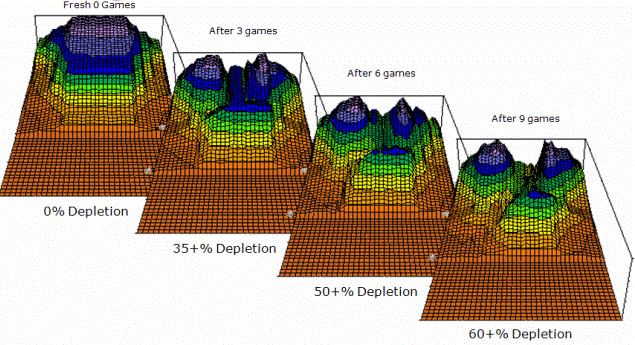
The greatest amount of depletion occurs during the early stages of play because the ball creates a larger footprint within the oil pattern. In the head area, there were 80 units of oil before bowling. After 9 games, there were about 35 units in that same head area. The move left by the players was not the lack of head oil; it was the ‘spark point’ being reached in the mid lane and the back part of the pattern causing the ball to hook more and forcing the players left.
Now we show why this massive depletion of the oil pattern can affect fair play. The following graphics are a comparison on how different styles of players break down oil patterns.
The event was the 2009 European Bowling Tour Masters featuring the top 16 players, men and women, from the 2008 European Bowling Tour point list. Both groups had 3 bowlers per pair and they played 8 games. So the lanes had 12 games per lane plus 10 minutes of practice on them. There was also an equal amount of lefties and righties on both the men’s side and the women’s side, and every player bowled on each pair of lanes twice within the block, so it was a very good comparison.
The fresh oil pattern was 44’ in length with the same pattern used for both the men and women. Below is the graphic of that pattern:
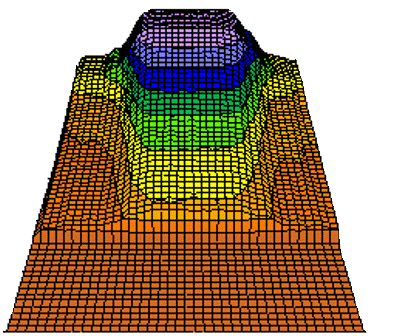
The first depletion example is the women’s side of the event. They were bowling by themselves and as with most lower rev players, because of the decreased motion on the back end, these type players tend to play in the same area on the lane and in a tighter line to the pocket.
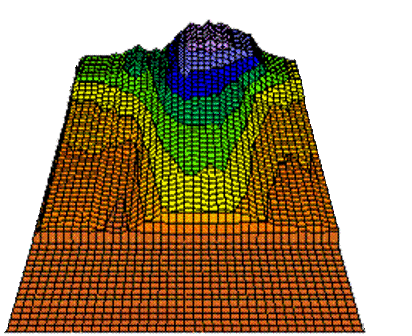
As you can see in the above graphic, the women essentially started at the slope of the oil pattern, the rise from the least amount of conditioner to the greatest amount of conditioner, and broke the oil pattern down in a very logical manner. When oil patterns are broken down this way, scoring pace can increase greatly.
The men played on lanes right next to the women players. Here we had players like Jason Belmonte, Osku Palermaa, Dominic Barrett, and several Scandinavian players with fairly high rev rates. Below is the graphic of how the men broke that same fresh oil pattern down.
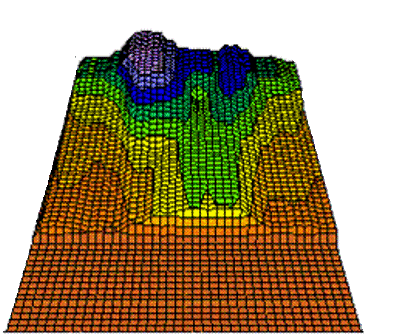
Because of the great amount of potential hook we have in the game today, and especially with the higher rev players, the slope of the oil pattern is not always followed as it used to be when bowling balls hooked less.
What is interesting, is the area where the bowling balls roll throughout the pattern, both groups depleted the same amount; over 60%. Testing has shown depletion is not significantly greater with higher rev rates, depletion is only more spread out. Towards the end of the pattern where all balls meet, both groups depleted the same amount, over 60%.
Here is the tape data and depletion percentages at comparable distances throughout the above patterns.
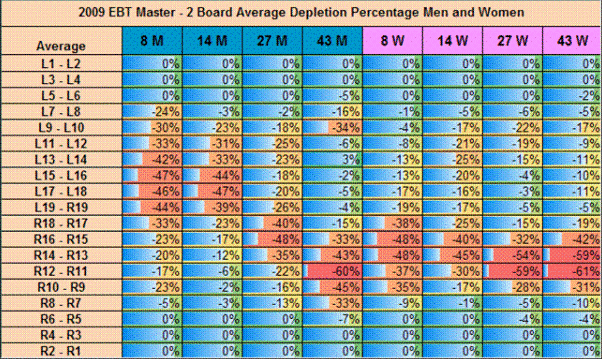
Most bowlers still believe “the heads” breakdown the most and therefore affect ball motion the greatest. This was the case with balls that did not flare, but that’s not the case with balls that flare.
When flaring balls are rolled over an oil pattern, the oil pattern is erased near the same amount,percentage wise, from the lay down point to when the ball exits the end of the oil pattern. The most oil is depleted where the footprint is the greatest, but at each distance, the percentage of depletion is essentially the same.
Once the oil pattern is depleted enough for the ball to reach the “spark point” in the mid lane and back part of the pattern, players start moving inside. And they move until the modern practice of lofting the gutter cap comes into play.
If depletion continues to happen at such a rapid rate, lofting could become the modern way to play the game. After all, we have yet to see a ball hook while it is in the air.
The Weather’s Changing…Are Your Lane Conditions?
It’s that time of year again. Leagues began towards the end of summer, the pattern gets tweaked, and everyone starts to get back into the swing of things. Everything is going great and then boom, the weather gets colder and all of a sudden things are different. Then comes the question every manager and mechanic has heard more than they can count - "What happened?"
The products that a bowling center uses to create optimal lane conditions; like lane machines, conditioners, cleaners, and even the lanes themselves, are all physical in nature and therefore temperature dependent. So as temperature changes, the properties and performance of all those products will change as well.
So how do changes in those physical properties show up in the bowling center? They show up in lane machine performance, oil pattern differences, lane topography changes, and of course, what the bowlers feel and see in ball reaction. As the temperature of the conditioner gets colder, the viscosity, surface tension, and density all increase which not only affects ball motion, this also affects different lane machines in different ways.
For this article, we will discuss these changes and offer advice on how to minimize the effects of cold weather on lane conditions. We will focus on the products used to condition the lanes, and in the next issue, we will move on to discuss the topographical changes the lane surface goes through as the climate changes.
Lane Conditioner
In early 1997, we conducted several tests to see how much conditioners changed when the temperature was raised or lowered. What we found was eye-opening. The viscosity of some conditioners changed 2 cps (centipoises) for every 1° F of temperature change. That means if you start with a 20 cps (viscosity) conditioner and the temperature drops from 80° F to 70° F, the viscosity of that conditioner would be 40 cps.
This is not true for all lane conditioners. Some only change 1 cp for every 2° F of temperature change. That is only 25% the change as some of the others, but regardless of how much they change, it's important to know that all of them do.
To minimize this change, look for a conditioner with a higher viscosity index (VI). VI is a way of assigning a value to a conditioner’s resistance in viscosity variation as the temperature changes. The manufacturer of your conditioner should be able to give you this value and guide you accordingly.
Lane Machines
For centers using wick technology lane machines, if the conditioner or lane machine is not kept at normal room temperature, or if stored near a cold wall, the oil will “thicken” and impede the wicking action which reduces conditioner flow onto the lane. As it gets colder, the capillaries in wicks shrink, also restricting flow. Therefore the oil pattern that you started out with at the end of summer might not be the same oil pattern as the weather gets colder.
For centers using Kegel Sanction Technology™, like the IKON, FLEX, and Kustodian line of lane machines, temperature decrease will not affect the output of conditioner like it will in a wick machine. However, if the conditioner gets colder, what you may see is the pressure in your oil pump gauge increase. Fortunately, this does not change the output of conditioner; that’s the beauty of Kegel’s Sanction Technology.
For Sanction Technology lane machine owners, Kegel’s Steve Cross suggests the following when seeing slight pressure fluctuations:
- DON'T PANIC! Expect pressure fluctuations because it is normal with temperature changes.
- Do not change the tubing (pressure regulator). Many people will try to put in a shorter tube to decrease the pressure, but this is not necessary. We have designed a large margin for psi and still have the machine perform as intended. Pressure alone does not affect oil output in Sanction Technology machines.
- Do not adjust the fluid metering pump to adjust pressure. Adjusting the fluid metering pump will increase and decrease the amount of conditioner output (volume).
- Get the machine out early, turn on the oil pump motor, and let it run for about 10 minutes. You should see the psi gauge go back to normal.
Our tech support department receives many calls this time of year with temperature related concerns and we recommend the following no matter what lane machine or lane conditioner you are using:
- Keep the lane conditioner in a temperature controlled environment. The office, front desk, or wherever the temperature is most constant.
- Keep on top of your chemical orders; try to place orders a few weeks in advance to give the chemicals a chance to “acclimatize.”
- Keep the lane machine in a temperature controlled environment so the machine functions properly. If that is not possible, look for other solutions like an electric blanket, packing blanket, or a space heater to help keep the machine warm.
Ball Motion
As we stated before, when conditioner gets colder, the viscosity, surface tension, and density increase. With the increase of these physical properties, more resistance is created on the bowling ball as it rolls through the conditioner. This, in return, usually causes the bowling ball to slow down faster which means it will hook a little more.
Another byproduct of colder weather is the conditioner tends to “stay in place” more which reduces carrydown and therefore, helps the backends stay stronger longer.
Not every bowling center is affected by outside temperature changes but if yours is, our technicians have a couple tips you can employ:
- If when the weather gets colder you notice the bowling balls are hooking more, increase your oil pattern by one foot. This will help bring back the hold area you had when the season began. Once the weather warms back up, decrease the pattern length back to what it was when the season began. Note: Wood lanes with overlays can change in shape which may increase this affect; read about "Changing Lanes".
- If you find temperature changes tend to affect your lane conditions, try to use a lane conditioner that is more resistance to temperature change (higher VI index). Kegel’s Offense HV (for Sanction Technology machines only) is such a product. Offense HV was created when Kegel was entrusted with lane maintenance for the PBA Tour. It was designed to minimize the difference in ball motion from the weekly competition to the TV Show. The TV Show uses many very hot lights that are not present during the rest of the week’s competition. To this day we use Offenses HV when we perform tournaments in venues with less than ideal climate control.
Keep in mind there is no magic lane conditioner or oil pattern that is best for every lane surface or bowling center. Finding a conditioner and oil pattern that is best for your center takes some research and a lot of patience. However, as a Kegel customer you have something going for you; award winning, industry leading tech support by Kegel’s 24/7 Tech Support. Best of all, it’s only a phone call away, and it’s free!