Dual Oil Patterns are here! What’s next?
The European Bowling Tour has recently announced it will have two tournaments in the 2009 schedule where players will compete on dual oil patterns. Following the lead of Ronald Dol and Luc Jensen, organizers of the EBT Hammer Bronzen Schietspoel Tournament which will use dual oil patterns for the third year in a row, the Brunswick Aalborg International will also be contested on dual oil patterns for the second straight year.
Although dual oil patterns have been a mainstay of international championship competition for the last several years, most other high level singles events still use a single oil pattern, but times are changing.
Even the 2008-09 PBA Tour season is testing the waters with an event that utilizes six different oil patterns and another event will employ dual oil patterns on each pair during the PBA Match Play Championship in Norwich, CT.
The format of the recently concluded PBA National Bowling Stadium Championship followed past Foundation Games, the WTBA World Ranking Masters, the EBT Masters and the ETBF European Champions Cup.
In all those events, one qualifying block is played on a short oil pattern and the other qualifying block is played on a long oil pattern. During the match play rounds, all games are played on pairs where every left lane is conditioned with the long oil pattern and every right lane conditioned with the short oil pattern.
How did this all come about?
There are two major reasons why dual oil patterns came into existence. One seemingly clear but not so obvious reason is the technological advancement of the modern lane machine. In the not so distant past, conditioning bowling lanes was done by hand or by machines that could only condition the lane. The challenge however was the time consuming cleaning of bowling lanes. Today’s combination lane machines can consistently condition and clean a bowling lane in less than two minutes making it possible for dual oil pattern events to become a reality.
The other and most significant reason is a group of people came together with a vision and were not afraid to depart from status quo. In the year 2000, then WTBA President PS Nathan called for a World Symposium in Malaysia to address many of the perceived problems related to the sport of bowling.
Out of that symposium, which included the likes of Sid Allen, Tom Kouros, John Davis, Len Nicholson, the late Bill Wasserberger along with other highly respected people in bowling, the WTBA Technical Committee concluded “that a single oil pattern format was unfair, since it overly favored a particular style of play regardless of how the lane was oiled.”
During that same symposium, the WTBA Technical Committee also felt the question of “who is the best bowler” needed to be examined further. Through much discussion and digging deeper into the question, the WTBA defined what they feel are the most important traits that should make up a World Class bowler.
The committee agreed to and created the synonym V-PARK which stands for; Versatility, Power, Accuracy, Repeatability and Knowledge. There was one trait however that was at the very top of every members list, Versatility.
The Technical Committee felt that “the ability to bowl over a wide range of conditions elevated a player from one of quality to that of greatness” and therefore led to the conclusion “that WTBA’s present oiling procedures were not conducive to identifying and rewarding great players, but instead only identified specialists.”
Then committee member Craig Woodhouse suggested the concept of multiple oil patterns and it was unanimously agreed that this would be the standard for all future World Championships.
From where does it go from here?
There is no question that every winner of a dual oil pattern event has garnered the respect of their peers for that week’s competition. It would be reaching pretty far for anybody to say “so-and-so” only won because “they matched up” to both oil patterns. In that regard, the WTBA Technical Committee’s vision about versatility held true but that doesn’t mean dual oil patterns doesn’t have it detractors.
There is no debating the fact that airlines have decreased the allowable weight limits and travel by way of air has been a challenge for the modern bowler. Automobile travel has even been impacted by the modern game and the number of bowling balls competitors need, or feel like they need, to travel to any one tournament even in single oil pattern events.
So one can only imagine that one of the more common negatives of these dual oil pattern events is the perception that the players need to travel to tournaments with an increased amount of equipment to combat this extra oil pattern.
Although dual oil pattern events solely utilizing very long and very short oil patterns actually limit the number of ball choices because optimal ball motions are very similar and the best line is normally very defined, as tournaments move towards dual oil patterns in the medium distance range, that perceived issue will most likely become more reality than perception. When competitive oil patterns are in the medium distance range, all the other variables that make up the playing field come into play more and optimum ball motion becomes an unknown until a player is onsite.
Another remarkable trend in the competitive bowling world the last few years is tournaments being organized and played with severely limited equipment rules or utilizing less frictional bowling balls. The 2005-2007 Dutch DVA Open, the 2006 WTBA World Challenge, the 1997 Scandinavian Plastic Only tournament and multiple Foundation Game events have been held with strict equipment limitations. Some events allowed only one ball while others allowed only one type of ball.
In the Scandinavian Plastic Only event, organizer Ulf Hämnäs stated that “many players in the region had the perception that the higher level players were the best because of their unlimited access to high tech equipment.”
Once the results were tallied however, those same high level players not only still finished at the top of the leader board, they far outpaced the field. Hämnäs said “the equipment advantage perception was replaced with the surprise that the amount of time spent on the lanes practicing actually made the difference, not just getting new balls.”
Hämnäs further stated, “I think this was the time when a lot of bowlers actually understood the greatness of bowlers like Tomas Leandersson.”
So did the winner “match up” best in these events? Much like the 1997 Scandinavian Plastic ball event, according to the other organizers the winners of their events received the same accolades from the competitors as the dual oil pattern event winners, respect from their peers for a job well done. The overall feelings were it was not that the winner matched up the best; it was that the winner bowled the best.
Now in the year 2009, even the PBA Tour is going to hold an event using only one type of bowling ball, the 50th Anniversary PBA plastic ball. In this historic PBA Tour event, all competitors will be limited to two of the special 50th Anniversary plastic balls for the entire event. The main idea is to level the playing field by taking the perceptual equipment advantage, or disadvantage, away so success is determined solely by a player’s physical and mental skill.
In other words, the event goal is to “ensure that the abilities of the athlete, first and foremost, will determine the outcome of the competition.”
Sound familiar?

Bowling Bedlam - Oil
The playing environment of bowling today may be as complex, unpredictable and chaotic as any time in the history of the game. We're not talking about the weekly league or club game where the participants just want to have fun. We're talking about professionally maintained and controlled tournament environments where bowling sports people compete.
It is in this type of sporting environment, along with the basic premise of playing well both physically and mentally, that the decisions the modem player makes will ultimately determine whether they perform up to their expectations or have to wait until the next event comes around.
This is the second in a series of articles that will try to shed some light on many of the variables in the current game of bowling and why the players of today need to be very open minded and aware of the total environment at all times when competing. The supplied information is all in the quest of understanding and to increase performance, not to create excuses.
Oil (Conditioner)
There are low viscosity oils and high viscosity oils. There are oils with different amounts of additives such as friction modifiers and flow agents for different types of lane machines. There are oils with varying surface tensions which help the oil bond to the lane surface.
Mineral oil is used in most lane conditioners as the base oil but over the years lane conditioner has evolved. Today's conditioners are now mixed with a percentage of specialized additives to increase the performance and durability of the conditioner.
All these different types of conditioners will make your bowling ball react differently on the lane. At the same time, different types of conditioner can make the same pattern play different.
If using a wick machine, some conditioners will flow through the wicks more than others making the same pattern settings apply a different pattern. With wick machines, temperature will affect the flow rate since temperature not only affects viscosity or the thickness of the conditioner, it will affect the size of the capillaries of the wicks as well.
If using spray type machinery, different conditioners will either peel off or hold onto the buffer brush more or less which can change the shape of any specific pattern even though the machine settings remain constant. Different lane surfaces will do the same thing so add that into the equation also.
There is a very good online article by Kegel's Chris Chartrand on lane conditioner (oil), "10 Things That Everyone Should Know about Lane Conditioners" which you can view by clicking on the title. Therefore we won't go into specific details on all conditioner properties but one thing we will touch base on is viscosity since the USBC has just made a new specification on this lane conditioner property.
The new viscosity rule the USBC has implemented "requires that lane conditioners used during USBC competition read between 12 and 81 centipoises at 70 degrees Fahrenheit." Centipoise (cps) is the standard unit of measurement for fluids and many lane oil manufactures will have this designated on their product.
Viscosity is very misunderstood in common bowling discussions. Most bowlers believe the higher the viscosity of oil, the "slicker" the bowling ball reacts to it. Actually the exact opposite happens.
By definition, viscosity is the measurement of internal friction of a fluid. The greater the amount of friction, the more force is required to move the fluid against itself which is called shear. Therefore the higher the viscosity, the more force it takes which increases friction. The lower the viscosity of oil, the less force it takes to shear which decreases friction.
In terms of a bowling ball rolling through these different oils, the higher the viscosity, the more resistance there is which makes the ball slow down more. When we get to the bowling ball portion of the series, we will spend more time on this subject but in short, friction is what makes the ball slow down and therefore enables it to hook.
Temperature is one of the biggest environmental factors in changing viscosity of a conditioner. So as the weather changes, so can the bowling conditions.
So what is the purpose of viscosity in lane oils? In short to provide durability to an oil pattern however, because of the many different additives being used in today's oils, viscosity is not as important as it once was in regard to lane maintenance. But as a bowler, you should be aware of how it relates to ball motion.
Oil Patterns
This subject of oil patterns is a difficult one and probably the most blamed and misunderstood subject in bowling. Lane conditioning rules have changed many times over the years and even today with the USBC 'three unit rule' or the USBC Sport Bowling rule in place, there are an infinite number of pattern combinations and ways to apply an oil pattern to the lane.
Kegel's Founder and CEO John Davis had a saying when he was entrusted in doing lanes over the years which goes something like this;
"Its 4 o'clock in the morning and the tournament starts at 8:00. You know if you do this; this might happen. But if you do something else, that might happen. So what are you going to do? Who do you call? Who can you call? You have to do something but there is no book. It is all up to you."
In these simple questions lies the major dilemma for every laneman at every bowling tournament in the world. Only after the tournament do they ever know if the job was socially acceptable or unacceptable. In simpler words, did the laneman do a good job or a bad job?
Of course the laneman might ask the same question to the bowlers; when trying to figure out the conditions, did the bowlers do a good job or a bad job?
2008 EYC - When Everything Comes Together
The 2008 ETBF European Youth Championships at famed Tali Bowl in Helsinki Finland showed what can happen in the modern bowling environment when all parts of the scoring environment are predictable and at a high level. During the Championships, 12 of 15 girls scoring records were broken and 11 of 15 boys scoring records were broken. There were also five 300 games during the Championships. However, the closer you look and dissect the possible reasons why those records were broken and scores were achieved, the less anyone should be surprised.
The Players
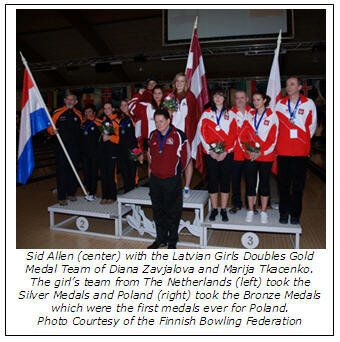
The youth players of Europe are more knowledgeable than ever and the overall level of coaching is at an all time high. Add to the fact that eastern European countries are increasing in participation numbers and they are treating bowling as a sport. Even world renowned coach Sid Allen has been attracted to Europe being hired as head coach of Latvia. This proved to be a great move on the Latvian Federations part as it helped them achieve the country’s first Gold Medals in Major Championship events. In fact Latvia won a total of five medals during the Championships, 1-Gold, 3-Silver and 1-Bronze. A fine testament to what a solid coaching program can bring to a Federation.
The Scandinavian countries have long been setting the standard in Europe by developing great player after great player. The Finns, Swedes, Norwegians and Danes all took medals in the boys divisions and from watching the youth competition at the 2008 EYC, the Scandinavian’s still are generating many great players.
But there are also some very good up and coming youth players from other parts of Europe because of solid coaching programs and Federation support. We should look forward to watching them in future European Championships and tournaments like the European Bowling Tour for many years to come.
Another item coming into place within Europe is increased equipment knowledge which is a huge part of being successful in the modern game. Until now and mostly because of language barriers, Europe as a whole has been behind the learning curve of countries where English is spoken or understood in high numbers. That however is changing and they are catching up fast as was evident by observing ball choices at this event.
The Lanes
But back to the environment, the scoring or playing environment that is. Tali Bowl is somewhat of an anomaly in the world of bowling. Built in 1972, the Finns might have known something very few knew, or at least practiced, about the installation of bowling lanes. Even after the replacement of the wood lanes to Pro Anvilane synthetic panels, all lanes at Tali Bowl consistently have a certain topographical characteristic and the key word here is “consistently.”
Many of the synthetic lanes we have checked over the years have showed very little regularity with regard to topography throughout any specific lane but not Tali Bowl, all lanes follow the same topographical features throughout the entire lane surface. When lanes are installed in as a consistent manner as they are at Tali Bowl, players have to adjust very little as they move across the center during any one block of bowling.
As Team Norway Coach Trond Syvertsen said, “Only thing we did, was not to move too much and keep the ball rolling forward.”
Just imagine not having to take one, two or even three frames to figure out how the next pair of lanes is playing in relation to the last pair and only having to concentrate on releasing the ball the same way. This adds a minimum of 10 pins to the scoring pace right off the bat.
As far as the specific topographical character of the lanes at Tali Bowl, lanes can be crowned, flat or depressed. But because it has been requested by Tali Bowl representatives to not make certain aspects of the installation public, here is how different types of topography act to a bowling ball.
Crowned lanes act like a banked curve that is falling away from the apex of the turn. You won’t see race tracks built this way but we do see many lane surfaces that are installed this way.
As the bowling ball travels towards the channel, crowned lanes decrease the pressure between the ball and the lane which also decreases friction. This decreased friction of the bowling ball keeps the ball from slowing down at the normal rate and therefore also decreases the hook potential of the bowling ball.
Basically, on a lane that is crowned the bowling bowl is rolling down a hill as it travels towards the channel and then has to climb a hill as it makes it moves towards the pocket. This topographical property also decreases pin carry because it lowers the entry angle of the bowling ball into the pocket.
Crowned lanes are also more sensitive to release variations or ‘mis-hits’ which can cause inconsistent ball motions for the less repetitious player. For right handed players, the 2-10 spare combination is a common leave on lanes that are crowned.
Flat lanes, or lanes that are in the plus or minus 10/1000 of an inch range, are very rare in synthetic lanes of today but there are actually a couple documented examples. One is the Kegel Training Center in Florida. The other is the bowling center that held the USBC 5 person team scoring record of 3905, Chacko’s Bowl in Wilkes-Barre, Pennsylvania. That record was broken in 2004 but Chacko’s is still the host to the USBC Men’s three player team series record of 2443. Flat lanes provide the most predictable ball motion for the greatest variety of styles.
Depressed lanes act like a high banked curve at a race track. Just like a banked curve helps a race car turn easier, depressed lanes help the bowling ball curve back to the pocket easier.
As the ball travels towards the channel, depressed lanes increase the pressure between the ball and the lane which also increases friction. This increased friction of the bowling ball helps the ball slow down and therefore hook into the pocket with more regularity. This not only helps with consistent ball motion, it also helps with pin carry because it increases the entry angle of the bowling ball into the pocket.
And last but certainly not least is the lengthwise levelness of bowling lanes. Lanes that predominantly go downhill from foul line to pin deck make the bowling ball slow down less and therefore decrease hook potential. Lanes that predominantly go uphill from foul line to pin deck make the bowling ball slow down more and therefore increase hook potential. As in crowns and depressions, flat lanes are the most predictable for most styles.
An example of how lengthwise level affects ball motion is a bowling center Kegel checked during their lane maintenance years on the PBA Tour. In this particular bowling center, the high end always played significantly tighter than the low end which had lanes that were added on after the initial installation.
After mapping the entire center, the difference was found to be in the lengthwise levelness of the lanes. All lanes in the high end went downhill almost two inches from foul line to pin deck. The lanes on the low end were relatively flat.
As stated in the opening paragraph of this section, the most important thing about a bowling center installation is “consistency” in lane levelness from the first lane to the last lane. For the bowling player, this gives the most predictable ball motion from lane to lane and that equals the highest scoring potential. If there is one thing we can say about the bowling lanes at Tali Bowl, they have very consistent topographical features from lane to lane.
The Pin Carry
Tali Bowl has long been known for good pin carry. The pins used during the 2008 EYC were Brunswick Max’s but it was not the pins that made the difference, it was the lane installation plus the entire pit area at Tali Bowl. The side boards (kickbacks) are tight, the pin decks are solid and the pin spotting was good.
The last 300 game bowled in European Youth Championship history in the boys division was, you guessed it, at Tali Bowl in 1994. The first and only 300 game by a European girl was last year in Thessaloniki Greece at another consistent lane installation but that bowling center has since closed down.
The Oil Pattern
Ah yes, the oil pattern. The one thing everyone likes to focus on because it is invisible and therefore open to discussion, controversy, interpretation or whatever analytical word one can come up with.
Being a mixed youth event that employed a single condition, the main goal for the 2008 EYC lane maintenance team was to provide a playing environment where many different bowling styles had a chance to succeed. In order for that to happen, it was important to provide an oil condition that complimented the lane surface.
The pattern used for the 2008 EYC was 39 feet in length as announced in Bulletin II. Standard procedure in ETBF Championship events is to announce only the distance based upon the pre-tournament inspection which is normally six to nine months in advance.
At the 2008 EYC, oil pattern information was transparently provided to the teams like never before. As usual the teams were provided the lane machine settings, the forward volume, reverse volume and the total volume of conditioner. However this time they were also provided with the front-to-back taper ratios and side-to-side ratios.
For all ratio readings, USBC Sport Bowling calculations were used which averages the unit amount of conditioner from boards 18L to 18R divided by the average unit amount from boards 3 to 7. Currently, USBC Sport Bowling has the only official guideline for competitive oil patterns in bowling and states side-to-side ratios must be 3:1 or less. The WTBA and ETBF do not have definite oil pattern specifications so the goal for the 2008 EYC was to hit the high side of the USBC Sport Bowling ratio parameters.
The front-to-back taper ratios at the 2008 EYC were 2.2:1 on the inside and 2.7:1 on the outside portion of the lane. This means in the front part of the pattern there is 2.2 and 2.7 times the amount of conditioner in those zones compared to the amount at the end of the pattern. A 3D visual of the oil pattern was also provided.
Also shown to the coaches and players were the side-to-side ratios from six different tape readings. The pattern ratios at the 2008 EYC were 2.5:1 at 6 feet, 2.9:1 at 14 feet, 3.0:1 at 22, 27 and 32 feet and 3.2:1 at 37 feet using USBC Sport Bowling calculations.
In comparison, the side-to-side ratios of the 2008 EYC pattern were the same as the 2007 PBA Greater Detroit Open and PBA Spartanburg Open. In those PBA events, the ratio at the end of the pattern was also 3.2:1 but all PBA tournaments must pass USBC Sport Bowling standards. Therefore, the 2008 EYC pattern also passes USBC Sport Bowling and was on the same difficulty level as those PBA patterns.
Conclusion
Too many people think scoring pace is all about the oil pattern. Of course the oil pattern can make the scores higher or lower but so do many other abovementioned areas of the playing field.
However, should we not just have some specific oil pattern parameters and let the scores be what they are? Bowling should not penalize a good installation and reward a bad installation because of a perceived perfect scoring pace and until now, that is what bowling has been doing.
The play and competition during the 2008 European Youth Championships was fantastic. There are many very talented youth players in Europe right now and all the record breakers and medalists should be very proud of their accomplishments because they earned it.
I also hope the players realize how lucky they were to be able to compete in an arena like Helsinki Finland’s Tali Bowl. It is arguably one of, if not the best, bowling arena in Europe. And the ETBF European Youth record book proves it.
Bowling Bedlam - The Lane
The playing environment of bowling today may be as complex, unpredictable, and chaotic as any time in the history of the game. We’re not talking about the recreational league or club game where the participants just want to have fun, and the conditions are designed as such. We’re talking about professionally maintained and controlled tournament environments where bowling sports people compete.
It is in this type of sporting environment, along with the basic premise of playing well physically and mentally, that the decisions the modem player makes will ultimately determine whether they perform up to their expectations or have to wait until the next event comes around.
The players of today have to choose how to execute their delivery using which type of bowling ball, with which layout, with what surface preparation, on what lane surface, with what lane characteristic, on which oil pattern, and following what group of players. The player must also change this strategy rapidly and often during any specific round of play or throughout the course of an event.
This series of articles will try to shed some light on many of the variables in the current game of bowling and why the players of today need to be very open minded and aware of the total environment at all times when competing. The supplied information is all in the quest of understanding and to increase performance, not to create excuses.
The Lane
There is no question bowling balls of today are more frictional, hook more, and cover more area across the lane as it travels from the foul line to the pins. The modern core designs and coverstock compositions create more friction, which also makes the bowling ball more responsive to all the different variables that make up the playing environment.
There are different types of plastic film coated wood lanes which are the softest lane surfaces. There are wood lane surfaces coated different types of urethane which are the next hardest lane surfaces. The hardest and most common lane surfaces around the world now are synthetic lanes, with many different installation and friction characteristics.
We won’t get to deep into the specific manufactured hardness, friction, or wear properties of synthetic lanes, but keep in mind that all manufactured synthetic lane surfaces are different and how those surfaces wear from use is also not equal.
The USBC has performed studies that show some modern synthetic lane surfaces score best when brand new, some score better after a few years, peak, and then begin to score worse, while other surfaces score higher as wear and friction increases.
In regard to topography, the sanding techniques on wood lanes make those lanes much flatter than that of the installation of multiple synthetic panels. When a particular bowling center employed a strict resurfacing program, with skilled resurfacers, all the lanes in the bowling center was of high-quality and fairly consistent.
It is therefore a fair statement to say that wood lanes that are consistently resurfaced, screened, and re-coated on a consistent basis are more level than the synthetic bowling lanes of today.
One might think the contrary when only thinking about the synthetic panel itself. But when multiple panels are attached in sections on top of structures made up of other wood components, and more often than not on top of older wood foundations, it is easy to see the challenge for consistent levelness across a center using synthetic overlays. But it’s not impossible to achieve.
The current lane specification rules were written in 1937 by the American Bowling Congress, for wood lanes. The basics of the rule are the entire lane must be less level within plus or minus 40/1000 of an inch to be certified and approved for sanctioned play. The idea was that any groove deeper than the specification would allow too much guidance, or path correction, of the bowling ball after it was released by the bowler.
These level number limits also apply to crowns (hills), depressions (valleys), crosswise tilts, and lengthwise levelness. Surprisingly, only recently has the lengthwise level specification been added into the rules. The 40/1000 inch specification now reads “over 42 inches in any direction”, but only for new installations or centers that are changing from wood lane surfaces to synthetic overlays.
However, the overwhelmingly majority of the lanes are still inspected and passed by inspecting the lanes at only three predetermined points. These three inspection points are at a distance from the foul line between 10’-15’, 30’-40’ and 50’-55’. It is of course at these predetermined inspection areas installers of synthetic lanes pay most attention to.
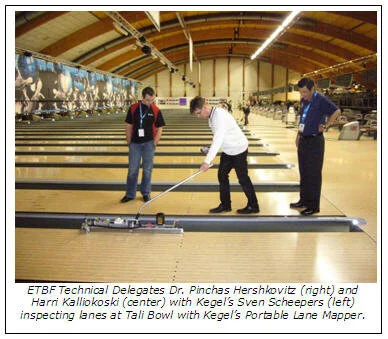
Of course there are some very good installations and installers of synthetic lanes today but the reality is, installations are only as good as the time and care that is taken on a particular installation. Since the advent of synthetic lanes, achieving consistent levelness throughout a bowling center is a very difficult painstaking task and the tools and technology to level lanes in a more efficient manner have not been available. (Note: The recent invention of the Kegel Portable LaneMapper has made this process more efficient and attainable.)
Long time laneman and former PBA Lane Maintenance Director Len Nicholson states, “I’ve seen synthetics installed in 4-6-hours and they were legal according to the Sanctioning Body. This was in bowling centers that were changing over to synthetic overlays after their wood surfaces have reached their life limit. However, when the arena settings started on the PBA Tour and companies like AMF and Brunswick wanted to showcase their synthetic lanes, it would take them up to two days to get them as perfect as they could. And they were using their best installers performing the job on only four lanes!”
As the bowling ball travels down the synthetic lanes of today, it has to go slightly uphill sometimes, and then downhill at other times. The ball encounters random patterns of hills, valleys, and it encounters microscopic frictional differences, all without any uniformity.
By performing tests at the Kegel Training Center’s adjustable lanes in 1999 with top PBA professionals such as Parker Bohn III, Brian Voss and Jason Couch, it was proving that as little as 20/1000 of an inch, or 25 percent of the allowable tolerances, will affect the path and reaction of today’s highly responsive bowling balls.
These seemingly minute irregularities can cause a ball to increase its footprint which increases the friction between the ball and the lane. This will make the ball slow down more therefore increasing the hook potential. These topographical irregularities may also decrease the footprint between the ball and the lane which causes less friction. This makes the ball slow down less therefore decreasing the hook potential.
These random irregularities can make your intended shot possibly either hit the pocket heavy, light or in extreme cases even miss the pocket entirely.
When oil patterns that are designed to play more towards the outside portion of the lane are applied to bowling lanes which are predominantly crowned on the outside boards, it is difficult for the bowling ball to hook back into the pocket. Most short oil patterns are designed this way, and crowned lanes can make those patterns more difficult. However on longer oil patterns, or patterns designed to play more towards the inside portion of the lane, crowned lanes can sometime act like hold area which can increase mistake area.
On the other hand, bowling lanes that are depressed from the edge board can act like a race track with high banked turns on short oil patterns. The highest scoring lanes for short oil patterns are when lane topography is either slightly depressed or flat.
On long patterns however, depressions can take away hold area and make a long pattern more difficult since the ball will have a tendency to hook more. That is unless the player is on the other side of the depression. Then a depressed lane acts like that same banked race track a depression gives a player on a short pattern.
Unfortunately, rarely do synthetic lanes have a consistent character with regard to topography which makes it a challenge for both the players and the laneman.
For tournament players, depending on what lane a player begins their round on, these lane differences may determine a player’s equipment choice for the day or even where to play with no likeness of another. These choices can and often will cause the oil pattern to change in a different manner from day to day, squad to squad, pair to pair and even lane to lane.
A scenario often seen in leagues and tournaments throughout the world is when there are perceived differences in ball reaction, total blame is put on the oil condition when in fact most times it is the difference in the topography, surface friction of the lanes, or even the bowler themselves.
The below picture show a real world example of two lanes that make up a pair in a sanctioned bowling center.
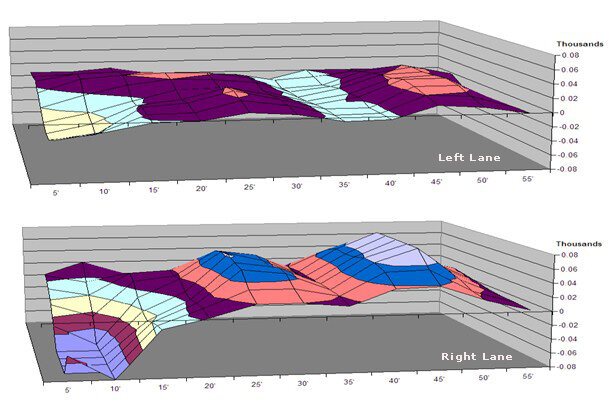
The left lane of the pair is within specification, plus or minus 40/1000 inch, at most points throughout the lane. The right lane however has historically played notably different than its companion.
In this case, because of the extreme depression in the head area, and the excessive crowns in the mid lane and break point area of the lane, the right lane has always played considerably tighter. Basically the bowling ball is falling off the mountain in the midlane and then trying to climb the mountain as it begins it move towards the pocket. The depression in the head area also causes the ball to 'burn up' earlier which causes less back end movement. The players in this center say they are always lined up 4-5 boards different between these two lanes with the ball hooking much less on the right lane.
Take notice the points on the right lane that are within specification, which in this example are not many but only in the three aforementioned inspection areas. The left lane is also most level in those same three inspection areas.
Kegel has measured 1000’s of lanes and studied the scores of many different tournaments they have been associated with. They have found these topographical and frictional differences are the reason those “mystery pairs” tend to show up at bowling centers. It’s not always that those lanes or pairs are bad or out of specification and sometimes that one lane or those mystery pairs are actually flatter than all the other lanes. What makes them challenging is they are different than the others and players are trying to adjust to that one different lane off of all the others.
With all other things being equal, low scoring centers or tournaments are more about the lane surfaces throughout center being very irregular from lane to lane, while higher scoring can be more about the lane surface being very consistent from lane to lane.
In short, when centers have consistent topographical features from lane to lane, fewer adjustments from the players are needed.
Nicholson tells of an example from the PBA Tour at The Showboat in Las Vegas; “The TV Pair always played weird. The great PBA players always had problems. Scores on that pair were never up to par and eventually they changed the TV pair.”
If there is one thing you can take from this article, is to look at bowling lanes individually with each having their own unique characteristics. Don’t look upon a pair of lanes as both being the same or adjust to one lane in a pair off of the other lane unless you notice a specific trend in the center.
The balance between caring for the playing environment and it participants from the monetary pressures is one of bowling's sanctioning bodies’ greatest challenges. Our recreational fads will come and go with having to be continually reinvented to keep interest amongst those non-sporting customers. A healthy sport of bowling however will produce lifelong customers which every business person should want to create and sustain.
The “Long and the Short of It” is now reality…is it also the future?
Published originally on Bowling Digital
An ultramodern proprietor, Ronald Dol of Bowling Dolfijn, along with avant-garde event organizer Luc Jensen of The Netherlands, and the forward thinking European Bowling Tour (EBT) have just completed a major bowling tour event which employed lane conditions like never before, at least on purpose.
During the entire 2007 EBT Bronzen Hammer Schietspoel Open, every left lane was conditioned with a 45’ oil pattern designed to play more towards the inside part of the lane and every right lane was conditioned with a 35’ oil pattern designed to play towards the outside part of the lane. Paul Moor, the reigning three times defending European Bowling Tour Ranking Champion proved those titles are well deserved as he defeated Osku Palermaa, Peter Smits and Maarten Pittens in a final one game shootout of this ground-breaking major event.
In the year 2000, then WTBA President PS Nathan called for a World Symposium in Malaysia to address many perceived problems related to the sport of bowling. Out of the symposium the WTBA Technical Committee, which was headed by Sid Allen at the time, concluded “that a single condition format was unfair, since it favored a particular style of play regardless of how the lane was oiled.”
Until now both the EBT and the PBA Tour formats make use of a single oil pattern for all rounds of competition. With these single condition events at times come social acceptance if the outcome is perceived fair by the bowling public but far too often the opposite is true. This social unrest comes as the winner of the event is perceived to have “matched up” because of their dominant style of play instead of just plainly performing better than the rest.
During that symposium in Malaysia the WTBA Technical Committee also felt the question of “who is the best bowler?” needed to be further examined. Through discussion and digging deeper into the question, the WTBA defined what they feel the traits that make up a World Class bowling player should be. The committee created what is known as VPARK; Versatility, Power, Accuracy,Repeatability and Knowledge. There was one trait however that was at the very top of each members list, Versatility.
The members felt that “the ability to bowl over a wide range of conditions elevated a player from one of quality to that of greatness” and therefore led to the conclusion “that WTBA’s present oiling procedures were not conducive to identifying and rewarding great players, but instead only identified the specialists.” Then committee member Craig Woodhouse suggested the concept of multiple conditions and it was unanimously agreed that this is the path for all future World Championships.
An over whelming majority of single condition events employ conditions in the thirty-seven to forty-two foot range. The WTBA dual condition events however use oil patterns thirty-five feet or shorter and forty-three feet or longer. So where does that leave the bowling players of the world to prepare for these World Championship events? The answer is you either need to own or have parents that own a bowling center or have a federation that supports such training. Not many participants have either.
For the EBT Tilburg dual condition tournament to be successful and socially accepted, it was evident that during the event some educational seminars dedicated to playing the short and long patterns were needed. With the help of Hammer’s Mike Quitter and bowling ball expert Denny Torgerson, material about what bowling ball types and layouts should be used was presented. With the help of Kegel and this writer, material about the bowling lane, oil patterns and keys to play those patterns, was also presented. With almost ninety tournament participants attending the seminars, the tournament players and coaches got a head start of what to expect.
Fully realizing “baby steps” needed to be taken, the design of the patterns were on the forgiving side and such that the widest variety of bowling balls could be used. In contrast to some of the early dual condition Championship events, it was refreshing to see the players in Tilburg clearly understood how the patterns needed to be attacked.
The feedback from the players according to Ronald Dol confirmed what Sid Allen’s group had concluded in that year 2000 symposium, that “dual lane conditions are fairer than a single condition event.” Will dual conditions be a thing of the future? Ronald Dol sure believes it will and he felt “they had a tremendous event with a great deal of enthusiasm from the players and spectators.” Dol and Jensen have already confirmed the 2008 EBT event in Tilburg will be dual lane conditions again.
It’s only a matter of time before more tournament organizers follow the lead of the innovative group in The Netherlands. Dual conditions may not be the answer the sporting players are looking for at each and every event or might it? After all it does satisfy the most essential criteria of becoming a world class bowling player…VERSATILITY.
Length vs. Volume
We at Kegel hear it all the time with statements like “man, the lanes are really flooded today” when a player has trouble hooking the ball or “wow, the lanes are really dry” when the ball hooks more than they are used to seeing. The variables that make up the playing environment today are so complex that one would need a super computer and a physics degree to decipher everything involved. There are so many factors other than oil that make up our playing environment but oil is the one factor everyone likes to focus on and for the purpose of this article, we will discuss this elusive, controversial and unseen variable as it relates to length and volume.
The length of a competition oil pattern may be the most important factor in how the bowler plays the lanes. While I was PBA Tour Player Services Director and Kegel was the official lane maintenance provider for the PBA Tour, there was a flood of information provided each week by Kegel to the players. Some of the more observant players began to take notice of how each of the patterns played and correlated their observations to the posted pattern.
The one item that seemed to be consistent with how a pattern played and developed was the length. I’ll never forget PBA Champion Ryan Shafer telling me he only looked at the length and the number of 2 to 2 loads on the weekly posted program sheet. The length gave him an idea of where he was going to play and the number of 2 to 2 loads gave him an idea of the difficulty - it's no different today. Knowing the length of the oil pattern and how it relates to your style of play may be the most important information you can learn about oil patterns.
In basic terms, the length of the pattern will determine how much time the bowling ball spends in the dry part of the lane (back end) and therefore how much time it is able to hook. For example; a length of 34 feet using modern bowling balls will usually force a player to play a more outside line because of the excessive amount of hook the ball will incur as it spends over 26 feet in the dry backend.
On the other end of the spectrum, a length of 44 feet will only give the ball 16 feet of dry backends, and therefore less time to hook towards the pocket. Therefore the player will normally play a line that is “closer to the pocket” since the ball has minimal time to hook into the pocket.
When using pattern lengths in the 37-40 foot range, the lane surface is usually the greatest factor in determining where the optimal place to play is, and that is never really known until competition begins and players experiment with different lines and ball choices. In this case a player must keep a very open mind when it comes to strategy.
Volume of oil on the other hand is not really a good barometer of how lanes will play since knowing the volume in itself does not tell you where the oil is applied to the lane surface. This reality can be found by looking no further than a short-long pattern example of the 2005 WTBA World Ranking Masters patterns. In those two patterns, the short pattern had a total oil volume of 20.76 milliliters while the long pattern had a total volume of 20.02 milliliters of oil. This is because the basic structure of shorter oil patterns normally have more "wide loads" than longer oil patterns, which increases the overall volume.
Every player at this event would tell you the short pattern had more “hook” than the long pattern. The greater amount of hook is because of the longer amount of time the ball spends on the drier back end.
In short, assuming equal lane surfaces, the load structure (width) of a pattern and where the oil is applied to the lane front-to-back determines how much overall hook a specific pattern allows the bowling ball to have - not necessarily how much overall volume is on the lane.
The Long and the Short of It: Pattern Play and Ball Choices
At various high level events the last few years, dual lane conditions have become more common. These lane patterns are categorized as long and short, or could also be referred to as "inside" and "outside", as John Davis likes to refer to them. The long patterns normally range from 42 to 45 feet in length and the short patterns range from 32 to 35 feet in length, with both of these lengths having very similar required ball motion characteristics.
Most players normally play on oil patterns that are in the 38 to 41 foot range at their home bowling center, or single condition events. These medium length patterns are used mainly because it puts most players in an area of the lane that is more comfortable to most of the participants. In addition, when these pattern lengths are used, high flare balls and layouts, which most ball drillers employ in their customers arsenal, normally work the best.
Medium length patterns also tend to allow the lane surface to be the determining factor when the pattern is not a blocked recreational oil pattern. These non-blocked medium oil pattern lengths however tend to favor a certain style, breakpoint, or "match up" too often, which can lead to social nonacceptance.
Unfortunately for the players, the ball choices used on medium length oil patterns may not be the best choices for World Championship dual condition events. (Note: World Bowling has since gone to single pattern events; medium length patterns may be the prevailing choice most often.)
For patterns that are shorter or longer than this 38-41 feet range, the breakpoint must be managed in a more defined and minimal manner. One must also look at the oil patterns being used, how they relate to ball motion, and what motion would be most advantageous to create the greatest margin for error.
Maximizing margin for error is what all players, coaches, and ball drillers should be looking for when deciding on where to play, how to play, and what equipment should be used for a specific oil pattern. Not withstanding a specific lane surface characteristics (topography and wear) and who you follow - different styles of play can affect oil pattern breakdown drastically.
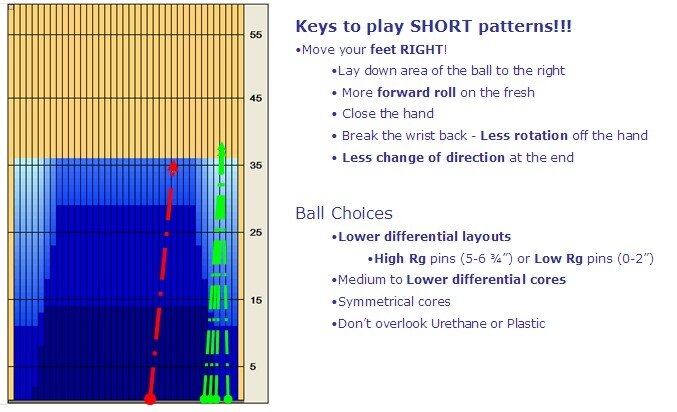
Let's start with the short pattern since it seems to be most challenging for today's modern player, available equipment choices, and layouts. As stated before in John Davis's article, "The long and the short of it", the short condition will be 32 to 35 feet in length.
The high point of the short oil pattern will normally begin from the forth board and rise to the eighth board. Inside the eighth board, the pattern is usually completely flat. Since the oil pattern is on the relatively short side (this used to be the normal pattern length before aggressive bowling balls) there is a lot of lane left, which other than topographical influences, has no definable shape or guidance.
Therefore the player should be targeting along the oil line as long as possible to maximize their room for error. More than likely a player will need to make a few technique adjustments as well. This entails foot placement during the slide, swing direction, hand position, and last but not least, correct ball motion.
If a player chooses a ball that is designed to go long and break sharp, it will not be able to read the oil line. If a player chooses a ball that is to aggressive and hooks to soon, it will force the player away from the oil pattern slope (from least to most amount of oil).
How should the short pattern be attacked? Here are some points and characteristics a player and coach should be looking for when playing the short pattern. Note: Line up techniques are for a right handed player, left handers should reverse the information:
GET THE SLIDING FOOT RIGHT!
The main thing a player must do first is make sure they are lining up the correct way. Most people will release the ball about 4-8 boards right (right handed player) of their sliding foot. Since the low point of the pattern has been stated to be outside of the forth board, if a player is sliding left of 15, most likely they are playing in the flat part of the pattern way too long, which minimizes their room for error.
Depending on the player and amount of free hook to the right, the sliding foot should be somewhere as far right as the sixth board to not much left of the 15th board.
KEEP THE INSIDE-OUT SWING PATH TO A MINIMUM!
If a player's swing is coming from the inside to the outside too much, they will have a launch angle that is too high which will make it very difficult to target along the oil line early enough or long enough.
The more inside out your swing path is, the more difficult it is to go "up the lane". Swing directions that are straighter down the target line will normally be more advantageous on the short patterns.
SWING DIRECTION TIP: Place your ball into the swing either straight down the target line or even a little to the right of your target line. This will keep the swing direction in a more "up the lane" direction. If you place your ball into the swing inside the target line, this will make your swing a "figure 8" type swing path, causing a launch angle that is often too high for short patterns.
KEEP THE HAND QUIET
Historically, players that excel on conditions that allow the extreme outside to play tend to be quieter in their release. What that means is there is not a lot of un-cupping and re-cupping of the wrist through the release point. It really does not matter if your axis rotation is high or low. Pete Weber is one of the best gutter players of the time, and his axis rotation is almost 90 degrees, but his release is very "quiet".
Get with a qualified coach to experiment what works best for your game and mental mindset.
EQUIPMENT
Choose bowling balls and/or layouts that create an elongated break point! Bowling balls that have high differential RG values, or layouts that maximize the differential in a high differential ball, tend to have a break point that is very short in nature. Basically the ball releases energy in a very short length wise area.
If you do not know your Positive Axis Point, find it before you layout or choose balls for the short and long patterns.
When Chris Barnes won his first PBA Title in Portland Oregon on a 32 foot oil pattern on freshly resurface wood lanes, his ball reps set him up a Navy Quantum with the pin located in his track (about 6 ¾ from his PAP). This helped him keep the ball in play because the weight block was already in a very stable position, and therefore flare was virtually eliminated.
When you eliminate flare, you minimize backend reaction. Most players on the PBA Tour will use layouts that place the pin farther from their PAP rather than closer to their PAP. Another option is to use a ball that already has a low flare core, preferably less than .026 differential.
However, the best option for most players is probably a low differential urethane, or even a polyester ball. These ball types will allow you target along the oil line for an extended period of time because they release energy in a more continual manner, which will maximize your room for error.
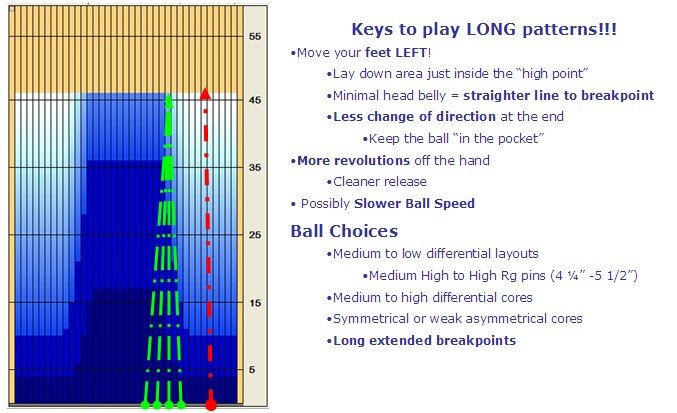
On the long patterns, the same type of ball motion philosophy should be used. The only difference is within the aggressiveness of the cover stock and how aggressive a player can go with the layout or ball core.
While I was Player Services Director for the PBA Tour, a.k.a. the PBA Ball Drilling Truck, when the players bowled on longer patterns, their ball layout choices were in the 4 ¾" to 6 ¼" layout spectrum from their PAP.
The reason for this is they are trying to control the breakpoint and minimize the backend change of direction, much like the short pattern philosophy. To refer again to John Davis' article again, "the long pattern dictates the ball will hook a minimal amount; a player's break point will usually need to be closer to the pocket." Since the breakpoint needs to be closer to the pocket, backend change of direction must be minimized while at the same time retaining energy.
Many high level players will strategically place an extra hole or the mass bias in a position to enhance these characteristics.
The long oil pattern slope will usually begin at the 10 board and increase to its peak at the 15th board. If your dominant ball path is either outside the 10 board or inside the 15th board, you will be playing in the flattest area of the pattern.
To maximize your margin for error, much like the short pattern, you should be targeting along the slope of the oil pattern.
The dual patterns used at the World Championship level are more defined than most of the patterns used in single condition events, and therefore should actually be simpler to figure out. As a player and coach, it is up to you to figure out exactly how to attack a specific oil pattern, and lane surface characteristic, for your particular style of play. (2016 Note: World Bowling has since gone to single pattern events where medium patterns will most likely dominate the pattern choice.)
The spectrum of available equipment is very wide these days so don't be so close minded you don't use it. There is definitely not a rule that says you must use the strongest ball in your bag, so don't be afraid to try the weakest ball in your arsenal if the environment warrants it.
One last thought everyone should remember about today's bowling environment. The group of players as a whole can and will make a pattern develop more predictable, more unpredictable, easier, or tougher. On top of that, with today's synthetic lane surfaces, topography can be anything on any part of the lane. Don't think for a moment topography can't change a way the oil pattern plays from lane-to-lane or center-to-center; it can, and does greatly.
Until LaneMap Guides become common place at all high level events, and oil patterns change less than they do now throughout any given period of games, these unknowns to the players will ultimately determine what happens to the development of the oil pattern, and what the resulting scoring pace will be.
So when competing in today's environment, let your ball be your guide more than ever, and get all you can get. What one squad does means very little to what the following squad may do.
The Long and Short of It: About the controversy surrounding multiple lane conditions
There is much controversy surrounding multiple conditions. It seems so different than the past. However, the sport of bowling has changed and formats of competition have not kept up with these changes to promote Fair Play for all styles.
The WTBA Technical Committee has separated the styles into two groups; first, those whose style prefers a breakpoint closer to the foul line and second, those who style prefer a breakpoint closer to the pins. By using two conditions, long and short, we can give each of the basic styles an equal advantage.
Out of the 30 plus tournaments that have been played on the two conditions, only one or two have shown unfair play as an apparent result and those were not between the two basic groups. They were thought of as unfair because of the left hand, right hand and light ball styles.
For the last 30 years fair play has become increasingly more difficult to attain, even though lane maintenance machines and lane oil chemistry have made major advances. At Kegel, we have over 1500 high level tournaments of experiences where we have provided our services.
Even with this experience and our advanced tools, we never feel comfortable with single condition formats. Multiple conditions give us a little more confidence that Fair Play can be achieved.
Furthermore, it is our opinion that multiple condition tournaments are only a band-aid to reduce the chances of Unfair Play. To achieve consensus of Fair Play for all, bowling must dig deeper into the reasons of our integrity and credibility crisis. That cannot happen over night. For now however, we feel confident that Fair Play is much more achievable.
Fair Play for all is a must. The sport cannot grow and prosper without it. All must agree with this statement.
Observations of international experiences of Multiple Condition Tournaments:
Five years ago the WTBA Technical Committee created the definition of the best bowling player. These attributes are:
- Accuracy
- Repeatability
- Power
- Knowledge
- Versatility
A bowler who possesses a balance of these five characteristics is therefore considered a world class player. From this definition, the WTBA Technical Committee produced the multiple condition concept. Instead of waiting for the lane condition to match up to a bowlers style, the committee forced the player to become versatile instead of being single dimensional. This format gave the player more prestige for winning instead of everyone thinking his game matched up with that particular condition.
Watching the many multiple condition tournaments, we have found that many players have not played the lanes correctly (knowledge), they used the wrong ball (knowledge) or they could not play one or the other conditions very well (versatility).
At every player and managers meeting that I have been involved in, we have told the players that the short condition was designed for playing outside and the long condition was designed to play inside. Most of the time, bowlers played the lanes the opposite way and used entirely the wrong type of bowling balls, especially on the short pattern.
I believe this is due to a lack of experience, knowledge and also the fact that most players now own and exclusively use excessively strong bowling balls and layouts. This could also be attributed to the fact that a larger majority of today's popular equipment is stronger than the equipment of five years ago. These equipment mistakes were very noticeable to the experienced and educated eye.
Here are some hints for short oil patterns:
The short condition will be 32 to 35 feet in length. The high point of the short oil pattern will normally be from the sixth to the eighth board. Inside the eighth board, the pattern is completely flat. It is also a point where the ball is only five to seven boards away from the pocket.
If the bowler attempts to play the short condition from a deep inside line because the ball hooks a lot, the ball will leave the oil pattern at an area from the eighth to the twelfth board. That does not leave much room for the ball to hold back into the pocket.
Because of the extreme amount of overall hook a short pattern will produce, by playing more towards the outside portion of the lane, the ball will have enough room to make its move towards the pocket.
We have also witnessed players trying to exclusively use very shiny equipment on the short patterns. This type of surface only adds in giving the ball little chance to begin to process to its forward roll. This lack of procession to a forward roll causes the ball to retain a high amount of energy, such that very small changes in speed, turn, and direction will result in violently different reactions.
The knowledgeable player will use a ball type that is smooth in character and play as far to the outside as possible in the lower amount of oil. This allows the ball to begin its turn towards a more forward roll which will smooth out the reaction and make the ball become more predictable as it travels down the lane.
Keep an open mind when choosing equipment to combat conditions. Here are some hints for long oil patterns:
The long oil condition will be in the 42 to 45 feet range. The high point of the oil pattern should be between the 12 and 15 board area. The oil pattern outside this area will be moderately flat and have much less slope than the 10 to 15 board area.
We have witnessed way too many bowlers playing outside on the long pattern. There is actually very little room for error in this portion of the lane on the long patterns as the pattern tends to be fairly flat in this area. If a bowler does choose an outside line on the long pattern, accuracy and repeatability will be extremely important and keeping the ball in play will be difficult to maintain.
The proper way to view a long pattern is this; if the ball comes off the end of the oil pattern at 45 feet at the five board, and there are twelve boards to cover to get to the pocket, the ball has only fifteen feet to make its move up to the pocket. Once again, like the short pattern, its basic geometry on where one should attempt to play.
Since the long pattern dictates the ball will hook a minimal amount, a player's break point will usually need to be closer to the pocket. Therefore, a bowler should find a line inside or around the second arrow as there are fewer boards to the pocket and keeping the ball in play will be much easier.
I personally watched the American Zone Youth Championships this past summer. One block on the short pattern sticks out in my mind. It was like a radio transmission was telling the young men to play inside on the short pattern. The whole squad was playing from 15 to 25 on 32 feet of oil and cranking the ball with as much speed as possible.
As we watched we felt like crying but after awhile it was almost comical. My colleague John Janawicz and I could only laugh. We watched coaches shaking their heads in frustration. They just could not get the concept in the minds of their players. That particular block scored much lower than the previous block where many bowlers played outside.
Conventional thought from a right handers point of view is that if the lanes hook, you move left and if the lanes don't hook you move right. This kind of thinking does not consider the fact that oil distance and where the ball leaves the oil pattern and enters the dry backend.
This is blocked lane thinking, not World Championship thinking. So, coaches please train your bowlers about oil distance before they get to championship events. This is not new knowledge; it is just not common knowledge ----- yet.
One more note on short and long conditions, the problem of playing long and short is somewhat different for men and women. Traditionally the women break down lanes together in the track area (7-12 board) and the graphs taken afterwards show the lane to almost be blocked after bowling.
When men bowl the whole middle of the lane oil pattern is destroyed in the front of the lane and narrows down to six or seven boards at the end. This works well on the long pattern but, on the short it is a disaster for scoring pace and the women usually outscore the men.
For the long the opposite is usually true. The women will still break down the track 4-5 boards away from the true best area to play and the men will outscore the women on the long, but not always.
In conclusion, bowling is a game of angles. If you can learn how the length of patterns directly affects how you should play a certain pattern, you will have a better chance at succeeding on all the different types of patterns you may encounter.