
Never Stop Learning – Bowling’s Lifelong Lesson
Most bowlers enjoy the fact that their game needs continuous adjustments and self-improvement throughout the life of your bowling career. Much of that is done on a trial and error basis that develops sensitivity, confidence, and trust in order to play at your best. However, it is most important to make the learning process fun, not frustrating.
First, let’s look at the strike game and spare game. In my nearly 30 years of teaching, I’ve developed some key principles that I have found hold true whether you’ve just picked up the game or have played it for 20 years:
1. A repeating approach that produces misses of one kind is better than a great-looking approach that produces misses both ways.
2. Do not make unattainable demands on yourself. Make sure your instruction program fits your lifestyle, goals, and the time that you have in order to make the necessary changes
3. Find an instructor that does not teach everyone in the same manner to make all approaches look alike or to have the perfect bowling approach. Consideration must be given for your strength, flexibility, and your emotional approach to the game. Walter Ray Williams Jr’s game is a perfect reflection of his aggressive mindset to compete.
4. Your priorities should be addressed in a cause and effect manner, not necessarily by what is being taught or predominately being used on the Pro Tour. Remember, they are doing calculus and you are still doing arithmetic.
5. Practice alignment and swing path lines during your practice sessions. Practice throwing balls to different targets (pins) to check your setup and alignment tendencies.
6. Make sure you learn a drill for each change you make in your approach and spend a minimum of 25 percent of your practice time throwing shots with the appropriate exercise.
7. Limit your spare shooting practice to short periods of time, such as 20 minutes or less. Focus the time on making the spares, instead of trying to fix the look of your approach.
8. When making changes in your approach, throw shots at less than full speed.
Once you’ve made progress with your delivery and can control the ball direction during your practice sessions, the next step is to take your game to league and tournaments and execute. This transition is a challenge that everyone struggles with on occasion – regardless of age.
I’m of the opinion that tension, both mental and physical, must be addressed. World-class athletes from all sports say that tension is the most damaging factor in the ability to execute at one’s highest level. Here are some tips for handling these challenges head on:
1. Play bowling with motion and rhythm, not by mechanics and positions. It’s ok to practice swing mechanics and positions during your practice sessions, but thinking about it when playing tournaments or league will only stifle your ability to produce a consistent motion and rhythm.
2. Grip pressure and minimal tension in your hand, wrist, arms, and shoulders are critical for feeling the swing, the sensitivity for the bowling ball and awareness for its desired path, rotation, and speed. Thinking about your breathing between shots will help you relax and keep damaging thoughts from entering your mind. Make sure you breath deeply and rhythmically. This applies to not only the strike shot, but to the spare game as well.
3. After throwing a bad shot, do not express self-talk as what you did wrong. Such as, “I was too quick.” Give yourself verbal keys that will help you feel what to do to make a better delivery on the next shot. Norm Duke is a genius at doing this. After a bad shot, he always takes the time to feel the correct swing movement before throwing the next shot.
4. Practice your pre-shot routine during your practice sessions by always throwing shots to a target. This creates desired habits without thinking too much and getting too tight in an attempt to over-control the bowling ball or over-power the bowling ball on the lanes. Set your mind at ease so your body can perform.
5. Preparation breeds success. Brian Voss felt he handled the difficulties of tournament bowling by being well-prepared. That gave him confidence and put him in a peaceful mindset in order to compete.
In conclusion, the most important advice I can give you is to enjoy the learning process. Whether you’re 30, 50 or 70+, it is truly a necessary process that will follow you throughout the life of your game.

Length vs. Volume
We at Kegel hear it all the time with statements like “man, the lanes are really flooded today” when a player has trouble hooking the ball or “wow, the lanes are really dry” when the ball hooks more than they are used to seeing. The variables that make up the playing environment today are so complex that one would need a super computer and a physics degree to decipher everything involved. There are so many factors other than oil that make up our playing environment but oil is the one factor everyone likes to focus on and for the purpose of this article, we will discuss this elusive, controversial and unseen variable as it relates to length and volume.
The length of a competition oil pattern may be the most important factor in how the bowler plays the lanes. While I was PBA Tour Player Services Director and Kegel was the official lane maintenance provider for the PBA Tour, there was a flood of information provided each week by Kegel to the players. Some of the more observant players began to take notice of how each of the patterns played and correlated their observations to the posted pattern.
The one item that seemed to be consistent with how a pattern played and developed was the length. I’ll never forget PBA Champion Ryan Shafer telling me he only looked at the length and the number of 2 to 2 loads on the weekly posted program sheet. The length gave him an idea of where he was going to play and the number of 2 to 2 loads gave him an idea of the difficulty - it's no different today. Knowing the length of the oil pattern and how it relates to your style of play may be the most important information you can learn about oil patterns.
In basic terms, the length of the pattern will determine how much time the bowling ball spends in the dry part of the lane (back end) and therefore how much time it is able to hook. For example; a length of 34 feet using modern bowling balls will usually force a player to play a more outside line because of the excessive amount of hook the ball will incur as it spends over 26 feet in the dry backend.
On the other end of the spectrum, a length of 44 feet will only give the ball 16 feet of dry backends, and therefore less time to hook towards the pocket. Therefore the player will normally play a line that is “closer to the pocket” since the ball has minimal time to hook into the pocket.
When using pattern lengths in the 37-40 foot range, the lane surface is usually the greatest factor in determining where the optimal place to play is, and that is never really known until competition begins and players experiment with different lines and ball choices. In this case a player must keep a very open mind when it comes to strategy.
Volume of oil on the other hand is not really a good barometer of how lanes will play since knowing the volume in itself does not tell you where the oil is applied to the lane surface. This reality can be found by looking no further than a short-long pattern example of the 2005 WTBA World Ranking Masters patterns. In those two patterns, the short pattern had a total oil volume of 20.76 milliliters while the long pattern had a total volume of 20.02 milliliters of oil. This is because the basic structure of shorter oil patterns normally have more "wide loads" than longer oil patterns, which increases the overall volume.
Every player at this event would tell you the short pattern had more “hook” than the long pattern. The greater amount of hook is because of the longer amount of time the ball spends on the drier back end.
In short, assuming equal lane surfaces, the load structure (width) of a pattern and where the oil is applied to the lane front-to-back determines how much overall hook a specific pattern allows the bowling ball to have - not necessarily how much overall volume is on the lane.
The Long and the Short of It: Pattern Play and Ball Choices
At various high level events the last few years, dual lane conditions have become more common. These lane patterns are categorized as long and short, or could also be referred to as "inside" and "outside", as John Davis likes to refer to them. The long patterns normally range from 42 to 45 feet in length and the short patterns range from 32 to 35 feet in length, with both of these lengths having very similar required ball motion characteristics.
Most players normally play on oil patterns that are in the 38 to 41 foot range at their home bowling center, or single condition events. These medium length patterns are used mainly because it puts most players in an area of the lane that is more comfortable to most of the participants. In addition, when these pattern lengths are used, high flare balls and layouts, which most ball drillers employ in their customers arsenal, normally work the best.
Medium length patterns also tend to allow the lane surface to be the determining factor when the pattern is not a blocked recreational oil pattern. These non-blocked medium oil pattern lengths however tend to favor a certain style, breakpoint, or "match up" too often, which can lead to social nonacceptance.
Unfortunately for the players, the ball choices used on medium length oil patterns may not be the best choices for World Championship dual condition events. (Note: World Bowling has since gone to single pattern events; medium length patterns may be the prevailing choice most often.)
For patterns that are shorter or longer than this 38-41 feet range, the breakpoint must be managed in a more defined and minimal manner. One must also look at the oil patterns being used, how they relate to ball motion, and what motion would be most advantageous to create the greatest margin for error.
Maximizing margin for error is what all players, coaches, and ball drillers should be looking for when deciding on where to play, how to play, and what equipment should be used for a specific oil pattern. Not withstanding a specific lane surface characteristics (topography and wear) and who you follow - different styles of play can affect oil pattern breakdown drastically.
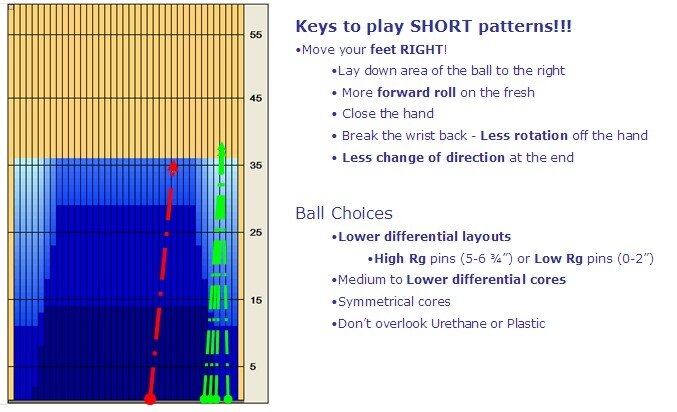
Let's start with the short pattern since it seems to be most challenging for today's modern player, available equipment choices, and layouts. As stated before in John Davis's article, "The long and the short of it", the short condition will be 32 to 35 feet in length.
The high point of the short oil pattern will normally begin from the forth board and rise to the eighth board. Inside the eighth board, the pattern is usually completely flat. Since the oil pattern is on the relatively short side (this used to be the normal pattern length before aggressive bowling balls) there is a lot of lane left, which other than topographical influences, has no definable shape or guidance.
Therefore the player should be targeting along the oil line as long as possible to maximize their room for error. More than likely a player will need to make a few technique adjustments as well. This entails foot placement during the slide, swing direction, hand position, and last but not least, correct ball motion.
If a player chooses a ball that is designed to go long and break sharp, it will not be able to read the oil line. If a player chooses a ball that is to aggressive and hooks to soon, it will force the player away from the oil pattern slope (from least to most amount of oil).
How should the short pattern be attacked? Here are some points and characteristics a player and coach should be looking for when playing the short pattern. Note: Line up techniques are for a right handed player, left handers should reverse the information:
GET THE SLIDING FOOT RIGHT!
The main thing a player must do first is make sure they are lining up the correct way. Most people will release the ball about 4-8 boards right (right handed player) of their sliding foot. Since the low point of the pattern has been stated to be outside of the forth board, if a player is sliding left of 15, most likely they are playing in the flat part of the pattern way too long, which minimizes their room for error.
Depending on the player and amount of free hook to the right, the sliding foot should be somewhere as far right as the sixth board to not much left of the 15th board.
KEEP THE INSIDE-OUT SWING PATH TO A MINIMUM!
If a player's swing is coming from the inside to the outside too much, they will have a launch angle that is too high which will make it very difficult to target along the oil line early enough or long enough.
The more inside out your swing path is, the more difficult it is to go "up the lane". Swing directions that are straighter down the target line will normally be more advantageous on the short patterns.
SWING DIRECTION TIP: Place your ball into the swing either straight down the target line or even a little to the right of your target line. This will keep the swing direction in a more "up the lane" direction. If you place your ball into the swing inside the target line, this will make your swing a "figure 8" type swing path, causing a launch angle that is often too high for short patterns.
KEEP THE HAND QUIET
Historically, players that excel on conditions that allow the extreme outside to play tend to be quieter in their release. What that means is there is not a lot of un-cupping and re-cupping of the wrist through the release point. It really does not matter if your axis rotation is high or low. Pete Weber is one of the best gutter players of the time, and his axis rotation is almost 90 degrees, but his release is very "quiet".
Get with a qualified coach to experiment what works best for your game and mental mindset.
EQUIPMENT
Choose bowling balls and/or layouts that create an elongated break point! Bowling balls that have high differential RG values, or layouts that maximize the differential in a high differential ball, tend to have a break point that is very short in nature. Basically the ball releases energy in a very short length wise area.
If you do not know your Positive Axis Point, find it before you layout or choose balls for the short and long patterns.
When Chris Barnes won his first PBA Title in Portland Oregon on a 32 foot oil pattern on freshly resurface wood lanes, his ball reps set him up a Navy Quantum with the pin located in his track (about 6 ¾ from his PAP). This helped him keep the ball in play because the weight block was already in a very stable position, and therefore flare was virtually eliminated.
When you eliminate flare, you minimize backend reaction. Most players on the PBA Tour will use layouts that place the pin farther from their PAP rather than closer to their PAP. Another option is to use a ball that already has a low flare core, preferably less than .026 differential.
However, the best option for most players is probably a low differential urethane, or even a polyester ball. These ball types will allow you target along the oil line for an extended period of time because they release energy in a more continual manner, which will maximize your room for error.
On the long patterns, the same type of ball motion philosophy should be used. The only difference is within the aggressiveness of the cover stock and how aggressive a player can go with the layout or ball core.
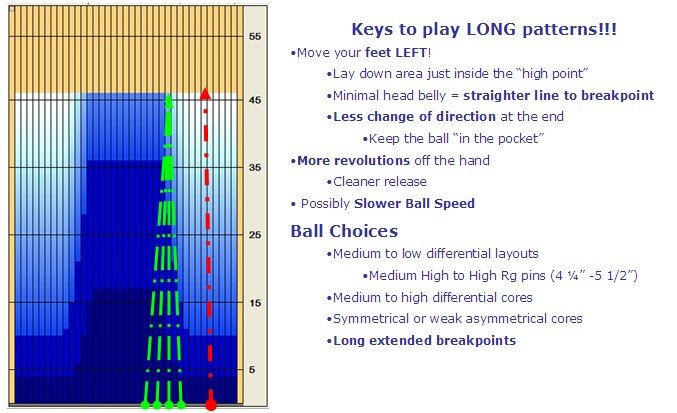
While I was Player Services Director for the PBA Tour, a.k.a. the PBA Ball Drilling Truck, when the players bowled on longer patterns, their ball layout choices were in the 4 ¾" to 6 ¼" layout spectrum from their PAP.
The reason for this is they are trying to control the breakpoint and minimize the backend change of direction, much like the short pattern philosophy. To refer again to John Davis' article again, "the long pattern dictates the ball will hook a minimal amount; a player's break point will usually need to be closer to the pocket." Since the breakpoint needs to be closer to the pocket, backend change of direction must be minimized while at the same time retaining energy.
Many high level players will strategically place an extra hole or the mass bias in a position to enhance these characteristics.
The long oil pattern slope will usually begin at the 10 board and increase to its peak at the 15th board. If your dominant ball path is either outside the 10 board or inside the 15th board, you will be playing in the flattest area of the pattern.
To maximize your margin for error, much like the short pattern, you should be targeting along the slope of the oil pattern.
The dual patterns used at the World Championship level are more defined than most of the patterns used in single condition events, and therefore should actually be simpler to figure out. As a player and coach, it is up to you to figure out exactly how to attack a specific oil pattern, and lane surface characteristic, for your particular style of play. (2016 Note: World Bowling has since gone to single pattern events where medium patterns will most likely dominate the pattern choice.)
The spectrum of available equipment is very wide these days so don't be so close minded you don't use it. There is definitely not a rule that says you must use the strongest ball in your bag, so don't be afraid to try the weakest ball in your arsenal if the environment warrants it.
One last thought everyone should remember about today's bowling environment. The group of players as a whole can and will make a pattern develop more predictable, more unpredictable, easier, or tougher. On top of that, with today's synthetic lane surfaces, topography can be anything on any part of the lane. Don't think for a moment topography can't change a way the oil pattern plays from lane-to-lane or center-to-center; it can, and does greatly.
Until LaneMap Guides become common place at all high level events, and oil patterns change less than they do now throughout any given period of games, these unknowns to the players will ultimately determine what happens to the development of the oil pattern, and what the resulting scoring pace will be.
So when competing in today's environment, let your ball be your guide more than ever, and get all you can get. What one squad does means very little to what the following squad may do.
Going for the Gold
When I say gold, I am not intending it means a medal. I use this term about a person intending to get the best or most out of some endeavor. In this case it is a score in bowling.
I watch people in a practice session before any bowling event. After each first throw, if it is not a strike, many either foul intentionally or push the reset to attain a full rack. This way they can practice their first throw, or should I say their strike shot.
At first I was worried they would develop the lane differently than development during the tournament. That the oil depletion and carry down would result in ball reaction not matching what happens during the tournament to a great degree. However, everyone uses different equipment and different lines to find out which ball gives them the best reaction so I no longer worry about different ball reaction from practice to the tournament. I now ponder the meaning of only practicing for a strike.
Yes, there is the token throwing of a shot or two at the 7 and 10 pin at the end of the practice session, but that is only a token and nothing like real competition. The balance of spares and strikes has possibly been permanently changed.
A 200 average bowler of the past never missed a spare. A 200 average bowler of today misses 2 or 3 spares a game. It is that 4 or 5 strikes in a row that keeps them over 200. To attain an average even higher such as 210 or 220, the 200 average bowler attempts to get more strikes. If the bowler gets more strikes it means he or she is shooting at less spares.
Filling the frame is a phrase not heard too many times in the game of today. One of the reasons that we see triple digit differences from one game to the next. It is not uncommon to see scores of 250 and above and then the very next game the very same bowler shoots 150.
Another possible cause for this is the dominate style being learned today is the power game. If the ball does not hit the pocket, the high spin rate ball entering the pins at a large angle will leave spares that are very difficult to pick up. Filling the frame becomes more difficult.
Is the balance of spares and strikes permanently changed? By going for the gold, it seems to me that we are missing 90% of the joy bowling.
This worries me, but at this time, bowling is still a seemingly and good diversion.
The Long and Short of It: About the controversy surrounding multiple lane conditions
There is much controversy surrounding multiple conditions. It seems so different than the past. However, the sport of bowling has changed and formats of competition have not kept up with these changes to promote Fair Play for all styles.
The WTBA Technical Committee has separated the styles into two groups; first, those whose style prefers a breakpoint closer to the foul line and second, those who style prefer a breakpoint closer to the pins. By using two conditions, long and short, we can give each of the basic styles an equal advantage.
Out of the 30 plus tournaments that have been played on the two conditions, only one or two have shown unfair play as an apparent result and those were not between the two basic groups. They were thought of as unfair because of the left hand, right hand and light ball styles.
For the last 30 years fair play has become increasingly more difficult to attain, even though lane maintenance machines and lane oil chemistry have made major advances. At Kegel, we have over 1500 high level tournaments of experiences where we have provided our services.
Even with this experience and our advanced tools, we never feel comfortable with single condition formats. Multiple conditions give us a little more confidence that Fair Play can be achieved.
Furthermore, it is our opinion that multiple condition tournaments are only a band-aid to reduce the chances of Unfair Play. To achieve consensus of Fair Play for all, bowling must dig deeper into the reasons of our integrity and credibility crisis. That cannot happen over night. For now however, we feel confident that Fair Play is much more achievable.
Fair Play for all is a must. The sport cannot grow and prosper without it. All must agree with this statement.
Observations of international experiences of Multiple Condition Tournaments:
Five years ago the WTBA Technical Committee created the definition of the best bowling player. These attributes are:
- Accuracy
- Repeatability
- Power
- Knowledge
- Versatility
A bowler who possesses a balance of these five characteristics is therefore considered a world class player. From this definition, the WTBA Technical Committee produced the multiple condition concept. Instead of waiting for the lane condition to match up to a bowlers style, the committee forced the player to become versatile instead of being single dimensional. This format gave the player more prestige for winning instead of everyone thinking his game matched up with that particular condition.
Watching the many multiple condition tournaments, we have found that many players have not played the lanes correctly (knowledge), they used the wrong ball (knowledge) or they could not play one or the other conditions very well (versatility).
At every player and managers meeting that I have been involved in, we have told the players that the short condition was designed for playing outside and the long condition was designed to play inside. Most of the time, bowlers played the lanes the opposite way and used entirely the wrong type of bowling balls, especially on the short pattern.
I believe this is due to a lack of experience, knowledge and also the fact that most players now own and exclusively use excessively strong bowling balls and layouts. This could also be attributed to the fact that a larger majority of today's popular equipment is stronger than the equipment of five years ago. These equipment mistakes were very noticeable to the experienced and educated eye.
Here are some hints for short oil patterns:
The short condition will be 32 to 35 feet in length. The high point of the short oil pattern will normally be from the sixth to the eighth board. Inside the eighth board, the pattern is completely flat. It is also a point where the ball is only five to seven boards away from the pocket.
If the bowler attempts to play the short condition from a deep inside line because the ball hooks a lot, the ball will leave the oil pattern at an area from the eighth to the twelfth board. That does not leave much room for the ball to hold back into the pocket.
Because of the extreme amount of overall hook a short pattern will produce, by playing more towards the outside portion of the lane, the ball will have enough room to make its move towards the pocket.
We have also witnessed players trying to exclusively use very shiny equipment on the short patterns. This type of surface only adds in giving the ball little chance to begin to process to its forward roll. This lack of procession to a forward roll causes the ball to retain a high amount of energy, such that very small changes in speed, turn, and direction will result in violently different reactions.
The knowledgeable player will use a ball type that is smooth in character and play as far to the outside as possible in the lower amount of oil. This allows the ball to begin its turn towards a more forward roll which will smooth out the reaction and make the ball become more predictable as it travels down the lane.
Keep an open mind when choosing equipment to combat conditions. Here are some hints for long oil patterns:
The long oil condition will be in the 42 to 45 feet range. The high point of the oil pattern should be between the 12 and 15 board area. The oil pattern outside this area will be moderately flat and have much less slope than the 10 to 15 board area.
We have witnessed way too many bowlers playing outside on the long pattern. There is actually very little room for error in this portion of the lane on the long patterns as the pattern tends to be fairly flat in this area. If a bowler does choose an outside line on the long pattern, accuracy and repeatability will be extremely important and keeping the ball in play will be difficult to maintain.
The proper way to view a long pattern is this; if the ball comes off the end of the oil pattern at 45 feet at the five board, and there are twelve boards to cover to get to the pocket, the ball has only fifteen feet to make its move up to the pocket. Once again, like the short pattern, its basic geometry on where one should attempt to play.
Since the long pattern dictates the ball will hook a minimal amount, a player's break point will usually need to be closer to the pocket. Therefore, a bowler should find a line inside or around the second arrow as there are fewer boards to the pocket and keeping the ball in play will be much easier.
I personally watched the American Zone Youth Championships this past summer. One block on the short pattern sticks out in my mind. It was like a radio transmission was telling the young men to play inside on the short pattern. The whole squad was playing from 15 to 25 on 32 feet of oil and cranking the ball with as much speed as possible.
As we watched we felt like crying but after awhile it was almost comical. My colleague John Janawicz and I could only laugh. We watched coaches shaking their heads in frustration. They just could not get the concept in the minds of their players. That particular block scored much lower than the previous block where many bowlers played outside.
Conventional thought from a right handers point of view is that if the lanes hook, you move left and if the lanes don't hook you move right. This kind of thinking does not consider the fact that oil distance and where the ball leaves the oil pattern and enters the dry backend.
This is blocked lane thinking, not World Championship thinking. So, coaches please train your bowlers about oil distance before they get to championship events. This is not new knowledge; it is just not common knowledge ----- yet.
One more note on short and long conditions, the problem of playing long and short is somewhat different for men and women. Traditionally the women break down lanes together in the track area (7-12 board) and the graphs taken afterwards show the lane to almost be blocked after bowling.
When men bowl the whole middle of the lane oil pattern is destroyed in the front of the lane and narrows down to six or seven boards at the end. This works well on the long pattern but, on the short it is a disaster for scoring pace and the women usually outscore the men.
For the long the opposite is usually true. The women will still break down the track 4-5 boards away from the true best area to play and the men will outscore the women on the long, but not always.
In conclusion, bowling is a game of angles. If you can learn how the length of patterns directly affects how you should play a certain pattern, you will have a better chance at succeeding on all the different types of patterns you may encounter.
Topography: What does it all mean?
Topography - The Science of Representing the Features of a Given Surface.
Lane topography in today’s bowling environment is one of the most influential factors in ball reaction. In the past, when bowling balls did not grip the lane surface as much and therefore hook as much as today’s balls, lane topography was not as much of a factor. In short, the less the amount of overall hook, the less lane topography comes into play and the more the ball hooks, the more influence topography has on ball reaction.
The topography of a lane surface consists of three different types of measurements: Crosswise Tilt, Crowns & Depressions, and Lengthwise Level. Topography affects the ball reaction characteristics on each lane and is mostly responsible for those ever present "mystery lanes" you may encounter in a bowling center.
Crosswise Tilt
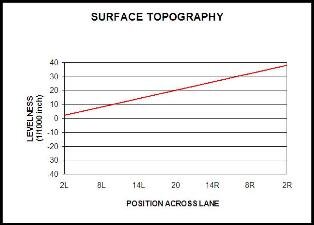
The United States Bowling Congress makes the rules covering lane specifications. All other Federations around the world follow the USBC in this regard. One such specification is the crosswise tilt, or the measurement from gutter to gutter which shows if one side of the lane is higher than the other side. The specification is plus or minus 40 thousandths (0.040) of an inch (1.106 mm). This is just over 1/32 of an inch.
The USBC provides special lane levels used in measuring and certifying bowling lanes. For crosswise tilt the level is laid across the lane, and the bubble of the level will move to the side that is high. Feeler gauges, ranging from 0.005 to 0.040 of an inch thick, are then placed under the low end of the lane level until the bubble is once again centered. The thickness of the gauges needed equals the amount of tilt on the lane.
The majority of lanes have some amount of tilt. While there may not be consistent tilt readings across all lanes in a particular center, there is often a degree of consistency on each lane, but not always. The amount the crosswise tilts affects the entire lane can be averaged between each arrow. Example: 0.040 thousandths tilt has an average value of 0.005 thousandths for every five board area.
The crosswise tilt becomes the greatest factor when the lane is tilted to one side for a certain length of the lane. The ball is more affected by the crosswise tilt from thirty feet to the pin deck as this is where the break point is or where the ball changes direction the most. It can have some impact in the front of the lane, but the tilt needs to be pretty large. (12-15-2009 edit: Recent testing and findings have changed this notion. Testing has found that the front part of the lane has as much, if not more, influence on ball motion and direction as any point throughtout the lane. In an area of less friction, less force is required to move an object off line. Newton's Laws of Motion)
In simpler terms, if a round object is placed on a flat level surface and then one side is raised, the object roll towards the low side. Remember, this is only one of the pieces of lane surface characteristics. Below are examples of crosswise tilts:
Crosswise Tilt - High Right
Crosswise Tilt - High Left

Crowns and Depressions
The crowns and depressions show the actual shape of the surface from gutter to gutter.
A crown is an increase in height from a given zero point. The peak of the crown, of course, is the highest point. The peak, however, is not necessarily the center of the lane. It can peak at any point across the lane. A crown, unlike crosswise tilt, is measured by the amount of change across each five-board area. This is also measured using the lane level with an attachment called the Dial Indicator. The indicator glides across the level reading the amount of rise or drop of the surface in thousandths of an inch. (12-15-2009 edit; with the invention fo the Kegel Lane Mapper, topography is now measured on each board instead across a five-board area.)
A crown can give the bowler a sense of hold but also takes away swing area. Like crosswise tilt, crowns have more influence when they remain consistent across a certain length of the lane. Crowns have a tendency to benefit players that do not cross a lot of boards. Two units of oil can feel like five units when the lane is crowned. The amount of pressure that the ball has against the lane is less when going away from the pocket but greater when more direct. It is like riding over a hill.
Example of a 0.040 inch Crown
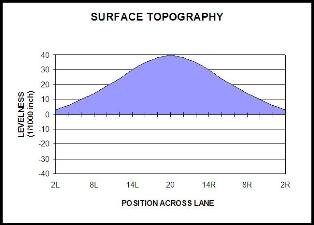
A depression is the opposite of a crown. The shape is measured by the amount of decrease from the zero point. This concave shape allows bowlers to feel that there is more swing area but less hold. It can make a line near the gutter have more swing area. Basically, five units of oil can react more like two units of oil.
A depression can also force players to cross an increase number of boards. The pressure the ball feels on a depression is greater when crossing boards which increases friction between the ball and the lane. But a ball thrown on a more direct trajectory will have trouble reaching its break point because of this increased friction.
A depressed lane is very much like a banked turn on a race track. When an automobile or motorcycle hits the banked curve, it becomes easier to turn and also slows easier. The momentum of the vehicle is now compressed into the embankment.
Example of a 0.040 inch Depression
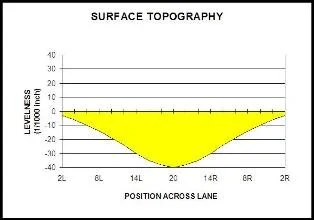
The USBC specifications for crowns and depressions are the same as crosswise tilt, plus or minus 0.040 of an inch.
Crosswise Tilt + Crowns + Depressions readings at a distance of 42 feet from the foul line.
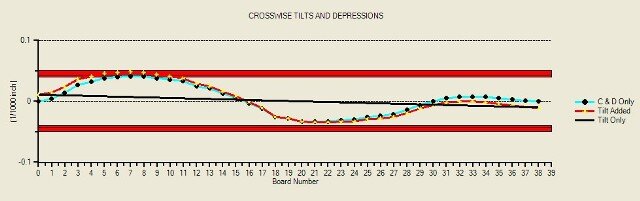
Lengthwise Level
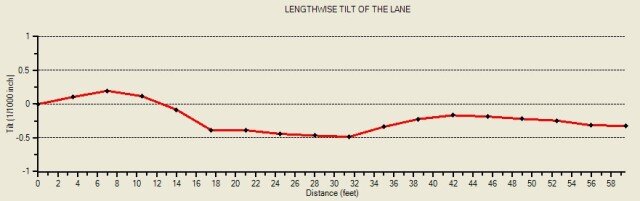
The lengthwise level of the lane is the final piece in the topography puzzle. This can also have dramatic effects on ball reaction. This allows us to see how many hills and valleys the ball sees rolling down the lane. Like driving, the vehicle maintains or even increases speed when moving down a hill. It slows quite a bit when moving uphill. A lane that runs uphill or downhill from 30 feet to the pindeck will become more sensitive to speed changes. This is caused by the amount of surface pressure that the ball has against the lane. A lane going downhill can play tighter and an uphill lane can promote more hook.
Most lanes are installed using a carpenter’s string or a laser. One problem with a carpenters string is it will tend to show the lane is lower in the center than at the foul line and pin deck. In our data collection process we collect the lengthwise measurements every five feet, with a laser.
Example of a lane’s lengthwise level taken every 3.5 feet:
Three-in-One
When all three factors (crosswise tilt, crowns and depressions, and lengthwise level) are added together, many different things can happen. Each lane has some differences whether it is one or all of the three factors. Certain combinations of the three can have somewhat similar characteristics as a lane that has a different topography. Inequity can be seen in a surface and the level of a lane can give a certain style or side an advantage.
The patterns run for most high level competitive bowling events allow the topography to stand out. The patterns themselves normally do not provide much swing area or hold area, so we have an idea of what the reaction should look like. When we see something different, we could make the conclusion its the topography. It might also the way the players you are following are breaking down the oil pattern, but that is another discussion for another day.
Believe it or not, wood lanes tend to be the most consistent across a given center. The reason is the sanding equipment does not allow for significant changes from lane to lane. Most lane resurfacing machines have a fixed pattern for making cuts during the resurfacing process. But keep in mind, there can still be mystery lanes.
On the other hand, most would think synthetic lanes are the flattest surface currently on the market, but that is far from the truth. Lanes made up of multiple synthetic panels can, and are the majority of the time, be vastly different from lane to lane across a house. There are many reasons for these inconsistencies with synthetic lanes.
Reason #1: The Weather
Centers located in areas of the world that can experience large temperature and humidity changes from season to season, see the most changes in topography (both wood and synthetic). Even though the lanes are synthetic, they are still made of wood in one form or another. Substructures are made of a pressed board, and pressed fiberboard's (wood fibers). The actual surface is made up of sheets of pressed paper with a melamine layer that the ball touches. So the surface can absorb moisture from the air and it can dry out when the air is dry. All wood does this!
Reason #2: The Installation
How synthetic lanes are installed is very important. They may initially be consistent across the house. Eventually the lane takes abuse and gets exposed to environmental factors, explained above. Remember that a wood lane is one solid piece while the synthetics are separate pieces screwed together. An installer may tighten screws tight enough to dimple the surface and cause the areas not screwed down to "bubble" up.
All of these factors make up the topography of a particular lane surface which can and probably will influence the reaction of your bowling ball.
What is "Process Verification" and Why do We do it?
There are four questions on the minds of competitive bowlers at every event in the world:
1. Who chose this condition?
2. What right did he or she have to do this?
3. What was the motivation of the person choosing?
4. Were the lanes conditioned the same from week-to-week, day-to-day, squad-to-squad, or was an adjustment made to change the outcome of the event?
It seems to me, that in order to make a dent in our psychological attitudes, these four questions need to be answered, and the answers need to be accepted.
For question number four we now have a solution. In the past, the lane maintenance person’s word has been questioned because of perceived changes in ball reaction. He/she never wins that one. We have found that there are many reasons why the lanes may be done the same, but ball reaction is different.
With the invention of Kegel’s Sanction Technology™, we can now prove the pattern is exactly the same every time. This is a huge step forward in understanding bowling's technical challenges because it eliminates the applied oil pattern as a variable.
Therefore, if the ball reaction is perceived by the players to have changed from the previous fresh condition, we can then look at variables other than the applied oil pattern.
When Kegel is in charge of conditioning the lanes for tournaments and events, we follow what we call the “Process Verification Procedure.” What this means is the process of cleaning and conditioning the lanes is verified. This ensures to the players that the same procedures are being followed each and every time we perform lane maintenance for an event.
Process Verification Procedure (PVP)
Inspection of the lane cleaning.
Ensure the oil program is correct in the lane machine computer.
Perform the oil calibration check. This is a procedure where the oil that would normally go onto the lane is captured into a graduated cylinder for exact measurement. The amount of oil is calculable and verifiable from the desired oil program.
Walking with the lane machine to ensure the machine operation is the same on each lane. This is done by looking at the valve time, the speed of the machine, and the total run time of each lane.
Look on each lane to make sure the oil pattern distance and the look of the oil pattern is the same on each lane.
Taking lane tapes at specific distances to make sure the lane machine applied the oil pattern as intended.
The tournament technical delegate/representative and lanes person then signs-off that nothing in the procedure has changed and is as intended.
By performing this procedure time after time, we not only protect the integrity of the lanes person, we also protect the integrity of the player, and most importantly as it relates to lane conditioning, the sport of bowling.